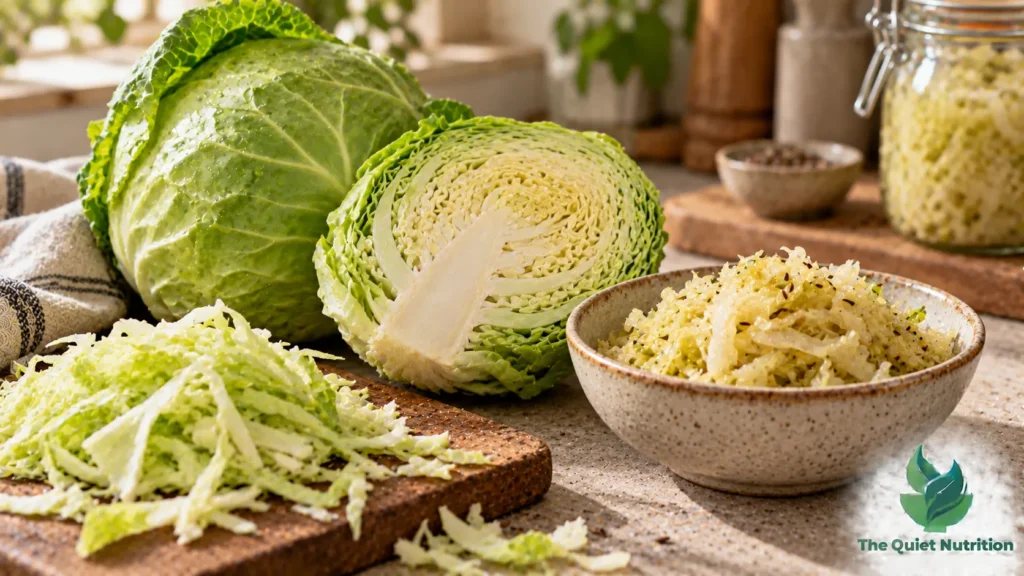
Cabbage can be eaten in a crunchy salad, slowly cooked into a soup or transformed into sauerkraut through fermentation. These preparations start with the same vegetable, but they deliver different combinations of texture, compounds and, in fermented versions, microorganisms.
Cabbage’s connection to gut health begins with something less fashionable than probiotics: dietary fibre. It also contains naturally occurring compounds found throughout the cruciferous vegetable family, some of which interact with the microorganisms living in the digestive tract. Fermenting cabbage introduces another layer of interest, although the resulting food should not automatically be treated as a proven probiotic.
The distinction matters because gut health is influenced by more than the number of bacteria in the intestine. Digestion, bowel regularity, the activity of gut microbes and individual tolerance to particular foods all play a part.
Cabbage can contribute to a gut-friendly eating pattern, but its benefits are best understood through what research has established, what scientists are still investigating and how the vegetable fits into everyday meals.
Cabbage provides fibre that helps keep digestion moving
Raw green cabbage contains approximately 25 calories and 2.5 grams of dietary fibre per 100 grams, according to USDA food-composition data. It also supplies vitamin C and other nutrients, making it a useful addition to meals without contributing many calories. [1]
The fibre is particularly relevant to digestive health.
Dietary fibre is the part of plant foods that the human digestive system cannot fully break down. Different types behave differently in the intestine, but fibre can help maintain bowel regularity by contributing to stool formation and, depending on the type, influencing how much water the stool retains.
This is one reason adequate fibre intake is associated with easier stool passage and can help prevent or relieve constipation. The US National Institute of Diabetes and Digestive and Kidney Diseases recommends that adults generally obtain 22–34 grams of fibre daily, depending on age and sex. Drinking enough fluid also helps fibre do its job.
Cabbage can contribute to that daily total, particularly when it appears regularly in salads, stir-fries, soups and other vegetable-based dishes. However, its contribution should be kept in perspective. A 100-gram serving provides a useful amount of fibre, not enough to meet most adults’ daily needs on its own.
The broader eating pattern matters more than any single vegetable. Combining cabbage with beans, oats, whole grains, fruit and other vegetables provides a wider range of fibres than relying on cabbage every day.
For someone trying to improve their fibre intake, that variety is valuable because different plant foods contain different types and amounts of fibre.
What cabbage does inside the gut is more complicated than simply adding bulk
Fibre can support digestion in more than one way. Some remains largely intact as it passes through the digestive tract, contributing to stool formation. Other fermentable components can be used by microorganisms in the colon.
When gut bacteria ferment suitable dietary substrates, they produce metabolites, including short-chain fatty acids. These substances are involved in the normal functioning of the intestinal environment and are being studied for their wider effects on human health.
Cabbage contains fibre and other plant components that make it interesting in this context. However, it would be inaccurate to suggest that every serving produces a specific increase in beneficial bacteria or that cabbage reliably raises a particular metabolite in every person.
People have different gut microbial communities, and their responses to the same food can vary.
A randomized, controlled feeding study published in The Journal of Nutrition in 2009 examined how cruciferous vegetables affected gut bacterial communities. Seventeen participants followed two different dietary periods, each lasting 14 days. One involved a low-fibre, low-phytochemical diet without fruits or vegetables; the other added a substantial amount of cruciferous vegetables.
Researchers found that the composition of participants’ gut bacterial communities differed between the two periods. The responses also varied between individuals.
The study provides evidence that consuming cruciferous vegetables can influence the gut microbiome, the community of microorganisms living in the digestive tract. But it does not establish that cabbage alone produced the changes, nor does it show that those changes improved participants’ digestive symptoms or prevented disease. The high vegetable intake and the small sample also limit how directly the findings can be applied to an ordinary serving of cabbage.
That is an important distinction: changing the microbiome is not automatically the same as improving health. Researchers need to establish which changes matter, for whom and under what circumstances.
For everyday eating, the established contribution of dietary fibre remains a sound reason to include cabbage. The more specific effects of cabbage on gut bacteria are promising areas of investigation rather than guaranteed outcomes.
Cabbage contains plant compounds that gut bacteria can help process
Cabbage belongs to the Brassica family, alongside broccoli, cauliflower, kale and Brussels sprouts. These vegetables contain sulfur-containing compounds known as glucosinolates.
When plant tissues are cut, chewed or otherwise damaged, glucosinolates can be broken down into several different products. Some of those compounds are studied for their biological activity, including their interactions with cellular pathways involved in the body’s response to potentially harmful substances. Gut microorganisms can also contribute to the breakdown and metabolism of certain glucosinolates.
This creates an interesting relationship between a vegetable and the microbes that encounter it during digestion. The food supplies compounds, and the microorganisms help determine how some of those compounds are transformed.
The process is not identical in everyone. Researchers have found that the metabolism of glucosinolates depends partly on the compounds present in the vegetable, food preparation and the microbial activity of the person consuming it.
These differences help explain why scientists are interested in the interaction between cruciferous vegetables and the gut microbiome. They also show why simple claims about one food activating a universal protective process can be misleading.
Some glucosinolate breakdown products have shown potentially beneficial biological effects in laboratory experiments and animal studies. Human research, however, is less conclusive about whether consuming cabbage specifically produces meaningful protection against disease. The US National Cancer Institute describes the evidence on cruciferous vegetables and human cancer risk as mixed.
These compounds are an additional reason to include cabbage among a variety of vegetables, but they should not be presented as a proven treatment for digestive problems or as a guarantee against chronic disease.
Is sauerkraut better for your gut than fresh cabbage?
Fresh cabbage and sauerkraut offer different nutritional and microbial characteristics.
Sauerkraut is made by fermenting finely cut cabbage, usually with salt. Under suitable conditions, naturally occurring lactic-acid bacteria convert available sugars into acids. As acidity increases, the food develops its familiar sour flavour and a fermentation environment that discourages many unwanted microorganisms.
When fermentation proceeds properly, some live microorganisms can remain in the finished food. That makes traditionally fermented cabbage different from fresh cabbage, but it does not automatically make every jar of sauerkraut a probiotic food with established health benefits.
Probiotics are live microorganisms that provide a demonstrated health benefit when consumed in adequate amounts. According to the US National Institutes of Health Office of Dietary Supplements, not every fermented food contains probiotics with proven benefits. The particular microorganisms and the evidence supporting their use matter.
Processing matters, too. Some sauerkraut is pasteurized after fermentation, a heat treatment that reduces or eliminates many live microorganisms. Other products are sold refrigerated and unpasteurized, although product handling and processing vary.
If the aim is to consume live cultures, check the product label and storage instructions rather than assuming that every fermented cabbage product contains them.
There is also a broader question: does eating sauerkraut actually change the gut microbiome in a meaningful way?
A 2025 crossover intervention trial published in Microbiome offers some useful evidence. Researchers studied 87 healthy adults who consumed fresh or pasteurized sauerkraut daily for four weeks during their respective intervention periods. They measured changes in the gut microbiome and metabolites in the participants.
The study found changes in individual bacterial species following sauerkraut consumption, with more pronounced changes in the pasteurized-sauerkraut intervention. Only the pasteurized intervention was associated with an increase in serum short-chain fatty acids.
These findings challenge the assumption that fermented cabbage must contain live bacteria to influence every measurable aspect of gut metabolism. They do not, however, establish that pasteurized sauerkraut is better for digestive health, or that either preparation will improve symptoms in everyone.
The researchers also concluded that the gut microbiome of healthy participants was relatively resilient to the short-term dietary intervention. Changes in certain bacterial species are interesting, but the trial did not establish a universal improvement in digestive function.
Sauerkraut can therefore be a useful way to add variety to a diet, particularly for people who enjoy fermented foods. The evidence is not strong enough to claim that it is essential for gut health or superior to fresh cabbage.
Why cabbage can cause gas in some people
A food can support a healthy diet and still cause discomfort in certain circumstances.
Cabbage contains carbohydrates and fibres that can be fermented by gut bacteria. Gas is a natural by-product of some of these processes. For many people, this is not a problem, but others may notice bloating, abdominal pressure or increased flatulence after eating a large serving.
People with irritable bowel syndrome (IBS) can be particularly sensitive to certain fermentable carbohydrates. These substances, often grouped under the term FODMAPs, may draw water into the intestine and produce gas when gut bacteria ferment them. In people with a sensitive digestive tract, those effects can trigger symptoms.
The type of cabbage preparation matters here, too. Monash University, which developed the low-FODMAP approach used in IBS dietary management, notes that raw common cabbage can be low in FODMAPs at a standard serving, while sauerkraut can contain higher levels of the fermentable sugar alcohol mannitol. The measured content and suitable portions vary with the product.
That means fermenting cabbage does not necessarily make it easier for everyone to digest.
People who experience symptoms may find that smaller portions, thoroughly cooked cabbage or a different preparation work better. Someone who tolerates a small serving of fresh cabbage may respond differently to the same amount of sauerkraut.
There is no need to force a particular food because it is considered beneficial for the gut. A healthy eating pattern should be nutritious and tolerable, not a daily exercise in managing discomfort.
For people with persistent digestive symptoms, especially those affecting everyday eating, advice from a qualified healthcare professional or dietitian can help identify whether a particular food or dietary pattern is contributing to the problem.
Raw, cooked or fermented: which form should you choose?
Each preparation has a place, and the most suitable option depends on what you enjoy and how you tolerate it.
Raw cabbage provides crunch and works well in salads, slaws and sandwiches. It is easy to prepare and can help increase vegetable intake without much effort.
Cooked cabbage becomes softer and develops a milder, sometimes sweeter flavour. It works well in soups, stir-fries and roasted vegetable dishes. Cooking changes the food’s texture and can alter the amounts of certain nutrients and plant compounds, but that does not make cooked cabbage nutritionally worthless.
Fermented cabbage, including sauerkraut, offers a tangy flavour and a different combination of acids and microbial characteristics. Some products contain live cultures, while pasteurized versions may not. Fermentation can change carbohydrate composition and does not guarantee a particular effect on digestion.
The best choice is not necessarily the preparation that preserves the highest amount of one compound or contains the greatest number of microorganisms. Those measurements alone do not tell us which food will produce the best health outcomes.
A simple meal can include shredded cabbage alongside beans or lentils, a source of protein and whole grains. A small serving of sauerkraut can provide additional flavour if you enjoy fermented foods and tolerate them comfortably. Cooked cabbage can be added to soups or stir-fries when raw vegetables are less appealing.
What matters most is the overall pattern: regular vegetable intake, sufficient fibre from a range of foods, adequate fluid and a way of eating that suits your digestive system.
How to make cabbage a useful part of your routine
Cabbage is inexpensive, widely available and versatile enough to use in more than one meal. Those everyday advantages make it easier to eat regularly, which matters more than seeking a supposedly perfect preparation.
Start with portions that feel comfortable. If your usual diet contains little fibre, increasing it gradually can help your digestive system adjust. Drink enough fluid, particularly as you increase fibre intake, because hydration supports normal bowel function.
Use cabbage to add variety rather than relying on it as your only vegetable. Different vegetables, fruits, legumes and whole grains provide different fibres and plant compounds. That diversity gives your diet a broader nutritional base.
If you enjoy sauerkraut, treat it as an optional addition rather than a mandatory gut-health food. Choose products according to flavour, ingredients and storage requirements, and be mindful of sodium if you regularly consume salty foods.
Above all, pay attention to how you feel after eating it. The value of a food depends partly on whether it can be included comfortably and consistently in your diet.
What cabbage can—and cannot—do for gut health
Cabbage provides dietary fibre that contributes to normal bowel function, along with plant compounds that scientists are investigating for their interactions with gut microorganisms. Early human research suggests that cruciferous vegetables can influence gut bacterial communities, but the evidence does not establish that cabbage alone produces specific improvements in digestive health.
Fermented cabbage adds another dimension, yet the distinction between a fermented food and a probiotic with demonstrated benefits remains important. Research on sauerkraut is developing, and measurable changes in bacterial species or metabolites do not automatically translate into symptom relief.
The useful conclusion is not that everyone should eat cabbage raw, cooked and fermented every day. It is that cabbage offers a practical way to add fibre and vegetable variety to ordinary meals. Pair it with other plant foods, increase fibre at a comfortable pace and choose the preparation that suits you.
A healthier gut is built through the broader pattern of what you eat—not through a single vegetable or a jar of sauerkraut.
Sources:
[1] U.S. Department of Agriculture, FoodData Central. Cabbage, raw. Food-composition data for energy, fibre and micronutrients. https://fdc.nal.usda.gov/food-search/?query=cabbage%20raw
[2] National Institute of Diabetes and Digestive and Kidney Diseases (NIDDK). Eating, Diet, & Nutrition for Constipation. Guidance on daily fibre intake, fluid intake and bowel regularity. https://www.niddk.nih.gov/health-information/digestive-diseases/constipation/eating-diet-nutrition
[3] Li F, Hullar MAJ, Schwarz Y, Lampe JW. Human gut bacterial communities are altered by addition of cruciferous vegetables to a controlled fruit- and vegetable-free diet. Journal of Nutrition. 2009;139(9):1685–1691. DOI: 10.3945/jn.109.108191. A randomized crossover controlled-feeding study of 17 participants that examined changes in gut bacterial community composition after a high-cruciferous-vegetable dietary intervention. https://pubmed.ncbi.nlm.nih.gov/19640972
[4] National Cancer Institute. Cruciferous Vegetables and Cancer Prevention. Describes glucosinolates and their breakdown products in cruciferous vegetables and reviews the mixed evidence on human cancer outcomes. https://www.cancer.gov/about-cancer/causes-prevention/risk/diet/cruciferous-vegetables-fact-sheet
[5] National Institutes of Health, Office of Dietary Supplements. Probiotics: Fact Sheet for Consumers. Explains what probiotics are and why not every fermented food has demonstrated probiotic health benefits. https://ods.od.nih.gov/factsheets/Probiotics-Consumer
[6] Schropp N, et al. The impact of regular sauerkraut consumption on the human gut microbiota: a crossover intervention trial. Microbiome. 2025;13:52. DOI: 10.1186/s40168-024-02016-3. A four-week crossover intervention trial involving 87 participants that compared fresh and pasteurized sauerkraut and measured gut microbial and metabolic changes. https://doi.org/10.1186/s40168-024-02016-3
[7] Monash University, Monash FODMAP. Fermented foods and FODMAPs. Explains why fermentation can change a food’s FODMAP composition, including the differences between fresh cabbage and sauerkraut. https://www.monashfodmap.com/blog/fermented-foods-and-fodmaps

Aarti Solanki, B.Sc. (Food Science), is a food science writer passionate about making nutrition simple and evidence-based. She creates well-researched, easy-to-understand articles on healthy eating, food science, and nutrition, using information from trusted scientific and public health sources.