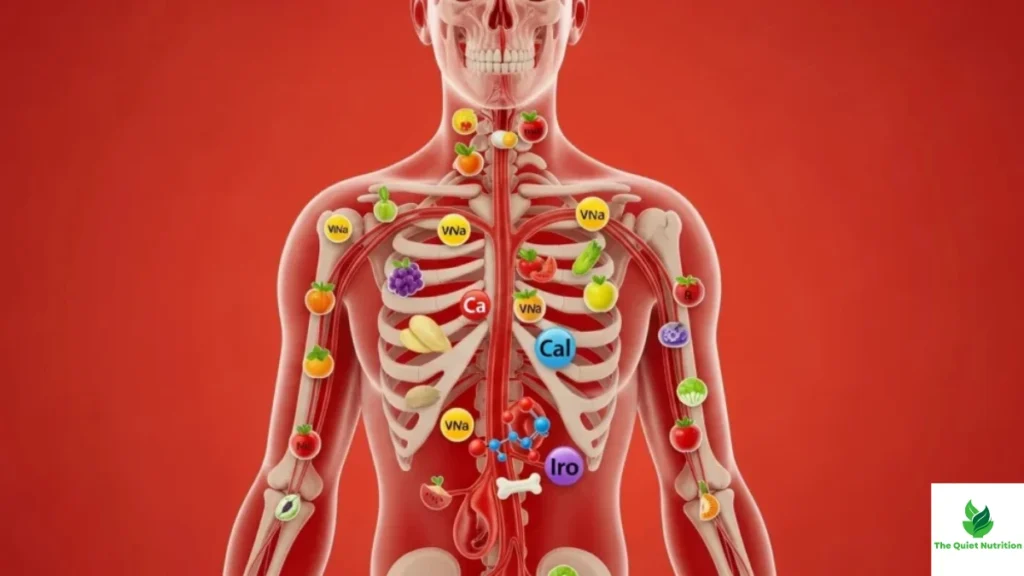
Ask someone what “balanced nutrition” means, and you’ll usually get some version of the same answer: a bit of protein, some vegetables, a grain, maybe a fruit — the classic divided plate you learned about in school. That mental image isn’t wrong, exactly, but it’s incomplete in a way that matters. Inside the body, balance isn’t really about how food is arranged on a plate. It’s about how nutrients interact, depend on each other, and function as a coordinated system — and that version of balance looks very different from the visual most people carry around.
Balance Is Relational, Not Just Additive
The plate model treats nutrition like a checklist: get some of this, some of that, and you’re covered. But many nutrients don’t work independently — they work in relationship to each other, sometimes requiring one another to function at all. This means “enough” of a nutrient in isolation can still fail to translate into “enough” functionally, if the nutrients it depends on aren’t also present in adequate amounts.
Vitamin D is a good example. It doesn’t do much good sitting in the body unactivated — converting it into its usable form and directing it to where it’s needed relies on magnesium as a cofactor. Someone can have technically adequate vitamin D intake or blood levels while still functioning suboptimally if magnesium status is poor, because the two nutrients are biologically linked rather than independently sufficient.
Nutrient Pairs That Depend on Each Other
This kind of interdependence shows up throughout the body’s chemistry, not just as an occasional exception. Iron absorption is a well-documented case: non-heme iron, the type found in plant foods, is absorbed far more efficiently when consumed alongside vitamin C, since vitamin C converts iron into a more absorbable form in the gut. Eating iron-rich lentils without any vitamin C source nearby is nutritionally different from eating the same lentils with a squeeze of lemon or a side of peppers, even though the iron content on paper is identical.
Calcium follows a similar pattern, requiring both vitamin D to be absorbed properly and vitamin K2 to be directed toward bone tissue rather than soft tissue where it isn’t wanted. Zinc and copper maintain a delicate ratio with each other, where excessive intake of one can interfere with the absorption of the other. None of these relationships are obvious from looking at a nutrition label in isolation, which is exactly why balance can’t be fully captured by simply hitting individual nutrient targets one at a time.
Balance Also Means Timing, Not Just Content
The traditional plate model also misses a temporal dimension: balance isn’t only about what nutrients are present, but when and how they’re delivered relative to the body’s needs throughout the day. Blood sugar regulation is a clear example. A meal with the exact same total calories and macronutrients can behave very differently in the body depending on whether protein and fiber are eaten alongside carbohydrates or separately, since protein and fiber slow gastric emptying and blunt blood sugar spikes.
Protein distribution across the day matters in a similar way. Research on muscle protein synthesis suggests the body can only effectively use so much protein for tissue building in a single sitting, which means concentrating most of a day’s protein into one large meal tends to be less effective for muscle maintenance than spreading similar amounts across two or three meals. Balance, in this sense, is as much about pacing as it is about total quantity.
Gut Microbiome Diversity Is Part of the Balance Equation Too
A less intuitive piece of the picture involves the trillions of bacteria living in the digestive tract, which play a meaningful role in digestion, immune regulation, and even nutrient synthesis, including certain B vitamins and vitamin K. A genuinely balanced diet supports a diverse microbial community, largely through a wide variety of plant fibers, since different bacterial species tend to favor different fiber types. A diet that’s technically balanced by macronutrient math but low in fiber diversity may still leave this microbial layer of the system underfed, even if calories, protein, and fat all look reasonable on paper.
Why the Plate Model Persists Anyway
None of this makes the classic plate model useless — it’s a genuinely helpful simplification for building general habits, especially for people who aren’t currently tracking anything at all. The issue is treating it as the complete picture rather than a starting point. Public health guidance tends to favor simple, memorable models precisely because complex biochemical relationships are hard to communicate at a population level, which is a reasonable tradeoff for broad guidance, even though it leaves out most of the nuance described here.
What This Means in Practice
True nutritional balance leans more on variety and consistency than on precise proportions. Eating a wide range of whole foods across weeks, not just within a single meal, naturally tends to cover most of these nutrient relationships without requiring anyone to consciously track cofactor pairings or absorption timing. The goal isn’t to memorize every interaction described here — it’s to understand that balance is a dynamic, interconnected system happening inside the body, not a static image of a divided plate, and that variety over time is what actually keeps that internal system functioning well.
Sources
- National Institutes of Health, Office of Dietary Supplements – Magnesium Fact Sheet
- National Institutes of Health, Office of Dietary Supplements – Iron Fact Sheet
- National Institutes of Health, Office of Dietary Supplements – Vitamin K Fact Sheet
- Harvard T.H. Chan School of Public Health – The Nutrition Source: The Microbiome
- U.S. Department of Agriculture and HHS – Dietary Guidelines for Americans

Aarti Solanki, B.Sc. (Food Science), is a food science writer passionate about making nutrition simple and evidence-based. She creates well-researched, easy-to-understand articles on healthy eating, food science, and nutrition, using information from trusted scientific and public health sources.







Pingback: Why “High Protein” Doesn’t Equal Balanced Nutrition — The Popular Health Shortcut That Often Backfires
Pingback: Why Consistency Matters More Than Perfection in Nutrition — The Quiet Rule That Actually Changes Health
Pingback: Why Your Body’s Strength Depends on What You Eat Every Day
Pingback: The Hidden Power of Kiwi: The Superfruit Most People Overlook
Pingback: Strawberries Are More Powerful Than You Think—Here’s What They Do Inside Your Body
Pingback: Why Avocados Are Considered the Gold Standard of Healthy Fats
Pingback: Can Beans Really Beat Beef? The Surprising Truth About Plant Protein