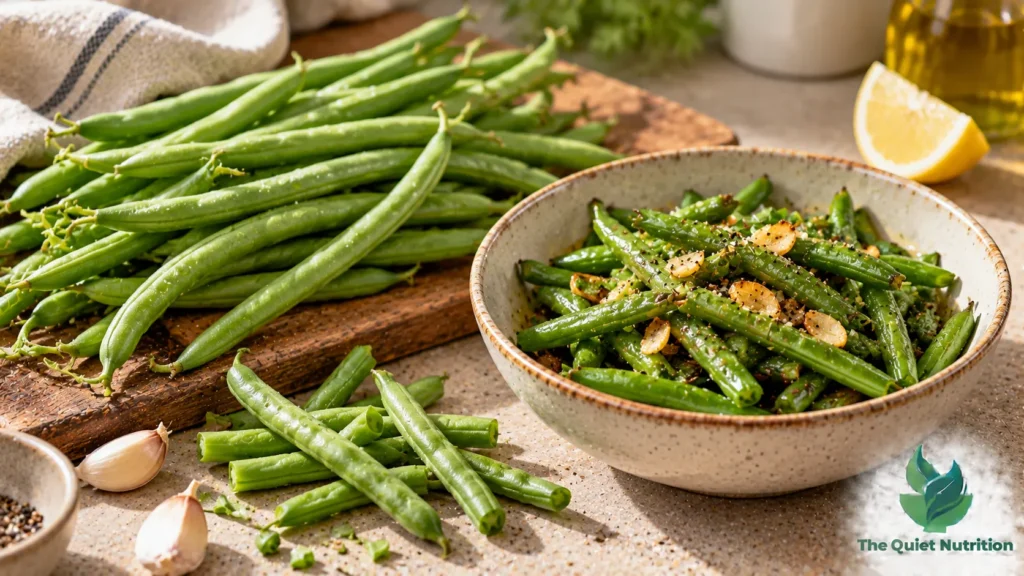
Green beans rarely get the attention given to spinach, broccoli or colourful bell peppers. They tend to appear beside the main course, lightly steamed or folded into a casserole, without much discussion of what they contribute nutritionally.
That modest reputation overlooks a useful combination of nutrients. Green beans provide dietary fibre, vitamin C, folate and vitamin K, with relatively few calories. They also offer a simple way to add another type of vegetable to meals that might otherwise rely on a narrow rotation of potatoes, carrots and leafy greens.
Their limitations are worth understanding, too. Green beans are not as protein-rich as mature kidney beans or lentils, and their vitamin C content is much lower than that of some other vegetables. Their value comes from what they contribute as a vegetable, not from being exceptionally rich in every nutrient.
There is also an important distinction hidden in their name: green beans are legumes botanically, but fresh green beans are eaten as immature pods and are generally treated as a vegetable in dietary planning. That makes their nutritional role quite different from that of dried beans.
Green beans offer useful nutrition without many calories
Raw green beans contain approximately 31 calories per 100 grams, along with about 2.7 grams of fibre and 1.8 grams of protein, according to USDA FoodData Central. The same amount provides vitamin C, folate and vitamin K.
These numbers may not look extraordinary, but they explain why green beans fit easily into everyday meals. They contribute volume, texture and several nutrients without adding much energy.
Fibre is one of their more useful attributes. It contributes to normal bowel function, and getting enough dietary fibre helps support regular bowel movements. Adults generally need around 22–34 grams daily, depending on age and sex, according to the US National Institute of Diabetes and Digestive and Kidney Diseases.
A serving of green beans will not meet that requirement by itself, but it can contribute to the total. The same is true of many other vegetables: their value accumulates across meals rather than resting on a single serving.
This is particularly relevant when planning dinners. A plate containing a protein source, a whole grain or potato, and green beans can provide a broader mix of nutrients than a meal built around the main dish alone.
Green beans do not need to replace another vegetable to be useful. They can add variety to a meal that already includes broccoli, carrots or leafy greens, bringing a somewhat different combination of nutrients and textures.
Their vitamin C contribution is modest but worthwhile
Vitamin C is commonly associated with citrus fruit, strawberries and bell peppers. Green beans contain it, too, although they are not among the richest sources.
USDA food-composition data put the vitamin C content of raw green beans at approximately 12 milligrams per 100 grams. That is a useful contribution, but it is important not to confuse a useful source with an exceptionally rich one.
The body requires vitamin C to produce collagen, a structural protein involved in connective tissue and wound healing. The vitamin also supports normal immune function and helps the body absorb non-haem iron, the form found in plant foods such as beans, lentils and leafy vegetables.
The iron-absorption connection offers a practical way to think about vegetables as part of a meal. Green beans can contribute some vitamin C alongside plant-based foods, although they should not be relied upon as the only source when building a diet rich in this vitamin.
Combining several vegetables throughout the day is more effective than expecting one side dish to supply everything. Bell peppers, broccoli, kiwi and citrus fruits can contribute substantially more vitamin C when that nutrient is a particular priority.
Green beans still have a place in this picture. Their contribution is one part of a varied diet, rather than a reason to rank them above foods with higher concentrations.
Folate gives green beans another role
Folate is a B vitamin that the body needs to make DNA and other genetic material. It is also essential for normal cell division, making an adequate intake important throughout life.
Green beans supply folate in naturally occurring form. Their contribution is not as concentrated as that of some foods particularly rich in the nutrient, but it adds to the folate obtained from other vegetables, legumes and grains.
This is one reason ordinary vegetables deserve attention even when they are not famous for a particular nutrient. Dietary adequacy often depends on the combined contribution of many foods rather than on a small number of supposedly perfect ingredients.
Folate is also a good example of why nutritional comparisons need context. A food can provide a meaningful amount of a nutrient without being classed as an especially rich source of it. The amount eaten, the frequency of consumption and the rest of the diet all affect how significant its contribution becomes.
For green beans, folate is an additional nutritional advantage rather than the main reason to choose them. Their fibre and range of micronutrients make them a useful part of meals, especially when several different vegetables are eaten regularly.
Vitamin K is another part of their nutritional profile
Vitamin K receives less everyday attention than vitamins C and D, yet it has an established role in normal blood clotting and is involved in bone metabolism. [5]
Green beans contain vitamin K, adding another nutrient to their overall contribution. However, leafy greens such as spinach and kale are generally much more concentrated sources, so green beans should not be treated as a substitute for every other vitamin K-rich food.
This distinction matters because the healthiest food choice is not always the one with the highest concentration of a single nutrient. A vegetable can be worth eating for its combined nutritional contribution, flavour and versatility.
For someone who already enjoys green beans, the vitamin K content is an added benefit. For someone trying to include more vegetables, they offer a straightforward alternative to leafy greens and cruciferous vegetables without requiring a completely different approach to cooking.
People taking warfarin or certain other vitamin K-sensitive anticoagulants should follow their healthcare professional’s advice about keeping vitamin K intake consistent. They do not generally need to eliminate vegetables such as green beans simply because they contain vitamin K.
Green beans are not the same as dried beans
The name can make green beans sound nutritionally interchangeable with black beans, kidney beans or chickpeas. They are not.
Green beans are harvested while their pods are still tender. Mature dry beans, by contrast, are harvested after the seeds have developed and dried. The foods therefore have different nutrient profiles and serve different purposes in meals.
A serving of cooked dried beans generally provides substantially more protein and fibre than a comparable serving of green beans. Dry beans are valuable sources of plant protein, carbohydrates and fibre; green beans function more like a non-starchy vegetable, supplying a lighter contribution of energy and protein alongside fibre and micronutrients.
Neither food needs to be considered superior overall. They simply do different jobs.
For example, a meal of rice, lentils and green beans can combine the energy and protein supplied by the rice and lentils with the fibre and micronutrients contributed by the vegetable. If the green beans replaced the lentils entirely, the meal would not provide the same amount of protein.
This is the practical distinction worth remembering. Green beans can complement protein-rich foods, but they are not a replacement for a substantial protein source.
The same principle applies to other vegetables. Spinach, broccoli and carrots offer their own nutrient profiles, and rotating among them provides variety without requiring every vegetable to perform the same nutritional function.
Does cooking reduce their nutritional value?
Green beans are usually eaten cooked, but preparation can change the amount of certain nutrients that remains in the finished food.
A study published in LWT – Food Science and Technology in 2012 examined how boiling and steaming affected folate, vitamin C and lutein in fresh, frozen and canned green beans and spinach. The researchers found that boiling reduced folate and vitamin C in the plant tissue. Some folate moved into the cooking liquid, while vitamin C losses were associated with heat. Steaming reduced vitamin C but retained more of the measured folate and lutein in the plant tissue under the tested conditions.
These results illustrate how the cooking method can matter, but they do not mean that every boiled vegetable is nutritionally poor. The research measured specific nutrients under particular preparation conditions; it did not compare long-term health outcomes among people eating different forms of green beans.
For everyday cooking, steaming is a reasonable option when you want to minimise contact with water. A quick sauté is another practical choice, while roasting can bring out a deeper flavour and a slightly browned texture.
Boiling is still perfectly acceptable, especially if the beans are cooked briefly. In dishes where the cooking liquid is retained, some nutrients that have moved into that liquid may also be consumed.
The duration matters as well. Cooking green beans until they are tender is different from leaving them submerged in boiling water for a prolonged period.
The nutritional priority should be to prepare vegetables in ways that make them enjoyable and easy to eat regularly. There is little benefit in pursuing a theoretically ideal cooking method if it makes the food less appealing or convenient.
Fresh, frozen or canned: which green beans are worth buying?
Fresh green beans can be an excellent option, particularly when they are in season and have a firm texture. But fresh produce is not the only reasonable choice.
Plain frozen green beans are convenient and can be kept available for quick meals. They can be added directly to many soups, stews and stir-fries, depending on the recipe, without the trimming required for fresh pods.
Canned green beans are another practical option, particularly for people who want to keep vegetables on hand with minimal preparation. Their sodium content can vary considerably by product, so the label is worth checking. Choosing no-salt-added or lower-sodium varieties can help when sodium intake is a concern.
The choice between fresh, frozen and canned depends on more than the form in which a vegetable is sold. Cost, availability, preparation time, taste and how much food will actually be eaten all matter.
There is little advantage in buying fresh green beans that end up being discarded because they were inconvenient to prepare. A frozen vegetable that makes it into a regular dinner may be a more useful addition to someone’s diet.
The same principle applies to convenience more broadly. Healthy eating does not require every meal to begin with unprocessed produce that must be washed, trimmed and cooked from scratch.
How to make green beans more satisfying
Green beans have a mild flavour, which makes them easy to pair with other ingredients. Their nutritional value also becomes more useful when they are part of a meal that supplies the other nutrients the body needs.
For a quick side dish, steam the beans until just tender and finish with olive oil, lemon juice, black pepper or garlic. For a more substantial vegetable dish, sauté them with mushrooms or onions. They can also be added to grain bowls, vegetable soups, pasta dishes and mixed salads.
Pairing green beans with lentils, chickpeas, eggs, fish, tofu or other protein-rich foods helps build a more complete meal. Whole grains or potatoes can contribute additional energy, while other vegetables and fruits broaden the range of nutrients available across the day.
There is no need to dress green beans in a heavy sauce to make them worthwhile, but neither does a little oil or seasoning undermine their nutritional value. The overall meal matters more than whether every component is prepared in the lowest-calorie way possible.
Portion size also deserves perspective. A side serving of green beans can contribute fibre and micronutrients, but larger portions or additional vegetables may be needed to make a meaningful contribution to an individual’s overall fibre intake.
The goal is not to make green beans carry the whole meal. It is to let them do what they do well.
Why green beans deserve more attention
Green beans are not a nutritional miracle, and their vitamin C content does not compete with that of peppers or many other vegetables. They also provide far less protein than mature dried beans.
Their value is more straightforward: they contribute fibre, vitamin C, folate and vitamin K, add volume to meals without many calories, and are flexible enough to be prepared in numerous ways. They are also available fresh, frozen and canned, making regular vegetable intake easier to fit around different budgets and schedules.
The most useful way to think about green beans is as one part of a broader rotation of vegetables, not as a replacement for more nutrient-dense foods or for protein-rich legumes. Serve them alongside other ingredients that fill those gaps, and they become a useful part of an ordinary balanced meal.
Sometimes the most worthwhile foods are not the ones with the most dramatic health claims. They are the ones that make a varied, nutritious diet easier to maintain.
Sources:
[1] U.S. Department of Agriculture. FoodData Central: Beans, snap, green, raw. Food-composition data for energy, protein, fibre, vitamin C, folate and vitamin K. https://fdc.nal.usda.gov/food-search/?query=green+beans+raw
[2] National Institute of Diabetes and Digestive and Kidney Diseases (NIDDK). Eating, Diet, & Nutrition for Constipation. Provides guidance on recommended daily fibre intake and the importance of adequate fluids. https://www.niddk.nih.gov/health-information/digestive-diseases/constipation/eating-diet-nutrition
[3] National Institutes of Health, Office of Dietary Supplements. Vitamin C: Fact Sheet for Health Professionals. Covers vitamin C’s functions in collagen formation, immune function and non-haem iron absorption, as well as cooking-related losses. https://ods.od.nih.gov/factsheets/VitaminC-HealthProfessional
[4] National Institutes of Health, Office of Dietary Supplements. Folate: Fact Sheet for Consumers. Explains folate’s role in DNA production, cell division and dietary adequacy. https://ods.od.nih.gov/factsheets/folate-consumer
[5] National Institutes of Health, Office of Dietary Supplements. Vitamin K: Fact Sheet for Health Professionals. Explains vitamin K’s role in blood clotting and bone metabolism and discusses considerations for people using vitamin K-sensitive anticoagulants. https://ods.od.nih.gov/factsheets/VitaminK-HealthProfessional
[6] U.S. Department of Agriculture. MyPlate: Beans, Peas, and Lentils. Provides context for the place of mature beans and other pulses in healthy eating patterns and their nutritional contributions. https://www.myplate.gov/eat-healthy/protein-foods/beans-peas-lentils
[7] Delchier N, Reich M, Renard CMGC. Impact of cooking methods on folates, ascorbic acid and lutein in green beans (Phaseolus vulgaris) and spinach (Spinacea oleracea). LWT – Food Science and Technology. 2012;49(2):197–201. DOI: 10.1016/j.lwt.2012.06.017. Examines how boiling and steaming affect selected nutrients in fresh, frozen and canned green beans and spinach. https://doi.org/10.1016/j.lwt.2012.06.017

Aarti Solanki, B.Sc. (Food Science), is a food science writer passionate about making nutrition simple and evidence-based. She creates well-researched, easy-to-understand articles on healthy eating, food science, and nutrition, using information from trusted scientific and public health sources.