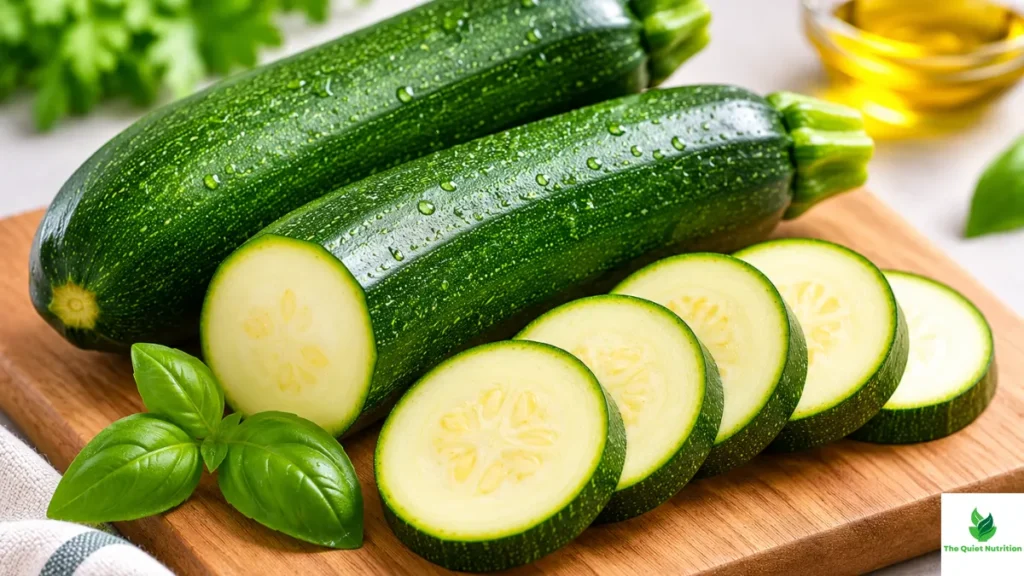
You know the dinner. You swapped the pasta for zucchini noodles, felt a little virtuous, and cleared the plate. By nine o’clock you were standing in front of the pantry with the door open.
That feeling gets blamed on willpower, but most of it comes down to what zucchini is, and what it isn’t. It is one of the most useful low-calorie foods in the produce aisle. It is also a food that needs a little help to keep you full, and a few common kitchen habits quietly cancel out its main advantage.
Here’s how the numbers actually work.
The number behind the reputation
Raw zucchini with the skin on carries about 17 calories per 100 grams, according to USDA data, and it is roughly 95% water. A cup of raw, chopped zucchini (about 124 grams) comes to around 21 calories.
Set that beside a cup of cooked spaghetti of the same weight, which lands near 196 calories, and you get a ratio of roughly nine to one. Same weight on the plate, a small fraction of the energy.
A fair caveat on that comparison: raw and cooked foods aren’t perfectly matched, and zucchini noodles shrink a little in the pan. Even so, a cup of sauteed zoodles has been put at about 30 calories, so the gap stays enormous.
Why a low number can still make a full plate
Nutrition scientists call this energy density: the calories packed into a given weight of food. According to a CDC research brief, water and fiber add weight and volume to food without adding much energy, while fat is the opposite, at about 9 calories per gram against roughly 4 for carbohydrate and protein.
The practical upshot is that people can eat a satisfying amount of food while taking in fewer calories when the plate leans on water-rich vegetables. CDC guidance on the topic says larger portions of water- and fiber-rich foods like vegetables and broth-based soups can fill you up on fewer calories, with one big condition. How you cook the vegetable can change the picture entirely.
Zucchini fits this idea neatly because it is mild, cheap, available most of the year, and it takes on whatever it’s cooked with. That last quality turns out to matter later.
What zucchini won’t do for you
Here is where the “free food” talk falls apart. Per 100 grams, raw zucchini has only about 1 gram of fiber and 1.2 grams of protein. The French fruit and vegetable nutrition group Aprifel notes its fiber and protein are both below the average for raw vegetables.
Fiber and protein are the two things that keep hunger quiet for hours. So a bowl of zoodles with a thin tomato sauce is light on calories and also light on staying power, which explains the pantry visit.
What zucchini does offer is a decent amount of micronutrients for so few calories. USDA values put it at around 17 to 18 milligrams of vitamin C per 100 grams, close to a fifth of a day’s needs for most adults, plus about 260 milligrams of potassium. Aprifel adds modest but real amounts of folate and vitamin B6. Think of it as a good supporting player, not the star of the plate.
The simple fix is to build the dish around something that does carry protein: eggs, white beans, chicken, shrimp, lentils, a handful of grated cheese. The zucchini supplies the volume, and the protein supplies the satisfaction.
Where the calories sneak back in
This is the part most people never do the math on. Four medium zucchini, about a pound and a third, are enough for the sauteed zucchini recipe at America’s Test Kitchen. At 17 calories per 100 grams, that pile of vegetables is only around 100 calories.
Now add two tablespoons of olive oil to the pan. At 9 calories per gram of fat, that’s roughly 240 calories if all of it ends up on the plate, more than double what the vegetables brought. Zucchini is porous and soaks up fat readily, which is part of why it tastes so good fried and why it can quietly turn into a high-calorie side. The CDC makes the same point in general terms: breading, frying, and rich sauces add extra calories to otherwise light vegetables.
None of this is an argument against olive oil. Fat helps you absorb some nutrients and makes food worth eating. It’s an argument for measuring it instead of pouring, and for knowing that in many zucchini dishes, the oil is the main event calorie-wise.
A few kitchen habits that help
The cooks at America’s Test Kitchen salt sliced zucchini and let it drain, which pulls out about a third of a cup of water from four zucchini over roughly 30 minutes. The point is texture: the zucchini browns rather than steams, so you don’t need extra oil to rescue a soggy pan. Rinse and dry it afterward if you’re watching sodium. They also note that smaller zucchini, under about 8 ounces, are less watery and more flavorful than the oversized ones.
A few more things that work in real kitchens:
- Use a wide pan and don’t crowd it. Crowded zucchini steams and turns mushy.
- Go quick with spirals. A minute or two in the pan is enough, and longer makes them limp.
- Roast or grill instead of frying. You get browning and sweetness with a teaspoon or two of oil.
- Go half and half. If a plate of pure zoodles never satisfies you, mix them with real pasta. You’ll cut the calories substantially without feeling cheated.
- Keep the skin on. The USDA figures above are for zucchini with the skin, and peeling likely trims some fiber.
When low-calorie isn’t the goal
It’s worth saying plainly: 17 calories per 100 grams works against you if you need to eat more, not less. Older adults with a small appetite, athletes in heavy training, and anyone recovering from illness shouldn’t let a big pile of zucchini crowd out foods that carry real energy and protein. And if counting calories has started to feel stressful or controlling, that’s a good reason to talk with a doctor or registered dietitian rather than reach for another low-calorie swap.
For most people, though, the case is easy to state. Zucchini lets you make a plate bigger without making it heavier, as long as you give it protein and watch the oil. That tired plate of zoodles from the first paragraph wasn’t a failure of the vegetable. It just needed an egg on top.
This article is for general information and isn’t a substitute for personal medical or nutrition advice. Calorie and nutrient values come from USDA data and vary by size, ripeness and preparation.
Sources
- U.S. Department of Agriculture, FoodData Central. Squash, summer, zucchini, includes skin, raw.
- U.S. Department of Agriculture, FoodData Central. Pasta, cooked, unenriched, without added salt.
- Centers for Disease Control and Prevention. Low-Energy-Dense Foods and Weight Management: Cutting Calories While Controlling Hunger. (Research to Practice Series, hosted by Kansas State University.)
- Centers for Disease Control and Prevention. Eat More, Weigh Less? How to manage your weight without being hungry. (CDC STACKS.)
- Aprifel. Zucchini: nutritional sheet.
- Center for Science in the Public Interest. Why you should try ditching pasta for veggie spirals.
- America’s Test Kitchen. Sauteed Zucchini with Olives and Lemon.
- America’s Test Kitchen. The Best Way to Cook Zucchini.

Aarti Solanki, B.Sc. (Food Science), is a food science writer passionate about making nutrition simple and evidence-based. She creates well-researched, easy-to-understand articles on healthy eating, food science, and nutrition, using information from trusted scientific and public health sources.