There’s a good chance you bought a tub of spinach last weekend. You had plans for it: a big salad on Monday, a handful stirred into eggs on Tuesday. By Thursday it had gone dark and slippery at the bottom of the box, and you carried it to the bin with a small pang of guilt you’ve felt before.
You’re in large company. When the CDC analyzed 2019 survey data, only about 10% of U.S. adults were meeting the vegetable recommendation, which works out to 2 to 3 cup-equivalents a day. Fresh greens, with their short shelf life, are an easy casualty of a busy week.
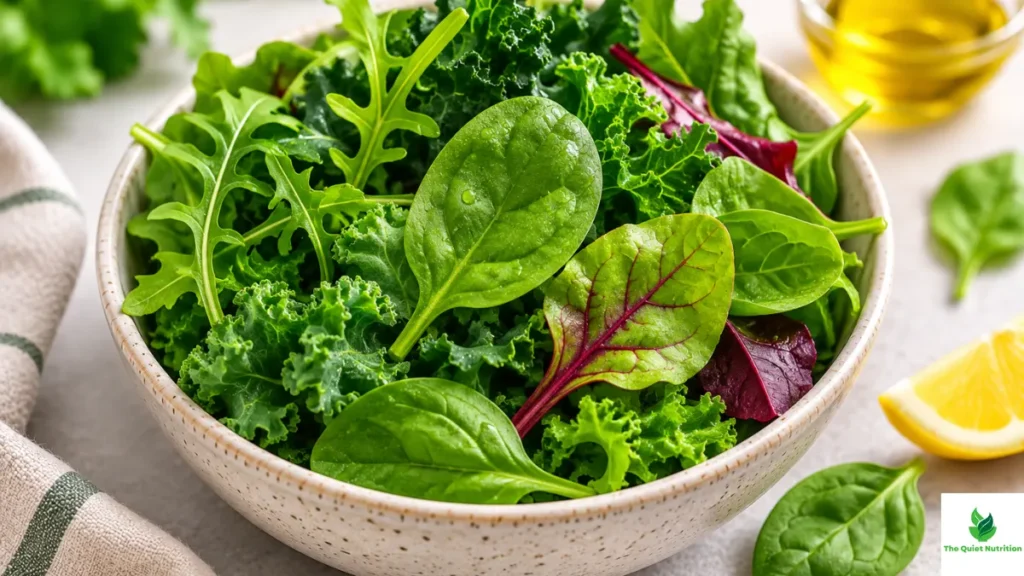
That’s a shame, because some of the more interesting nutrition research of the past decade suggests the bar for leafy greens is lower than most people assume. Not a mountain of kale. Closer to one decent handful a day.
The Chicago study that researchers keep coming back to
In 2018, a team at Rush University Medical Center published a paper in Neurology drawing on the Rush Memory and Aging Project. It followed 960 older adults, aged 58 to 99, who filled out food questionnaires and sat for memory and thinking tests year after year. The average participant was 81 when it began.
After roughly five years, people in the top fifth for leafy green intake, averaging about 1.3 servings a day, had a rate of cognitive decline about half that of people who ate little or none. The headlines turned that into brains “11 years younger,” a statistical way of expressing the gap rather than a literal brain age.
Now the part that rarely makes the headline. This was an observational study. Lead author Martha Clare Morris has said plainly that it shows an association and can’t rule out other explanations. The biggest eaters of greens also started out with slightly higher test scores, which likely reflects a lifetime of eating habits, and the study can’t tell us whether someone who starts eating greens at 80 would get the same effect.
So why would greens matter at all? The team looked at the nutrients packed into them and found that vitamin K, lutein, nitrate, folate, alpha-tocopherol and a plant compound called kaempferol were each linked to slower decline. Morris’s own take is that few foods deliver that whole combination in one package. She and a colleague also advised getting these nutrients from food rather than supplements.
A serving is smaller than you’d think, and also trickier
Here’s something that changes how you shop. In that study, a serving meant one cup of raw greens or half a cup cooked. Those are the same amount of spinach, just before and after the heat gets to it. A cup of raw leaves that looks like a lot on the cutting board collapses into a few forkfuls in the pan.
So if a salad feels like a chore, sauteed or steamed greens are the lazy route to the same place. (One caveat: when the federal dietary guidelines count vegetables, raw leafy greens are credited at half their volume, so a cup of raw spinach counts as half a cup-equivalent toward that 2 to 3 cup target. The Dietary Guidelines for Americans lay out the full system.)
Your heart gets a say, with a ceiling
A separate line of research, out of Edith Cowan University in Australia, looked at nitrate, the compound that gives greens like spinach, lettuce and arugula a role in blood vessel health. Researchers followed 53,150 people in the Danish Diet, Cancer, and Health Study over 23 years. Those eating a moderate amount of nitrate-rich vegetables had about a 15% lower risk of cardiovascular disease, and the people in the highest fifth of intake had systolic blood pressure about 2.5 mmHg lower than those in the lowest.
The finding I find most useful is the plateau. Benefits leveled off at roughly a cup of raw leafy greens a day, and eating more didn’t seem to add anything. If you’re someone who feels you must do greens perfectly or not at all, that’s permission to stop at one good cup.
A fair counterweight: observational data can only go so far. A four-week randomized trial by some of the same research group found that eating more nitrate-rich vegetables did not lower blood pressure in people with mildly elevated readings. Short trials and long cohort studies don’t always agree, and nobody should expect a few handfuls of rocket to stand in for medication.
One practical note from the ECU team: blending greens into a smoothie is fine, but juicing strips out the pulp and fiber.
Why the olive oil isn’t cheating
This is the detail that surprised me most when I went digging. The vitamin K in greens, called phylloquinone, is tightly bound inside the plant’s chloroplasts. According to the National Institutes of Health, the body absorbs only about 4% to 17% as much of it from spinach as from a supplement tablet, and eating vegetables together with some fat improves absorption.
In plain terms: the dressing, the splash of olive oil in the pan, the egg you fold the greens into, all of these are doing real work. A plain bowl of dry leaves is the least efficient way to eat them.
It’s also a reason to be skeptical of green powders and capsules as a shortcut. The food comes with fiber, water and a dozen compounds nobody has bottled yet.
Who should read the fine print
For most people, greens are about as low-risk as food gets. Two groups deserve a closer look.
If you take warfarin. Vitamin K helps your blood clot, and warfarin works by interfering with that. The NIH advice isn’t to avoid greens; it’s to keep the amount of vitamin K you eat roughly the same every day. For scale, the NIH lists about 145 micrograms of vitamin K in a cup of raw spinach and 113 in a cup of raw kale. A big weekend spinach binge after a week of none is the pattern that causes trouble. Tell your care team before you change your diet.
If you’ve had kidney stones. Spinach is among the highest-oxalate foods around, and most stones are calcium oxalate. The National Kidney Foundation suggests cutting back on salt, staying hydrated, and pairing calcium-rich foods with oxalate-rich ones, rather than cutting calcium. The NIDDK has more on diet and stones. Whether you personally need to limit spinach is a question for your doctor or a dietitian. Other greens are often lower in oxalate, so you may not need to give up the habit altogether.
Making the habit survive a Thursday
Here’s what tends to work when a tub of spinach is competing with a tired week:
- Buy the sturdy stuff for later in the week. Kale and collards hold up far longer in the fridge than baby spinach or delicate salad mixes. Eat the tender leaves first.
- Use the freezer. Frozen chopped spinach and collards are still greens, and the NIH data on vitamin K counts them. They go into soups, curries, pasta sauce and scrambled eggs without anyone noticing.
- Wilt, don’t wash up. A big handful dropped into hot soup or pasta in the last minute disappears and costs you no extra dish.
- Add fat on purpose. Oil, nuts, avocado, cheese or eggs help you absorb more from the same leaves.
- Aim for one cup raw or half a cup cooked. That’s the amount both studies keep landing on. More is fine. It just may not be needed.
The research on leafy greens is encouraging but not magic, and it comes mostly from observational studies that can’t prove cause and effect. What it does suggest, consistently, is that a small and boring daily habit may be worth more than an occasional heroic salad. The tub of spinach in your fridge doesn’t need a grand plan. It needs to be eaten by Wednesday.
This article is for general information and isn’t a substitute for personal medical advice. If you take medication or have a condition such as kidney disease, talk to your doctor or a registered dietitian before changing how you eat.
Sources
- Lee SH, Moore LV, Park S, Harris DM, Blanck HM. Adults Meeting Fruit and Vegetable Intake Recommendations, United States, 2019. MMWR, CDC, January 2022.
- Morris MC, Wang Y, Barnes LL, Bennett DA, Dawson-Hughes B, Booth SL. Nutrients and bioactives in green leafy vegetables and cognitive decline: Prospective study. Neurology, 2018.
- NPR. Eating Leafy Greens Daily May Help Keep Minds Sharp. February 2018.
- Consumer Reports. Eating Leafy Greens May Slow Memory Loss.
- Healy M. Kale, other leafy vegetables may make your brain seem years younger. Los Angeles Times via The Atlanta Journal-Constitution, January 2018.
- Bondonno CP, et al. Vegetable nitrate intake, blood pressure and incident cardiovascular disease: Danish Diet, Cancer, and Health Study. European Journal of Epidemiology, 2021. Summary: Edith Cowan University via ScienceDaily and ECU Nutrition and Health Innovation Research Institute.
- Blekkenhorst LC, et al. Nitrate-rich vegetables do not lower blood pressure in individuals with mildly elevated blood pressure: a 4-wk randomized controlled crossover trial. American Journal of Clinical Nutrition, 2018.
- National Institutes of Health, Office of Dietary Supplements. Vitamin K: Fact Sheet for Health Professionals.
- U.S. Department of Agriculture and U.S. Department of Health and Human Services. Dietary Guidelines for Americans, 2020-2025.
- National Kidney Foundation. Kidney Stone Diet Plan and Prevention.
- National Institute of Diabetes and Digestive and Kidney Diseases. Eating, Diet, & Nutrition for Kidney Stones.

Aarti Solanki, B.Sc. (Food Science), is a food science writer passionate about making nutrition simple and evidence-based. She creates well-researched, easy-to-understand articles on healthy eating, food science, and nutrition, using information from trusted scientific and public health sources.