You’re standing in the bread aisle. One loaf has a brown crust, a few oats scattered on top, a picture of a wheat field, and the word “multigrain” in a confident green font. You buy it, feeling good about yourself.
At home, you turn the bag over. The first ingredient is enriched wheat flour.
That small deflation is worth paying attention to, because it points at the real story with whole grains. The health research is strong, but a lot of what ends up in shopping carts under that name doesn’t qualify. So what does eating the real thing every day actually do, and how do you make sure you’re getting it?
First, how far most of us are from “daily”
A whole grain is the entire kernel: the bran, the germ and the starchy middle. Refining removes the bran and germ, which is where most of the fiber sits. The U.S. dietary guidelines ask people to make at least half their grains whole, which for a 2,000-calorie diet means about 3 ounce-equivalents a day.
Most people aren’t close. One published review notes that fewer than 5% of Americans meet the minimum recommendation, with the average person eating less than one ounce-equivalent a day. And one ounce-equivalent is smaller than it sounds: a slice of bread, or about half a cup of cooked rice, pasta or oatmeal, per the Clemson Extension guide.
What the long-term research actually shows
The most cited analysis comes from a 2016 BMJ paper led by Dagfinn Aune at Imperial College London. It pooled 45 studies covering about 700,000 people and 100,000 deaths. For every extra 90 grams of whole grain a day, roughly three servings, the risk of heart disease was about 19% lower, cardiovascular disease 22% lower, cancer 15% lower and death from any cause 17% lower.
Three details in that paper rarely make it into the headlines.
First, the biggest gains came at the low end. The researchers saw the largest benefit when people went from eating no whole grains to about two servings a day. For type 2 diabetes, the paper reports no further reduction in risk beyond two to three servings a day. So you don’t need to eat bowls of barley to get most of what’s on offer.
Second, the effect belonged to whole grains specifically. The analysis found little evidence of an association with refined grains or white rice.
Third, the caveat. These were observational studies, and the authors acknowledged that many of them measured whole grain intake poorly. People who eat lots of whole grains also tend to smoke less, move more and eat more vegetables, and statistics can only partly untangle that. The pattern is consistent across many studies, but it isn’t proof that bread caused anyone to live longer.
What shifts in the body within weeks
Cohort studies take years. A tighter experiment came from Tufts University in 2017, in which 81 adults aged 40 to 65 ate either whole grains or refined grains with all meals provided. Those on whole grains came out about 100 calories a day ahead, through a mix of a slightly higher resting metabolic rate and more calories lost in stool. The fiber in whole grain foods, about double that of refined versions, is thought to explain much of it.
Two honest notes. The authors cautioned that the metabolic rate result was sensitive to how closely people stuck to the diet, and they didn’t test long-term weight change. One co-author also works at the General Mills Bell Institute of Health and Nutrition, which is worth keeping in mind when you read it. Still, a controlled trial pointing the same direction as the observational data is useful.
A companion study from the same group found modest improvements in the gut environment and certain immune responses in the whole grain group.
The fiber problem hiding underneath
Much of the whole grain story is a fiber story. Adult women need about 25 grams of fiber a day and men 38 grams, and about 90% of Americans fall well short, averaging around 15 grams, according to Mayo Clinic.
If you’re starting from that 15, going all in overnight will punish you. Mayo’s guidance is to raise fiber gradually over a few weeks, because adding too much too fast can cause gas, bloating and cramping. Add one whole grain swap, give your gut a week or two, then add another. Drink water along the way.
How to beat the bread aisle
Back to that loaf. Harvard Health lays out what front-of-pack claims really mean: “whole grain” can mean as little as 51% whole grain flour, “made with whole grains” says nothing about the amount, and “multigrain” is a mixture of grains that may be mostly refined. Color tells you little, since darker bread can get its shade from molasses or caramel coloring.
A few checks that work better:
- Read the first ingredient. Look for the word “whole” in front of the grain, as in whole wheat flour, whole oats or whole rye. “Wheat flour” and “enriched flour” are refined.
- Use the 8-gram rule. Federal guidance treats a product as mostly whole grain when it has at least 8 grams of whole grain per ounce-equivalent.
- Don’t use fiber as a stand-in. The Whole Grains Council points out that fiber content isn’t a reliable test, because fiber can be added to refined products.
- Look for the Whole Grain Stamp. It states the grams per serving, which removes the guesswork.
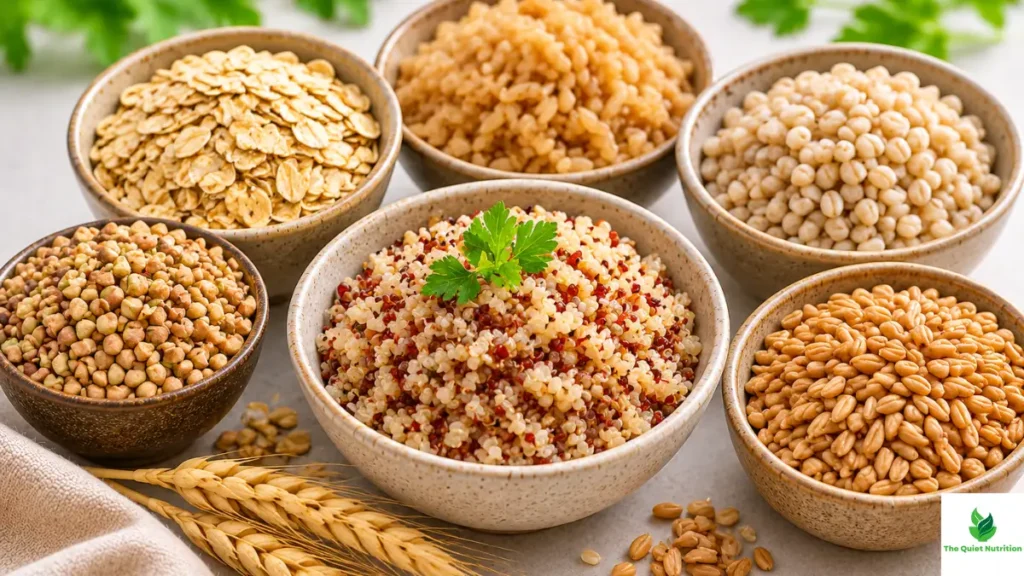
Some of the easiest whole grains need no label at all: oatmeal, popcorn, brown rice, barley, bulgur and quinoa.
One catch with brown rice
Brown rice is a classic whole grain with a wrinkle. Arsenic collects in the bran, and rice absorbs more of it than other crops, so brown rice tends to carry more arsenic than white rice. The FDA has said the levels aren’t a short-term risk but advises variety: eat a balanced diet with a wide range of grains.
In practice that means rotating, not quitting. Dartmouth’s arsenic research program suggests varying your grains, especially if rice is a big part of your diet, choosing lower-arsenic rice such as California white basmati when you do eat rice, and cooking it in extra water and draining it. Oats, barley, bulgur and farro pick up the slack nicely. Rice is most worth limiting for babies and young children.
If gluten is off the table
People with celiac disease or gluten sensitivity can still get whole grains. Harvard Health lists these gluten-free whole grains: amaranth, brown rice, buckwheat, corn, millet, quinoa, teff and wild rice. Check packaging for certified gluten-free oats, since oats are often processed alongside wheat.
What three servings looks like on an ordinary day
The BMJ authors give a handy example of 90 grams: two slices of whole grain bread and one bowl of whole grain cereal. Here’s another version.
Oatmeal for breakfast counts as one or two. A sandwich on 100% whole wheat bread at lunch covers another. Dinner can be a half cup of barley stirred into soup, or whole wheat pasta. Popcorn, which is a whole grain, covers the afternoon. None of it needs a special trip to a health food store.
Start with one swap. If that goes well, make another a week later. The research suggests the first couple of servings do the most work, so a modest, boring habit kept for years beats an ambitious one dropped by February.
This article is for general information and isn’t a substitute for personal medical advice. If you have celiac disease, a digestive condition, diabetes or kidney disease, talk to your doctor or a registered dietitian before changing how you eat.
Sources
- Aune D, et al. Whole grain consumption and risk of cardiovascular disease, cancer, and all cause and cause specific mortality: systematic review and dose-response meta-analysis of prospective studies. BMJ, 2016. (Full text, White Rose Research Online)
- BMJ press release via Medical News Today. Whole grain intake and chronic disease risk. June 2016.
- TCTMD. Whole Grain Consumption Linked to Less CVD and Lower Mortality, Meta-analyses Say.
- Karl JP, et al. Substituting whole grains for refined grains in a 6-wk randomized trial favorably affects energy-balance metrics in healthy men and postmenopausal women. American Journal of Clinical Nutrition, 2017. Coverage: Tufts Now, UPI/HealthDay and Tufts press release via Medical Xpress.
- National Library of Medicine. Refined grain intake and Americans’ whole grain consumption (review).
- Whole Grains Council. Whole grains in the Dietary Guidelines for Americans.
- Clemson Cooperative Extension. Whole Grains fact sheet.
- Harvard Health Publishing. How important are whole grains in my diet?
- Harvard Health Publishing. Whole grains or no grains? Food labels can be misleading.
- Harvard Health Publishing. In search of healthy whole grains: How to read a whole grain nutrition label.
- Whole Grains Council. How to identify whole grain products.
- Mayo Clinic News Network. Mayo Clinic Q and A: Increasing fiber intake for constipation relief. and coverage of Mayo guidance on raising fiber gradually.
- U.S. Food and Drug Administration arsenic-in-rice findings, as reported by The Atlanta Journal-Constitution and NBC News.
- Dartmouth College, Arsenic and You. Arsenic in Rice and Rice Products.

Aarti Solanki, B.Sc. (Food Science), is a food science writer passionate about making nutrition simple and evidence-based. She creates well-researched, easy-to-understand articles on healthy eating, food science, and nutrition, using information from trusted scientific and public health sources.