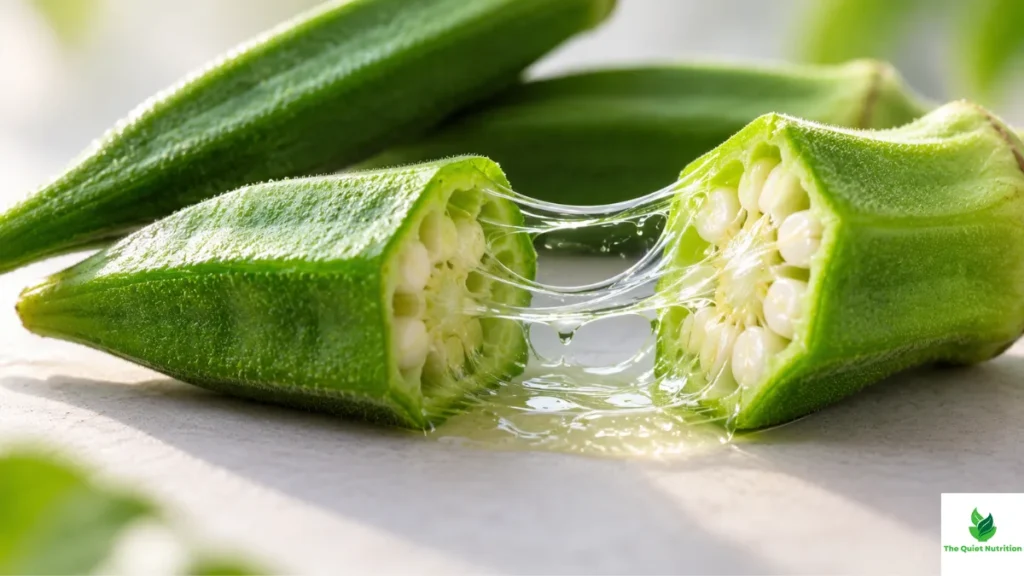
You lift the lid, give the pot a stir, and there it is: okra threads stretching off the spoon like warm mozzarella. Somebody at the table pulls a face. Somebody else quietly reaches for the rice.
It’s a fair reaction, and a slightly unlucky one, because the stuff that makes okra so divisive is the very thing researchers keep coming back to when the conversation turns to digestion. That glossy gel isn’t a cooking mistake or a sign the pods have gone off. It’s how the vegetable is built, and it happens to be a type of fibre that gut bacteria can ferment.
Whether okra really deserves its gut-friendly reputation is a more interesting question than most wellness posts let on. So here’s what’s actually known, what’s still lab-bench speculation, and how to cook it so you’ll genuinely want to eat it.
So what is that slime, anyway?
Botanists call it mucilage, and it’s less mysterious than it looks. It’s a tangle of long-chain carbohydrates with a little protein and a few minerals mixed in, and when it meets water it swells into that slippery gel, as the authors of a 2025 study on slimy vegetables describe it. Take it apart and you find sugars like galactose, rhamnose and galacturonic acid, which makes okra’s goo a pectin-like substance, a distant cousin of what sets your jam.
That puts the slime firmly in the soluble-fibre camp. Harvard Health explains the two types this way: soluble fibre pulls in water and turns to gel, which slows digestion and softens stool, while insoluble fibre adds bulk and keeps things moving along. Most vegetables carry some of each, and okra is no exception.
The amounts are modest, and it’s worth being straight about that. Raw okra has roughly 3 grams of fibre per 100 grams, about a cup of slices, according to USDA FoodData Central. Harvard’s rule of thumb is 14 grams of fibre per 1,000 calories, which works out to somewhere around 28 to 34 grams a day for most adults, and most people eat less than half of that. So a cup of okra gets you about a tenth of the way there: not a miracle, but cheap, low-calorie progress.
What the research shows, and where it runs out
Most of the gut-related findings come from lab dishes and animals, not from people eating okra for a month. Three threads are worth knowing about.
- It ferments gently. In a thesis from Durban University of Technology, okra mucilage was fermented with human stool samples and compared against inulin, a well-studied prebiotic. Okra produced about half the gas (roughly 114 mL against 233 mL) and encouraged a bacterial family called Bacteroidaceae. Gentle fermentation is what you’d hope for if fibre tends to leave you bloated, but this is one lab experiment, not a trial in people.
- Not all okra slime is the same. A peer-reviewed study in Food Hydrocolloids found that okra’s pectin-like polysaccharides were fermented differently depending on their molecular size and how branched they were, and that they favoured different gut microbes accordingly. “Okra fibre” is a family of molecules, not a single ingredient.
- Mouse studies lean the same direction. In the 2025 study of ten slimy vegetables, the blend shifted gut bacteria in mice eating a high-fat diet, and okra had the richest polysaccharide and polyphenol content of the lot. Separate work in mice found okra polysaccharides raised Lactobacillus levels.
The missing piece is human data. The trials that do exist on okra mostly measure blood sugar and cholesterol, and many use powdered okra rather than the vegetable, as this nutritionist’s roundup of recent reviews lays out. A solid trial testing ordinary cooked okra for constipation or regularity is hard to find.
Reviews of okra’s pharmacology, like this 2025 overview in Foods, keep landing in the same place: promising, early, more research needed. So think of okra as a decent fibre vegetable with interesting gut science behind it, not as a remedy.
Cooking it your way
Here’s something freeing: as far as I can tell, nobody has measured how much gut-relevant mucilage survives roasting versus stewing. Until someone does, texture is a matter of taste, not a health trade-off. Cook okra the way you’ll actually finish the plate.
If stringy isn’t your thing, a set of kitchen tests reported in the Palm Beach Post found that okra gets thickest at neutral to alkaline pH, so acid like vinegar or tomato tones it down. Dry, high heat (roasting, grilling, frying) did even better than acid. That squares with the usual advice in step-by-step guides like this one from Alphafoodie, which favour quick, hot methods.
In practice that comes down to a few habits:
- Choose small, bright green pods and keep them in a paper bag in the fridge; cook them within a day or two.
- Dry them completely after washing. Wet pods steam, and steam is where the stringiness starts.
- Use a hot pan or oven, cook in batches so the pods aren’t crowded, and finish with a squeeze of lemon or a splash of vinegar.
And if you’re making gumbo or a slow-simmered curry, ignore all of this. In a stew the gel is a feature, since it thickens the pot for free.
Who should ease in
For most people okra is an easy vegetable to like. Three situations deserve a bit more care, though.
A sensitive gut. Some FODMAP lists, like the one News-Medical summarises, flag okra as a source of fructans and galacto-oligosaccharides. These are short-chain carbohydrates that Monash University researchers identified as a trigger for bloating and pain in many people with IBS. Portion size matters a great deal here and food lists don’t always agree, so if you have IBS, check the current Monash FODMAP app and start with a few pods rather than a bowlful.
A history of kidney stones. Okra counts as a moderate-to-high oxalate food, at about 56 mg per half-cup of boiled pods, per figures Nutrition Advance draws from the Oxalosis and Hyperoxaluria Foundation. The National Kidney Foundation says a strict low-oxalate diet usually isn’t the best route for preventing calcium oxalate stones. It points instead to enough calcium, plenty of water, lots of fruit and vegetables, and a 24-hour urine test to personalise the plan. Its examples of very high oxalate foods don’t name okra, but if you’ve had stones, check with your doctor or a kidney dietitian.
Warfarin. Cooked okra supplies roughly a third of the daily value for vitamin K per 100 grams, according to the same Nutrition Advance breakdown of USDA data. That’s no reason to skip it, but an NIH Clinical Center handout for people on warfarin stresses keeping vitamin K intake steady from day to day. Mention it to your care team before okra becomes a daily habit.
Start small, keep it boring
If okra is going to show up more often, a half cup to a cup a few times a week is plenty to begin with. Harvard Health’s guidance on fibre applies here: your digestive system needs time to adapt, and too much too soon brings gas, bloating and cramps. Build up gradually and drink water as you go. The same publication’s piece on fibre facts also advises against obsessing over exact grams; variety across fibre-rich foods matters more. Okra works best as one of several, alongside beans, oats, fruit and whole grains.
And if things stay stuck even when you’re eating more fibre and drinking more fluids, that’s a question for a doctor, since medications and medical conditions can be behind it.
So the next time the spoon comes up stringy, you’ll know what you’re looking at: the plant’s own gel, a fibre your gut bacteria seem to find interesting, and a perfectly good reason to keep the pan hot and the lemon close.
This article is general information, not personal medical advice.
Sources
- Harvard Health Publishing, The facts on fiber
- Harvard Health Publishing, Fabulous fiber
- USDA FoodData Central, Okra, raw
- Plants (MDPI), 2025, Gut-liver axis-mediated anti-obesity effects of a viscous vegetable mixture in mice fed a high-fat diet
- Frontiers in Microbiology, 2024, Okra polysaccharide microcapsules and intestinal microbiota in mice
- Food Hydrocolloids, 2022, Fermentation of okra pectic-polysaccharides and effects on gut microbiota
- Durban University of Technology, thesis on prebiotic potential of amadumbe and okra mucilage
- Foods, 2025, Overview of the current scientific evidence on the biological properties of okra
- Nutrition Advance, Okra nutrition: potential health benefits and full nutrition facts
- Monash University FODMAP, Research behind the low FODMAP diet
- News-Medical, High FODMAP foods and low FODMAP alternatives
- National Kidney Foundation, Six easy ways to prevent kidney stones
- NIH Clinical Center, Coumadin and vitamin K handout (archived)
- Palm Beach Post, 2018, Okra gets a bad rap: 3 recipes to redeem it
- Alphafoodie, How to cook okra (6 easy methods)

Aarti Solanki, B.Sc. (Food Science), is a food science writer passionate about making nutrition simple and evidence-based. She creates well-researched, easy-to-understand articles on healthy eating, food science, and nutrition, using information from trusted scientific and public health sources.