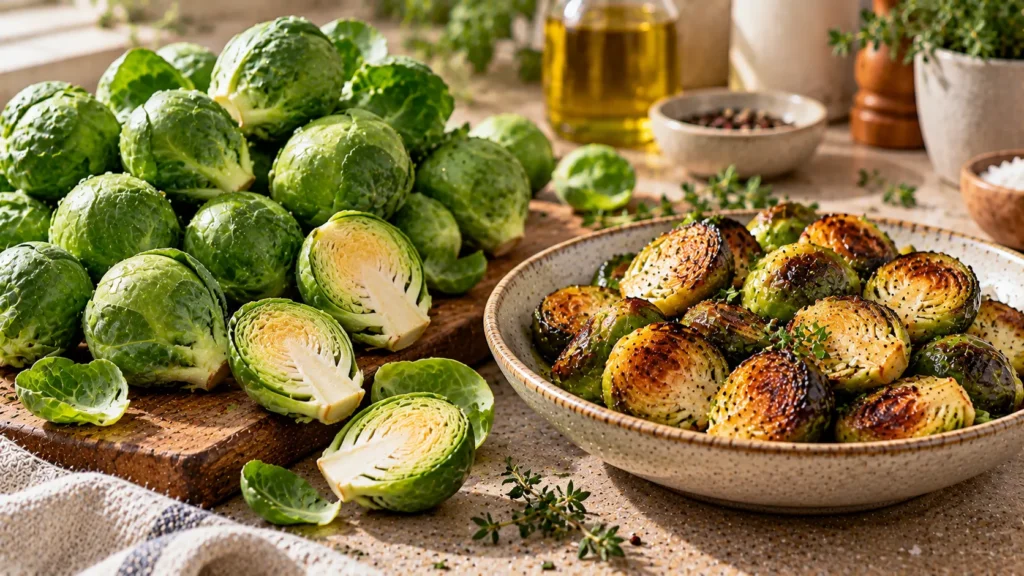
Brussels sprouts look like miniature cabbages, but their nutritional profile gives them a place among the more useful vegetables to include regularly. A cup of cooked Brussels sprouts provides fibre, vitamin C, vitamin K and folate, along with naturally occurring compounds found throughout the cruciferous vegetable family.
Their reputation has grown alongside interest in vegetables that supply more than basic vitamins and minerals. Researchers are particularly interested in glucosinolates, sulfur-containing compounds that can be broken down into biologically active substances. Yet the distinction between promising laboratory research and demonstrated health benefits in people is important.
Brussels sprouts do not need to prevent disease or deliver extraordinary results to be worth eating. Their established nutritional contributions, versatility and ability to make a meal more varied are already good reasons to include them.
A small serving contributes several important nutrients
According to USDA food-composition data, one cup of cooked, boiled Brussels sprouts provides approximately 56 calories, 4 grams of fibre and 4 grams of protein. It also supplies substantial amounts of vitamin C and vitamin K, although exact values depend on the variety and preparation method.
That combination is useful because a relatively modest serving contributes several nutrients without adding many calories. Brussels sprouts can complement foods that provide more energy or protein, making them an easy addition to a varied meal.
Their fibre helps distinguish them from vegetables that supply very little of this nutrient per serving. Dietary fibre supports normal bowel function, and some types can be fermented by microorganisms in the large intestine. Getting enough fibre from a variety of foods is associated with broader digestive and cardiometabolic benefits.
Brussels sprouts are not the most concentrated fibre source available. Beans, lentils, oats and certain other whole grains can supply considerably more, depending on portion size. Nevertheless, a vegetable does not need to be the richest source of a nutrient to contribute meaningfully to a person’s overall intake.
For example, roasted Brussels sprouts served alongside lentils and brown rice provide a different combination of nutrients from a meal built around meat and refined starch alone. The sprouts contribute fibre and micronutrients, while the lentils supply additional fibre and plant protein.
Their value becomes clearer when viewed as one component of a meal rather than a standalone health food.
Vitamin C is one of their nutritional strengths
Brussels sprouts are a notable vegetable source of vitamin C. The nutrient is needed to make collagen, a structural protein involved in connective tissue and wound healing. It also contributes to normal immune function and helps the body absorb non-haem iron, the type found in beans, lentils and other plant foods.
Vitamin C is often associated with oranges and other citrus fruits, but Brussels sprouts demonstrate why vegetables deserve attention in this context, too. Their contribution can be substantial, especially when a reasonable portion is included in a meal.
This becomes particularly useful when planning meals built around plant-based foods. Serving Brussels sprouts alongside lentils, for example, brings together a source of vitamin C and a source of non-haem iron. Vitamin C can improve the absorption of some of that iron.
The amount of vitamin C remaining in the finished vegetable depends partly on storage and cooking. It is water-soluble and sensitive to heat, so prolonged cooking or extensive contact with water can reduce the amount retained.
This is a reason to avoid boiling Brussels sprouts for much longer than necessary, not a reason to eat them raw at every opportunity. Cooking makes their texture more appealing to many people, and appropriately prepared vegetables remain worthwhile sources of nutrients.
Vitamin K supports normal blood clotting
Vitamin K is another important part of the nutritional picture. The body uses it to make proteins involved in normal blood clotting, and it also has roles in bone metabolism.
Brussels sprouts provide vitamin K alongside vitamin C and fibre, giving them a combination of nutrients that supports several different normal bodily functions.
However, the presence of vitamin K should not be interpreted as proof that Brussels sprouts directly strengthen bones or prevent fractures. Bone health depends on many factors, including adequate calcium and vitamin D, physical activity, age and the broader dietary pattern.
There is one practical consideration worth knowing. People taking warfarin, a vitamin K-sensitive anticoagulant, are generally advised to keep their vitamin K intake reasonably consistent rather than suddenly making large changes to the amount of vitamin K-rich food they eat. Brussels sprouts do not automatically need to be avoided, but substantial dietary changes should be discussed with the healthcare professional managing the medication.
For most people, vitamin K is simply another reason to appreciate the variety of nutrients found in vegetables.
Folate helps the body make and maintain cells
Brussels sprouts also provide folate, a B vitamin needed for DNA production and normal cell division. The body requires it throughout life, although adequate folate intake is particularly important during early pregnancy because of its role in fetal development.
The US National Institutes of Health lists cooked Brussels sprouts among the foods that contribute substantial amounts of folate. A half-cup serving of boiled frozen Brussels sprouts provides approximately 78 micrograms of dietary folate equivalents, or about 20% of the Daily Value used on US food labels.
That is a useful contribution from a vegetable side dish. It is not a substitute for every other folate-containing food, and the amount in a particular serving will vary with the vegetable and how it is prepared.
The broader point is that Brussels sprouts supply several micronutrients together. Their nutritional value does not rest on vitamin C alone or on a single plant compound receiving attention in scientific research.
Eating a range of vegetables helps broaden the intake of these nutrients without requiring someone to rely heavily on any one food.
The compounds that make Brussels sprouts scientifically interesting
Brussels sprouts belong to the Brassica family, which also includes broccoli, cabbage, cauliflower and kale. These vegetables contain naturally occurring compounds known as glucosinolates.
When the plant’s tissues are chopped, crushed or chewed, glucosinolates can be broken down with the help of an enzyme called myrosinase. This process can produce substances such as isothiocyanates and indole-related compounds, which researchers study for their effects on biological pathways.
Some of these substances have shown interesting activity in laboratory experiments. Researchers have investigated their roles in the body’s responses to oxidative stress, inflammation and the processing of certain chemicals.
These findings help explain the interest in cruciferous vegetables, but they need to be interpreted carefully. A compound producing a particular effect in cultured cells does not establish that eating Brussels sprouts creates the same effect in a human being.
The amount consumed, the compound’s absorption, its metabolism and individual differences can all influence what happens after eating the vegetable.
A systematic review published in 2023 examined 28 human intervention studies involving glucosinolates and related compounds from cruciferous foods in different forms, including foods, extracts, beverages and tablets. The review found useful evidence about their metabolism and bioavailability, while also identifying areas where more research is needed.
The studies varied in what they investigated, and the findings cannot all be applied directly to an ordinary serving of Brussels sprouts.
Consequently, it would be inaccurate to claim that Brussels sprouts prevent cancer or guarantee protection against chronic disease. Their glucosinolates are biologically interesting, but much of the research investigates mechanisms or outcomes that have not yet established a specific clinical benefit from eating this vegetable.
For everyday nutrition, the sensible conclusion is to include Brussels sprouts among a variety of cruciferous and other vegetables rather than depending on them for a particular health outcome.
Does cooking change their nutritional value?
The way Brussels sprouts are cooked affects both their flavour and the amount of certain compounds retained.
A study published in the Journal of Agricultural and Food Chemistry in 2010 examined the effects of boiling, microwaving and different steaming methods on several plant compounds in fresh and frozen Brassica vegetables, including Brussels sprouts. The researchers found that cooking altered the measured concentrations of glucosinolates, polyphenols, carotenoids and vitamin C. The effects differed according to the vegetable, compound and cooking method.
Boiling caused losses of many measured compounds, while microwaving retained glucosinolates relatively well under the tested conditions. However, the results did not establish that one preparation method produces better long-term health outcomes than another.
It is worth distinguishing two questions: how much of a compound remains in a cooked vegetable, and whether that difference leads to a meaningful improvement in human health. The first can be measured in a food laboratory; the second requires evidence from people.
Steaming is a reasonable everyday choice because it cooks the sprouts without prolonged contact with water. Microwaving can also be convenient. Roasting is useful when flavour matters most, since the outer leaves become crisp and the cut surfaces develop a nutty, browned taste.
Boiling remains acceptable, too, particularly when the sprouts are cooked briefly or incorporated into a dish where the cooking liquid is consumed.
The most useful method is one that produces a vegetable you enjoy and will eat regularly. There is little benefit in pursuing perfect nutrient retention if the result is an unappealing dish that rarely makes it to the table.
Why Brussels sprouts sometimes taste bitter
The bitterness associated with Brussels sprouts has a nutritional connection, although flavour and health benefits should not be confused.
Brussels sprouts naturally contain sulfur-containing compounds and other substances that contribute to their distinctive flavour. Their variety, maturity and preparation can all affect the final taste.
Older varieties were often associated with a stronger bitter flavour, while modern varieties have been developed with improved eating quality. Even so, some bitterness remains part of the vegetable’s natural character.
Cooking can change how these flavours are perceived. Brief steaming tends to preserve a firmer texture and relatively mild flavour, while roasting brings out sweetness and develops a more savoury taste. Overcooking can produce a stronger, less pleasant smell and flavour for some people.
There is no need to force yourself to enjoy a preparation you dislike. Slicing the sprouts in half, roasting them until their cut surfaces brown, or adding lemon juice and a little olive oil can make them more appealing.
Nor should bitterness be treated as a reliable indicator of antioxidant content or health benefits. Taste is influenced by multiple compounds, and a more bitter Brussels sprout is not necessarily healthier than a milder one.
Variety and preparation remain more useful considerations than trying to identify the most medicinal-tasting vegetable.
Fresh, frozen or roasted: what should you choose?
Fresh Brussels sprouts are useful when they are available in good condition. Look for firm sprouts with compact leaves and minimal yellowing, then store them appropriately and use them before they deteriorate.
Frozen Brussels sprouts are a convenient alternative. They can be kept on hand for quick meals, and their nutritional contribution remains worthwhile even though processing and cooking can change some nutrient levels.
There is no general rule that fresh vegetables are always more nutritious than frozen ones. The outcome depends on the nutrient, storage time, processing and cooking method.
Roasting is particularly useful for people who find steamed or boiled Brussels sprouts unappealing. Halve the sprouts, toss them with a modest amount of olive oil and roast until the edges brown and the centres become tender. Garlic, black pepper, lemon or herbs can add flavour without requiring a heavy sauce.
They also work well in salads when thinly sliced, tossed into grain bowls or served alongside fish, chicken, tofu or legumes. The accompanying ingredients affect the overall nutritional profile, so a plate of Brussels sprouts alone should not be expected to provide the full range of nutrients needed in a meal.
Frozen sprouts can be added to soups, casseroles and mixed vegetable dishes with little preparation. Their convenience can be particularly valuable when time is limited.
The choice should reflect taste, budget and routine. Eating Brussels sprouts occasionally in a form you enjoy is more practical than buying fresh produce that goes unused because it is inconvenient to prepare.
A small note about digestion
Brussels sprouts contain fibre and fermentable carbohydrates. Gut bacteria can break down some of these substances, producing gas as part of the process.
For many people, this is a normal response to eating cruciferous vegetables. Others may notice bloating, abdominal pressure or flatulence, especially after eating a large serving or increasing their fibre intake suddenly.
Smaller portions may be more comfortable, and thoroughly cooked sprouts can be easier for some people to tolerate. Individual responses vary, so there is no need to force a large serving simply because Brussels sprouts have a strong nutritional reputation.
People with ongoing digestive symptoms may benefit from discussing their diet with a qualified healthcare professional or dietitian rather than eliminating broad groups of vegetables without guidance.
A vegetable’s nutritional value and an individual’s tolerance are separate considerations. The best eating pattern is one that provides adequate nutrition while remaining comfortable and sustainable.
What Brussels sprouts really bring to the table
Brussels sprouts provide a useful combination of fibre, vitamin C, vitamin K and folate, alongside naturally occurring plant compounds that continue to attract scientific interest. They can contribute to a varied diet without adding many calories when prepared simply.
Their glucosinolates are one reason researchers study cruciferous vegetables, but laboratory activity and changes in measured compounds are not equivalent to proof that Brussels sprouts prevent disease. Strong claims about cancer prevention or other specific outcomes go beyond what can be established from the evidence discussed here.
The practical approach is straightforward: include Brussels sprouts when you enjoy them, prepare them in ways that suit your taste and combine them with other vegetables, whole grains and suitable protein sources. Fresh, frozen, steamed and roasted versions can all have a place in a balanced diet.
Brussels sprouts are nutritious because they contribute several useful things at once—not because they possess a single extraordinary power.
Sources:
[1] U.S. Department of Agriculture, Agricultural Research Service. FoodData Central: Brussels sprouts, cooked, boiled, drained, without salt. Reference for energy, protein, fibre and micronutrient estimates. https://fdc.nal.usda.gov/food-search/?query=brussels%20sprouts%20cooked
[2] National Institutes of Health, Office of Dietary Supplements. Vitamin C: Fact Sheet for Health Professionals. Explains vitamin C’s role in collagen production, wound healing, immune function and non-haem iron absorption, as well as its sensitivity to heat and prolonged storage. https://ods.od.nih.gov/factsheets/VitaminC-HealthProfessional
[3] National Institutes of Health, Office of Dietary Supplements. Vitamin K: Fact Sheet for Consumers. Explains vitamin K’s role in blood clotting and bone health and the importance of consistent vitamin K intake for people taking warfarin. https://ods.od.nih.gov/factsheets/VitaminK/Consumer
[4] National Institute of Diabetes and Digestive and Kidney Diseases. Eating, Diet, & Nutrition for Constipation. Provides guidance on fibre intake, bowel regularity and gradual increases in dietary fibre. https://www.niddk.nih.gov/health-information/digestive-diseases/constipation/eating-diet-nutrition
[5] National Institutes of Health, Office of Dietary Supplements. Folate: Fact Sheet for Health Professionals. Describes the role of folate in DNA production and cell division and provides folate values for selected foods, including Brussels sprouts. https://ods.od.nih.gov/factsheets/Folate-HealthProfessional
[6] Maina S, et al. Systematic Review on the Metabolic Interest of Glucosinolates and Their Bioactive Derivatives for Human Health. 2023. Reviews 28 human intervention studies examining the metabolism and bioavailability of glucosinolates and related compounds from cruciferous foods. The review identifies promising areas of research while highlighting continuing evidence gaps. https://pubmed.ncbi.nlm.nih.gov/36986155
[7] Palermo M, Pellegrini N, Fogliano V. Effect of different cooking methods on color, phytochemical concentration, and antioxidant capacity of raw and frozen Brassica vegetables. Journal of Agricultural and Food Chemistry. 2010;58(7):4310–4321. DOI: 10.1021/jf904306r. Examines changes in vitamin C and several plant compounds after cooking broccoli, cauliflower and Brussels sprouts. https://pubmed.ncbi.nlm.nih.gov/20218674

Aarti Solanki, B.Sc. (Food Science), is a food science writer passionate about making nutrition simple and evidence-based. She creates well-researched, easy-to-understand articles on healthy eating, food science, and nutrition, using information from trusted scientific and public health sources.