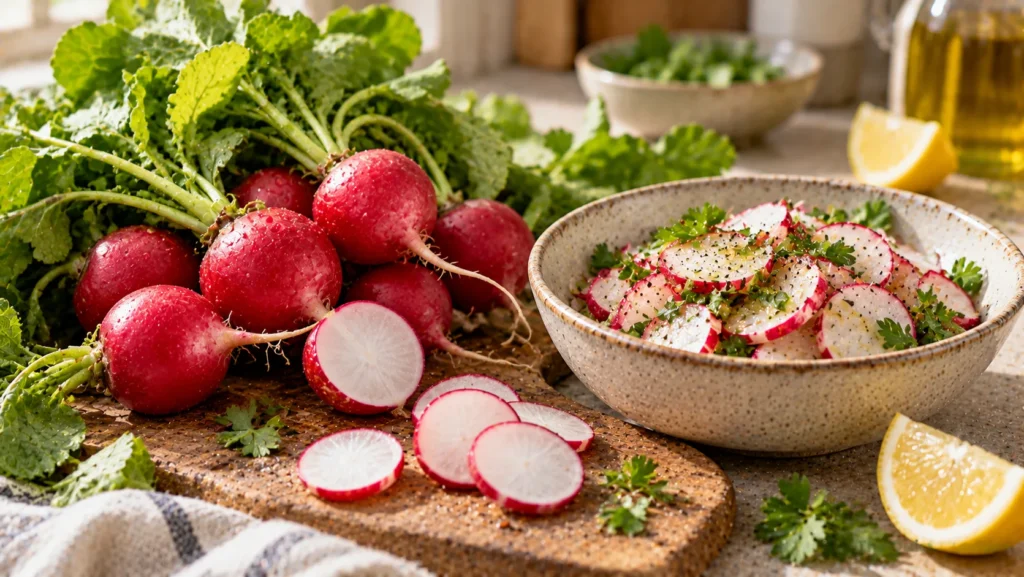
Radishes have a reputation for being little more than a crunchy salad garnish. Their peppery flavour, crisp texture and high water content make them easy to overlook, particularly beside vegetables that receive more attention for their nutritional value.
Yet radishes offer something worth appreciating: they provide vitamin C, a small amount of dietary fibre and naturally occurring plant compounds found in the mustard and cabbage family. They are also low in calories, making them an easy addition to meals that could benefit from more vegetables.
Their association with detox diets, however, deserves a closer look. There is a difference between eating a nutritious vegetable as part of a balanced diet and claiming that it flushes toxins from the body. The first is a sensible dietary choice. The second is a health claim that requires evidence.
Radishes can fit comfortably into a diet that supports normal digestion and overall health. Understanding what they actually provide—and what research has not yet established—is a better way to appreciate their place on the plate.
What makes radishes a useful addition to everyday meals?
Raw red radishes contain approximately 16 calories per 100 grams, with around 1.6 grams of fibre and 15 milligrams of vitamin C, according to USDA food-composition data. They also contain potassium and small amounts of several other nutrients.
Those figures are not extraordinary, but they illustrate why radishes can be useful in an everyday eating pattern. They add crunch, moisture and a distinctive flavour without contributing many calories.
Their high water content is another practical advantage. Radishes can add volume to salads, sandwiches and vegetable bowls, helping make meals more varied without requiring complicated preparation.
The nutritional contribution depends on the variety and the part of the plant being eaten. Small red radishes, larger white daikon radishes and black radishes do not necessarily have identical nutrient profiles. Radish leaves and sprouts also contain different concentrations of nutrients and plant compounds from the roots.
This variation is one reason broad claims about radishes can be misleading. Evidence about a particular extract, sprout or variety should not automatically be applied to every radish eaten as food.
For most people, the simplest reason to include radishes is more straightforward: they make it easier to add another vegetable to ordinary meals.
The detox connection: what radishes can and cannot do
The word detox is used so widely in wellness marketing that it can become difficult to distinguish an established biological process from an unsupported promise.
The body already has systems that process and remove waste products. The liver processes nutrients and certain drugs and helps transform substances so they can be eliminated. The kidneys filter the blood, removing wastes and excess water through urine.
Radishes do not replace these functions, and there is no good clinical evidence that eating them as an ordinary food flushes unspecified toxins from the body.
The National Center for Complementary and Integrative Health, part of the US National Institutes of Health, has reviewed detox diets and cleansing programmes. It concludes that convincing evidence supporting detox diets for eliminating toxins or producing lasting health benefits is lacking. Some programmes can also be harmful, particularly when they involve severe dietary restriction, unsafe supplements or laxatives.
That does not mean that food has no role in supporting normal bodily function. A balanced diet supplies the nutrients needed for ordinary physiological processes, while adequate fibre, fluid intake and vegetable variety can contribute to digestive health.
Radishes can be part of that pattern. Their nutritional value is a reasonable basis for eating them, even without claiming that they cleanse the liver or kidneys.
The distinction is particularly important for anyone considering a restrictive juice cleanse. Replacing balanced meals with radish juice or another vegetable drink is not an established way to remove toxins, and it can make it harder to obtain sufficient energy and nutrients.
A more useful approach is to include radishes in meals that already provide protein, fibre, healthy fats and a variety of other plant foods.
Radishes contain plant compounds that researchers are investigating
Radishes belong to the Brassicaceae family, alongside broccoli, cabbage, cauliflower, mustard and several other vegetables.
Members of this family contain sulfur-containing compounds called glucosinolates. When plant tissues are cut, chewed or otherwise damaged, enzymes can help break down these compounds into products that include isothiocyanates. The specific compounds and their quantities vary with the plant variety, growing conditions, plant part and preparation method.
These substances attract scientific interest because experimental research suggests that some can influence cellular pathways involved in the body’s response to potentially harmful compounds.
This is sometimes described in research as an effect on detoxification enzymes. The terminology can sound like proof that eating radishes cleans the body, but the two ideas are not equivalent.
An enzyme-related effect observed in cultured cells does not establish that eating a serving of radishes produces the same effect in a person. Researchers must also establish whether a compound is absorbed, how it is metabolised, what dose is relevant and whether the observed changes translate into a meaningful health outcome.
A systematic review of radish nutrition and phytochemistry identified a broad range of compounds across radish roots, leaves and sprouts, including polyphenols, flavonoids and glucosinolates. It also documented substantial variation in the reported composition of these different plant parts.
This evidence helps explain why radishes are scientifically interesting, but it does not justify describing them as a proven treatment for liver problems, a method of removing environmental toxins or a means of preventing disease.
For readers, the practical takeaway is modest but useful: radishes contribute to the variety of plant compounds supplied by a diet containing different vegetables.
Vitamin C is one of their established nutritional benefits
Radishes provide vitamin C, an essential nutrient involved in several normal functions in the body.
Vitamin C is required for collagen production, which supports connective tissue and helps with wound healing. It also contributes to normal immune function and improves the absorption of non-haem iron, the form found in foods such as beans, lentils and leafy vegetables.
Approximately 100 grams of raw red radishes supplies around 15 milligrams of vitamin C, although the amount varies with variety and growing conditions.
This is a useful contribution, but radishes are not among the richest sources of vitamin C. Bell peppers, kiwifruit, citrus fruits and several other vegetables and fruits generally provide more per comparable serving.
The distinction matters because nutrition is not a competition in which one food needs to supply the greatest amount of a nutrient to be worthwhile.
Radishes can contribute vitamin C while providing texture and flavour that make vegetables more appealing. Pairing them with other vitamin C-containing foods throughout the day helps broaden the diet’s overall contribution.
They can also accompany plant-based meals containing iron. A salad made with lentils, leafy greens and sliced radishes, for instance, combines several nutrient sources, although the radishes alone should not be expected to meet the body’s vitamin C requirements.
Can radishes support digestion?
Radishes provide some dietary fibre, which is one reason they can contribute to a diet that supports normal bowel function.
Dietary fibre includes parts of plant foods that are not completely broken down during digestion. Depending on the type, fibre can contribute to stool formation, influence water retention in the intestine and provide substrates that gut microorganisms can ferment.
Adequate fibre intake helps support regular bowel movements. The US National Institute of Diabetes and Digestive and Kidney Diseases generally recommends that adults obtain around 22–34 grams of fibre daily, depending on age and sex.
Radishes contribute to that total, but the amount is modest: around 1.6 grams per 100 grams of the raw red variety.
This means radishes can help diversify fibre sources, but they should not be treated as a stand-alone solution for constipation or digestive problems. Beans, lentils, whole grains, fruit and other vegetables can make larger contributions depending on portion size.
There is also an important difference between adding a crunchy vegetable to meals and expecting a particular food to improve the gut microbiome in a predictable way. The effects of foods on gut microorganisms depend on their composition, the rest of the diet and individual differences in microbial communities.
Research on glucosinolates and their breakdown products has explored several possible mechanisms relevant to human health. However, evidence establishing specific gut-health benefits from a normal serving of radishes remains limited.
For everyday eating, the strongest practical reason to include radishes is their contribution to vegetable variety and overall fibre intake, rather than an unproven promise to rebalance the gut.
What about radishes and liver health?
Some radish-related research has explored the activity of compounds involved in the body’s handling of chemicals.
One example is a small, open-label pilot study published in 2015 that investigated a supplement containing Spanish black radish in healthy men over four weeks. Researchers measured changes in acetaminophen metabolites and certain other laboratory markers. The findings suggested changes in the metabolism of acetaminophen, a widely used medicine.
The study is interesting, but its limitations are important.
It examined a specific black-radish supplement rather than ordinary servings of the small red or white radishes commonly eaten in salads. It was also a pilot study without a comparison group, making it difficult to determine how much confidence to place in the observed changes.
Most importantly, changes in measured drug metabolites do not establish that radishes remove harmful substances from the body more effectively in everyday conditions, improve liver health or prevent liver disease.
This is an example of why research findings need to be interpreted according to what was actually studied. Laboratory mechanisms, small supplement trials and clinical evidence showing meaningful health improvements are different levels of evidence.
Until stronger human studies establish benefits from eating ordinary radishes, they should be treated as a nutritious vegetable—not a liver-cleansing treatment.
Raw, cooked or blended: which is the better choice?
Radishes are most familiar in raw form, sliced into salads or sandwiches. Their crisp texture and peppery flavour can bring contrast to ingredients that are otherwise soft or mild.
Raw radishes are convenient because they need little preparation beyond washing and trimming. They can be grated into slaws, added to grain bowls or served alongside hummus and other dips.
Cooking offers a different experience. Roasting softens radishes and can mellow their sharp flavour, while adding them to soups or stir-fries creates a more delicate texture.
Neither raw nor cooked radishes should be regarded as universally superior. Cooking can change the retention and availability of some nutrients and plant compounds, with the effects depending on the method and duration. The nutritional value of a meal also depends on what accompanies the radishes.
Blending radishes into juice is another option, but it is not necessary for obtaining their nutrients. Juice preparation can remove some of the fibre, depending on whether the pulp is retained, and drinking a concentrated vegetable juice does not confer a special detoxification effect.
For most people, eating the whole vegetable in a form they enjoy is a sensible starting point.
How to include radishes in a balanced diet
Radishes are especially easy to use when a meal needs something fresh and crisp. Their peppery flavour can brighten dishes without requiring a rich sauce or elaborate seasoning.
Try slicing them into a salad of leafy greens, beans and whole grains. Add them to a sandwich for crunch, serve them with a yoghurt-based dip or toss them into a quick stir-fry near the end of cooking.
Their flavour also works well with lemon juice, fresh herbs, cucumber and olive oil. These combinations create varied meals without turning a simple vegetable into a complicated wellness ritual.
Radish leaves may also be edible when they are fresh and in good condition. They can be washed thoroughly and used in suitable cooked preparations or mixed into other greens. However, their nutritional composition differs from that of the root, so findings about the leaves should not be assumed to apply to the whole radish.
If raw radishes cause discomfort, try a smaller portion or experiment with cooked preparations. Individual tolerance varies, and there is no reason to force large quantities of a particular vegetable simply because it is marketed as beneficial.
The goal is to make vegetables a regular part of meals while maintaining enough variety to meet broader nutritional needs.
What radishes really bring to a wellness-focused diet
Radishes offer a straightforward combination of qualities: low calorie content, high water content, some fibre, vitamin C and naturally occurring plant compounds. These characteristics make them a practical addition to salads, cooked dishes and other everyday meals.
Their glucosinolates and related compounds remain scientifically interesting, particularly in research examining how plant chemicals interact with cellular pathways. But laboratory findings and limited studies of particular extracts do not establish that ordinary radishes detoxify the body or prevent liver disease.
A detox-friendly approach to eating is better understood as a consistent pattern of nutritious food choices than as a special cleansing programme. Eat a range of vegetables, obtain adequate fibre, drink enough fluid and avoid relying on restrictive detox products that promise more than the evidence supports.
Radishes fit naturally into that approach. Their value comes from what they contribute to a varied diet—not from an ability to flush toxins that other foods cannot.
Sources:
[1] U.S. Department of Agriculture, Agricultural Research Service. FoodData Central: Radishes, raw. Reference for calorie, fibre, vitamin C and other nutrient estimates. Values vary with variety and growing conditions. https://fdc.nal.usda.gov/food-search/?query=radishes%20raw
[2] Kern H, et al. Nutritional and phytochemical characterization of radish (Raphanus sativus): A systematic review. Trends in Food Science & Technology. 2021. Reviews reported nutritional and phytochemical composition across radish roots, leaves and sprouts. https://doi.org/10.1016/j.tifs.2021.04.045
[3] National Institute of Diabetes and Digestive and Kidney Diseases. Your Kidneys & How They Work. Explains how the kidneys filter blood and remove wastes and excess water. https://www.niddk.nih.gov/health-information/kidney-disease/kidneys-how-they-work
[4] National Institute of Diabetes and Digestive and Kidney Diseases. Liver Disease. Provides information on the liver’s normal functions, including processing and distributing nutrients and other physiological roles. https://www.niddk.nih.gov/health-information/liver-disease
[5] National Center for Complementary and Integrative Health, National Institutes of Health. “Detoxes” and “Cleanses”: What You Need To Know. Reviews the limited evidence for detox diets and cleansing programmes and discusses potential safety concerns. https://www.nccih.nih.gov/health/detoxes-and-cleanses-what-you-need-to-know
[6] Maina S, et al. Systematic Review on the Metabolic Interest of Glucosinolates and Their Bioactive Derivatives for Human Health. 2023. Reviews human intervention studies on glucosinolates and related compounds, their metabolism and bioavailability, and the remaining research gaps. https://pubmed.ncbi.nlm.nih.gov/36986155
[7] National Institutes of Health, Office of Dietary Supplements. Vitamin C: Fact Sheet for Health Professionals. Explains the established functions of vitamin C, including collagen production, immune function and non-haem iron absorption. https://ods.od.nih.gov/factsheets/VitaminC-HealthProfessional
[8] National Institute of Diabetes and Digestive and Kidney Diseases. Eating, Diet, & Nutrition for Constipation. Provides guidance on dietary fibre, fluid intake and bowel regularity. https://www.niddk.nih.gov/health-information/digestive-diseases/constipation/eating-diet-nutrition
[9] An open-label pilot study to evaluate the efficacy of Spanish black radish on the induction of phase I and phase II enzymes in healthy male subjects. 2015. Examined changes in acetaminophen metabolites following four weeks of a Spanish black radish supplement. The pilot design and specific supplement studied limit the conclusions that can be drawn about ordinary dietary radishes. https://pubmed.ncbi.nlm.nih.gov/25490898

Aarti Solanki, B.Sc. (Food Science), is a food science writer passionate about making nutrition simple and evidence-based. She creates well-researched, easy-to-understand articles on healthy eating, food science, and nutrition, using information from trusted scientific and public health sources.