
Function Doesn’t Disappear Overnight — It Fades When Support Does
Most people don’t suddenly lose function.
They notice small things first:
- Stairs feel harder
- Balance feels less reliable
- Energy dips faster
- Recovery takes longer
- Focus isn’t as sharp
These changes are often blamed on aging.
But in many cases, the real driver is simpler:
The body is running with less nutritional support than it needs.
Function fades not because the body forgets how to work —
but because it no longer has enough resources to keep working well.
What “Function” Really Means in the Body
Function isn’t about elite performance.
It’s about everyday capability:
- Standing up easily
- Walking without fatigue
- Lifting groceries
- Thinking clearly
- Healing normally
- Adapting to stress
Function is the outcome of thousands of small systems working together:
- Muscles contracting efficiently
- Nerves firing accurately
- Hormones signaling correctly
- Cells repairing on time
All of these depend on adequate nutrition.
Adequate Nutrition Is Not the Same as “Eating Enough”
Many people consume enough calories.
They are not adequately nourished.
Adequate nutrition means:
- Sufficient protein for tissue maintenance
- Enough micronutrients for enzymes and repair
- Reliable energy availability
- Consistency over time
Research institutions like Harvard T.H. Chan School of Public Health emphasize that long-term dietary adequacy — not short-term intake — determines how well the body maintains function as it ages.
Calories keep you alive.
Nutrients keep you functional.
Why Function Is the First Thing the Body Protects — and the First Thing It Sacrifices
When nutrition is stable, the body invests in:
- Muscle preservation
- Neuromuscular coordination
- Hormonal balance
- Efficient repair
When nutrition becomes unreliable, the body shifts priorities:
- Vital organs first
- Function second
This shift is subtle.
It shows up as:
- Slight weakness
- Reduced stamina
- Slower reactions
- Increased injury risk
Not disease.
Just under-supported function.
Muscle Function: The Cornerstone of Independence
Muscle is not just about strength.
It supports:
- Balance
- Metabolism
- Glucose control
- Joint protection
Adequate protein intake is essential for maintaining muscle tissue, especially with age.
Guidance summarized by the National Institute on Aging highlights that maintaining muscle mass is one of the strongest predictors of long-term independence and mobility.
Without adequate nutrition:
- Muscle breakdown accelerates
- Recovery slows
- Functional capacity shrinks
This happens quietly — until it becomes noticeable.
Brain and Nerve Function Depend on Nutrient Availability
Function isn’t only physical.
Cognitive and nervous system function rely on:
- B vitamins for nerve signaling
- Healthy fats for myelin integrity
- Minerals for neurotransmitter balance
- Glucose availability for brain energy
Inadequate nutrition often leads to:
- Brain fog
- Slower reaction time
- Poor stress tolerance
- Reduced focus
These are frequently mislabeled as “mental aging.”
They’re often fuel and nutrient issues.
Energy Is a Functional Signal, Not a Personality Trait
Low energy is not a lack of motivation.
It’s often a lack of:
- Carbohydrate availability
- Iron or B vitamins
- Magnesium
- Overall intake consistency
When energy drops, function follows:
- Movement decreases
- Strength declines
- Coordination worsens
Adequate nutrition stabilizes energy — which stabilizes function.
Adequate Nutrition vs. Chronic Under-Support
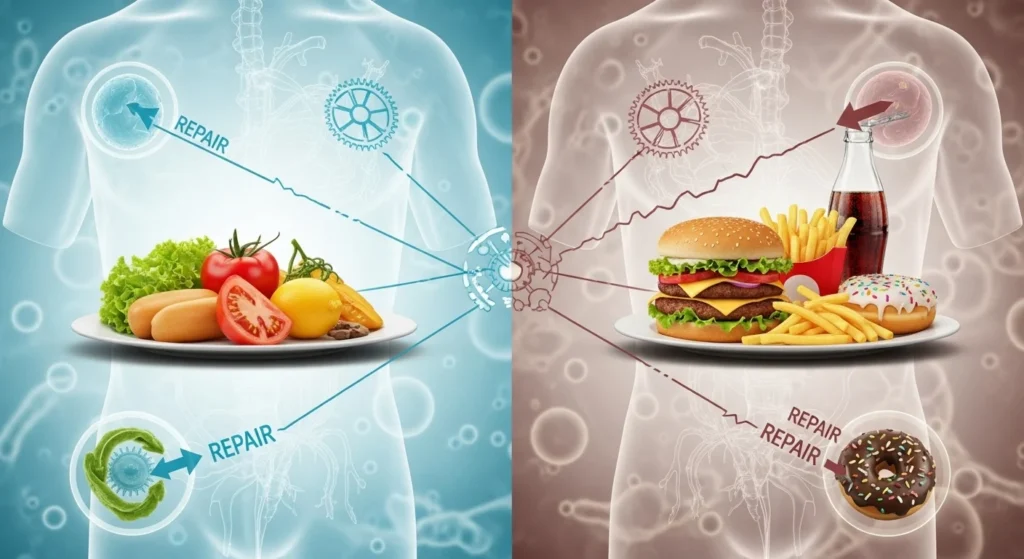
| Adequate Nutrition | Chronic Under-Support |
|---|---|
| Preserved muscle | Gradual muscle loss |
| Stable energy | Frequent fatigue |
| Efficient recovery | Lingering soreness |
| Better balance | Higher fall risk |
| Maintained cognition | Brain fog |
Function reflects what the body can afford to maintain.
Real-Life Example: Why Function Declines “Out of Nowhere”
Many people say:
“I was fine last year. Now everything feels harder.”
Often, nothing dramatic changed — except:
- Meals became irregular
- Protein intake dropped
- Stress increased
- Appetite decreased
Function didn’t disappear.
It was slowly defunded.
Hidden Ways Adequate Nutrition Gets Lost
Even health-conscious people slip into under-support.
Common mistakes:
- Skipping meals during busy days
- Eating “light” for extended periods
- Fear-driven fat avoidance
- Replacing meals with snacks
- Ignoring reduced appetite with age
None feel dangerous.
Together, they erode function.
Why This Matters Today
Modern life challenges functional health:
- Sedentary work
- High stress
- Convenience foods
- Diet culture promoting under-eating
At the same time, public health guidance from the World Health Organization emphasizes adequate, balanced nutrition as a foundation for maintaining physical and cognitive function across the lifespan.
Function is becoming harder to preserve — not because bodies are weaker, but because support is inconsistent.
Actionable Ways to Preserve Function With Nutrition
You don’t need extreme strategies.
You need reliability.
Focus on:
- Protein at every main meal
- Regular meal timing
- Whole-food micronutrient sources
- Eating enough during stress or illness
- Avoiding long, frequent food gaps
Adequate nutrition works quietly — but powerfully.
Emotional Relief: Function Loss Is Often Reversible
Many people assume function decline is permanent.
Often, it’s not.
When nutritional adequacy improves:
- Energy stabilizes
- Strength returns
- Recovery improves
- Confidence rebuilds
The body wants to function.
It just needs enough to work with.
Key Takeaways
- Function depends on consistent nutritional support
- Calories alone do not preserve performance
- Protein and micronutrients protect muscle and cognition
- Under-eating quietly erodes daily capability
- Adequate nutrition preserves independence and resilience
Frequently Asked Questions
1. Can nutrition really preserve function as we age?
Yes. Adequate nutrition supports muscle, nerves, energy, and repair systems that maintain function.
2. Is exercise enough without proper nutrition?
No. Exercise increases nutrient demand; without support, function still declines.
3. Why does function drop even when weight stays stable?
Muscle and nutrient loss can occur without weight change.
4. Do supplements replace adequate eating?
They can help gaps, but food-based nutrition is foundational.
5. Is it too late to improve function with nutrition?
No. Functional systems respond positively at any age.
Function Is Maintained, Not Magically Preserved
The body doesn’t fail without warning.
It adapts to what it’s given.
When nutrition is adequate, the body maintains:
- Strength
- Energy
-n- Stability - Independence
That preservation doesn’t look dramatic.
It looks like continuing to live well — longer than expected.
Disclaimer: This article is for general educational purposes and does not replace personalized medical or nutritional advice.







Pingback: How Nutrition Shapes the Body’s Baseline Health — The Invisible Foundation That Determines How You Feel Every Day
Pingback: Why Your Body’s Strength Depends on What You Eat Every Day
Pingback: Spinach Is More Powerful Than You Think — The Hidden Nutrients Inside Every Leaf