
There’s a moment almost everyone has had. You run into someone you haven’t seen in ten years, and your brain does a quiet double take. Not because they look bad — because they look like time forgot to touch them. Meanwhile, you’ve watched someone else the same age seem to age in fast-forward, joints stiffer, skin duller, energy thinner, all in the same decade.
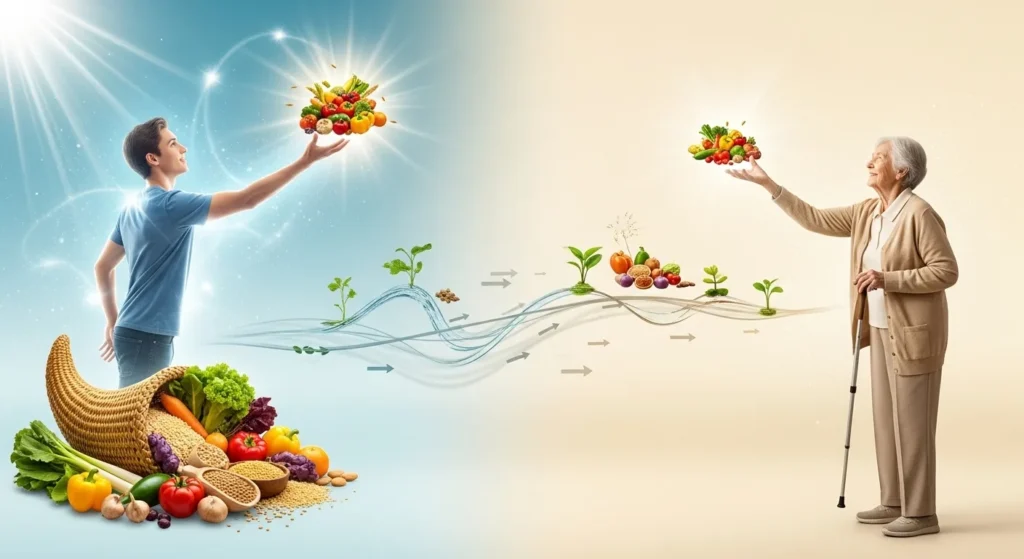
The instinctive explanation is “good genes.” It’s the easiest story to tell, and it lets everyone else off the hook. But here’s the uncomfortable truth researchers keep confirming: genetics load the gun, but your daily plate pulls the trigger. Twin studies have repeatedly found that only around 20% of how long — and how well — you live comes down to your DNA. The remaining 70–80% is shaped by things you control every single day, and diet sits at the very top of that list.
This isn’t a “eat your greens” lecture. It’s a look at the actual biology of why food is one of the most powerful anti-aging tools that exists — and why most people are unknowingly speeding up their own decline, one meal at a time.
Aging Isn’t Just Time Passing — It’s Cellular Damage Accumulating
Aging feels abstract until you understand what’s actually happening at the cellular level. Every time your cells divide, the protective caps on the ends of your chromosomes — called telomeres — get a little shorter. Scientists now use telomere length as a marker of “biological age,” which can be wildly different from the number on your birth certificate. A stressed, poorly-fed 45-year-old can be biologically older than a well-nourished 55-year-old.
What accelerates that shortening? Chronic inflammation and oxidative stress — both of which are directly fed (literally) by what you eat. What slows it down? Nutrients that calm inflammation and protect your cells from damage. This single mechanism is a big part of why nutrition has such an outsized effect on how fast you age.
Researchers at Harvard-affiliated Brigham and Women’s Hospital studied nearly 4,700 women and found that closer adherence to a Mediterranean-style diet was directly associated with longer telomeres, with the effect strongest among those most consistent about it. Even modest dietary improvements moved the needle — you didn’t need to overhaul your entire life overnight to see a measurable biological difference.
The 80/20 Rule Nobody Told You About
If genetics only explains about a fifth of your lifespan, why does it get 100% of the credit at family dinners? Probably because it feels comforting — if aging is predetermined, there’s nothing to do about it. But that same research, drawn from large-scale twin studies, is exactly why longevity scientists get excited about lifestyle intervention: it means the majority of the aging process is negotiable.
This is the entire premise behind the world’s “Blue Zones” — the five regions (Okinawa, Sardinia, Nicoya, Ikaria, and Loma Linda) where people routinely live past 100 without chronic disease. These populations don’t share a genetic superpower. They share dietary patterns: mostly plants, minimal processed food, modest portions, and consistent nutrient density decade after decade. It’s not a supplement stack or a biohack. It’s boringly, powerfully consistent nutrition.
The Specific Nutrients That Slow the Clock
Not all food acts the same way on your biology. Some categories have shown up again and again in longevity research as genuinely protective:
Omega-3 fatty acids and vitamin D. In a large, long-term randomized controlled trial run through Harvard-affiliated Mass General Brigham, participants who took vitamin D supplements showed measurably better telomere maintenance than those on a placebo over several years — one of the first big trials to show this effect isn’t just correlation.
Folate and B12. An analysis of over 5,500 U.S. adults found that higher folate and B12 levels were associated with meaningfully longer telomeres, likely because these nutrients help the body manage oxidative stress at a cellular level.
Polyphenols and antioxidants. Colorful plant compounds — found in berries, olive oil, leafy greens, and green tea — neutralize the free radicals that damage DNA and cell membranes over time. This is a big part of why “eat the rainbow” isn’t just a catchy phrase; different pigments correspond to different protective compounds.
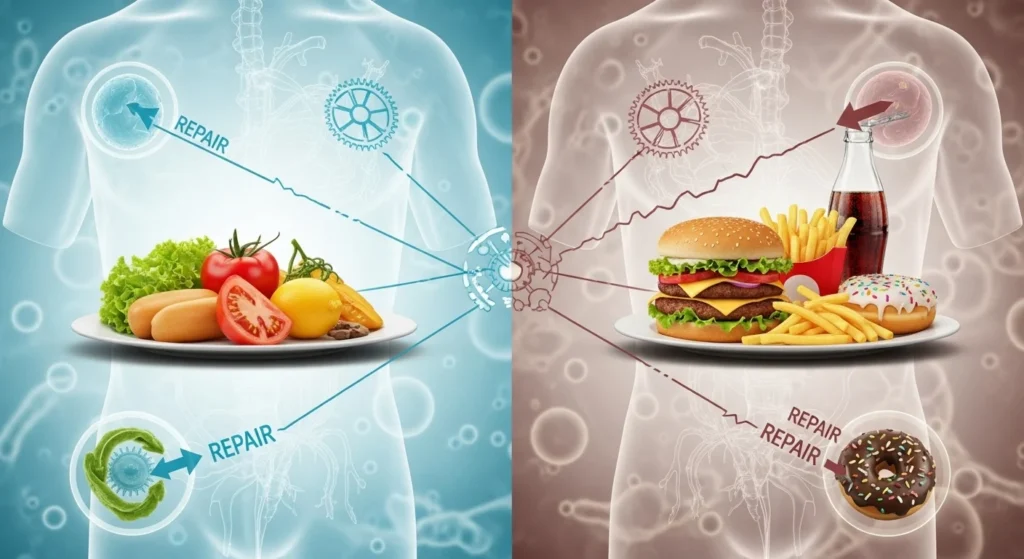
What accelerates aging: Refined sugar, ultra-processed food, and inflammatory vegetable oils have consistently been linked to shorter telomeres and higher biological age markers. It’s not about one indulgent meal — it’s about which foods make up the baseline of your daily pattern.
Why This Feels So Counterintuitive
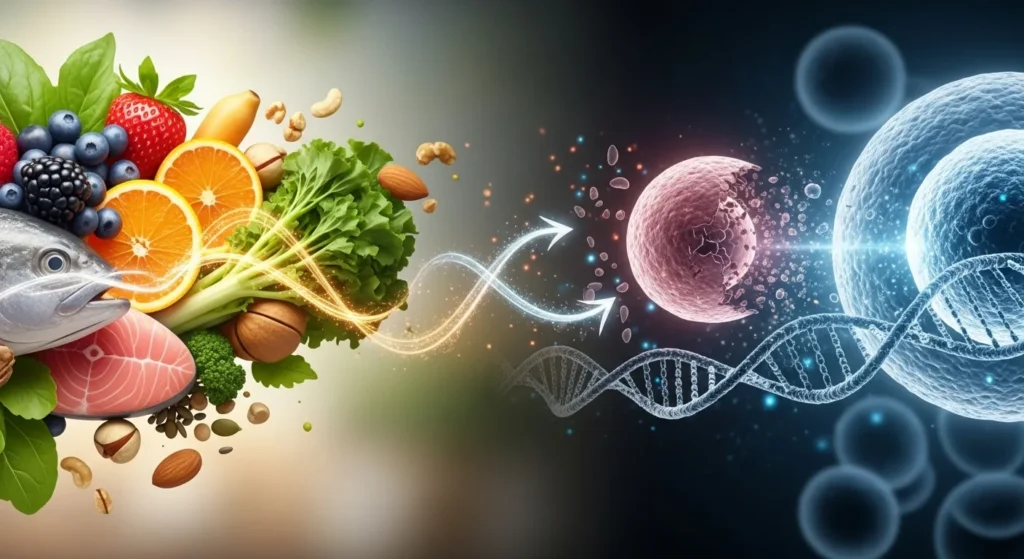
We’re wired to think of aging as something that happens to us, on a schedule we don’t control. But biology tells a different story: aging is closely tied to epigenetics — how your genes get expressed, not just which genes you were handed. Diet is one of the strongest epigenetic levers available. Nutrients can literally switch certain genes on or off, activating repair pathways or dialing down chronic inflammation, all without changing a single letter of your DNA.
This reframes the entire conversation. You didn’t inherit a fixed expiration date. You inherited a set of raw materials, and nutrition is one of the main tools shaping how those materials get used — for better or worse — every single day.
What This Actually Looks Like in Practice
None of this requires perfection, and it definitely doesn’t require expensive supplements or extreme diets. The patterns that show up consistently in longevity research are refreshingly simple:
- Build meals around vegetables, legumes, and whole grains rather than treating them as sides
- Get regular omega-3s from fish, walnuts, or flaxseed instead of relying only on supplements
- Keep ultra-processed food and added sugar as the exception, not the daily default
- Prioritize consistency over intensity — a sustainable 80% adherence beats a perfect week followed by total abandonment
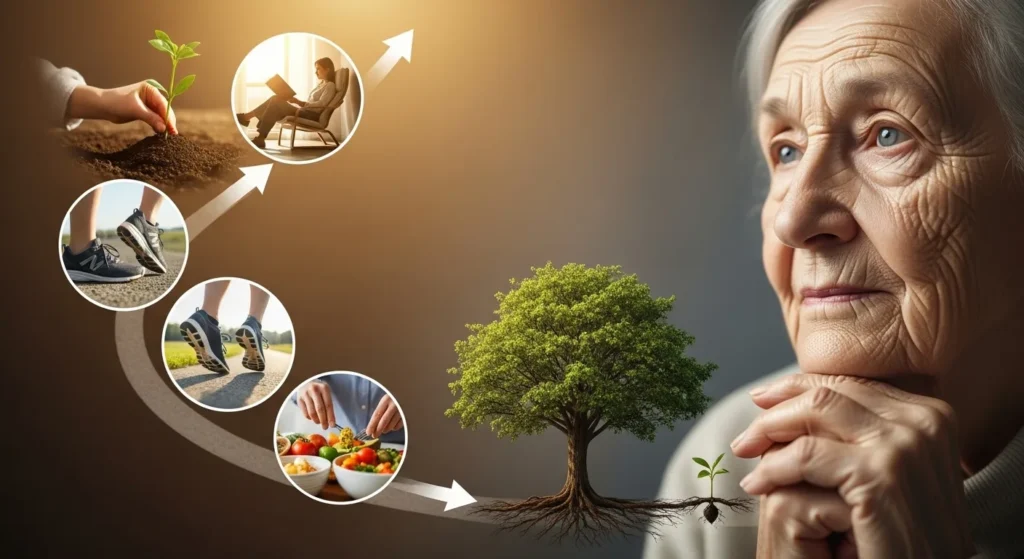
The people in Blue Zones aren’t chasing biohacks. They’re eating this way for decades, without thinking about it as an “intervention” at all. That consistency is exactly what shows up in the research as protective.
The Real Takeaway
Genetics can load certain risks — but nutrition decides how much of that risk actually gets expressed, and how fast your body accumulates the wear and tear we call aging. The science is increasingly clear that what’s on your plate today is quietly writing instructions to your cells about how well you’ll move, think, and feel decades from now.
You can’t rewrite your DNA. But you can absolutely change the environment your genes operate in — three times a day, every day. That’s not a small thing. That might be the biggest lever you have.
Sources
- Harvard Gazette — Mediterranean diet has marked impact on aging
- Harvard Gazette — Vitamin D supplements may slow biological aging (VITAL trial)
- NIH/NCBI — Serum and Dietary Folate and Vitamin B12 Levels and Cellular Aging (NHANES study)
- NIH/NCBI — Lessons from the Blue Zones (National Academies)
- American Journal of Clinical Nutrition — VITAL Telomere Study, 4-Year Findings

Aarti Solanki, B.Sc. (Food Science), is a food science writer passionate about making nutrition simple and evidence-based. She creates well-researched, easy-to-understand articles on healthy eating, food science, and nutrition, using information from trusted scientific and public health sources.


Pingback: Why Aging Reflects Years of Small Habits (Not Sudden Decline or Bad Luck)