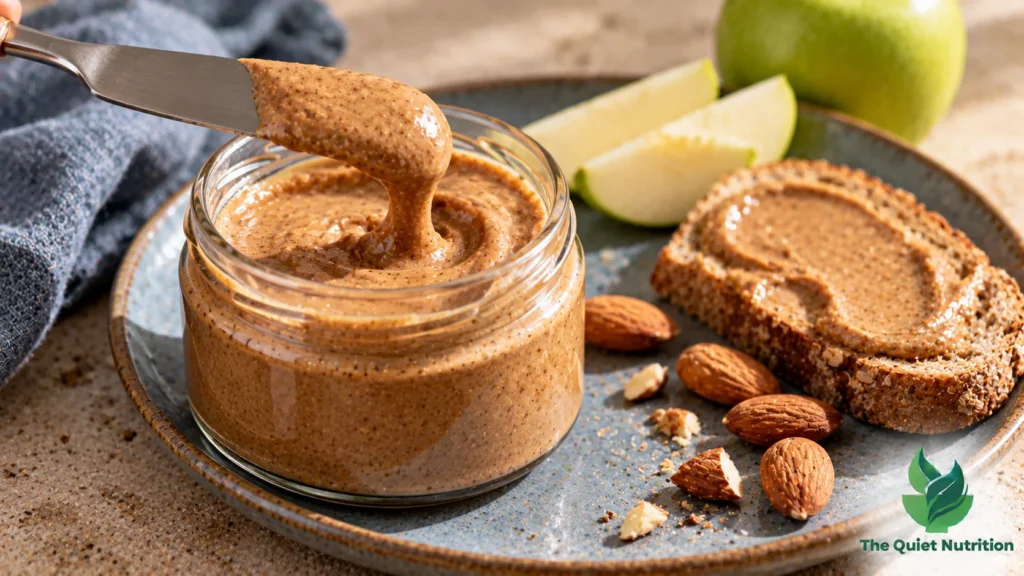
Nut butters have a simple ingredient at their heart: nuts ground into a smooth or chunky paste. Yet this transformation creates a food with a distinctive nutritional profile—one that combines healthy fats, plant protein, fiber, and a range of vitamins and minerals.
Peanut butter is perhaps the best-known example, but almond, cashew, hazelnut, and other nut butters each have their own nutritional characteristics. Some provide more protein, others are particularly rich in vitamin E or certain minerals, and their fat composition varies.
The science behind nut butters is more interesting than the idea that they are simply a healthy spread. Grinding nuts changes their texture and makes them easier to incorporate into meals, while the ingredients used in commercial products can significantly affect their nutritional quality.
Nut butters are also energy-dense. That does not make them unhealthy, but it means that portion size and the foods they replace matter.
Understanding the nutrition science helps explain why nut butters can be useful in a balanced diet—and how to choose a product that delivers more of what you want.
1. Their Fat Content Is Not a Reason to Avoid Them
One of the defining features of nut butters is their fat content. Most varieties contain substantial amounts of fat, much of it unsaturated.
Almond and peanut butters, for example, provide predominantly monounsaturated and polyunsaturated fats. These fats are important sources of energy, contribute to cell structure, and help the body absorb fat-soluble vitamins.
The type of fat matters. Replacing some saturated fat with unsaturated fat can help improve blood cholesterol levels and support cardiovascular health. Using nut butter in place of a spread high in saturated fat may therefore be a useful dietary swap.
However, the effect depends on the overall eating pattern. Adding several tablespoons of nut butter to a diet without adjusting anything else is different from using it instead of a less nutritious snack or spread.
It is also important to recognise that not all nut butters have identical fat profiles. Almond, peanut, cashew, and hazelnut butters differ in their proportions of monounsaturated, polyunsaturated, and saturated fats.
The takeaway is not that fat is automatically healthy regardless of its source or quantity. Rather, the unsaturated fats in many nut butters can make them a valuable alternative to foods richer in saturated fat.
2. They Supply Plant Protein
Nut butters can make a useful contribution to daily protein intake.
Peanut butter typically provides around seven to eight grams of protein in a two-tablespoon serving, although the exact amount depends on the product. Almond butter provides a similar amount in many products, while cashew and hazelnut butters may contain somewhat less.
Protein is essential for maintaining and repairing body tissues. It also supports the production of enzymes and other molecules involved in normal physiological processes.
For people following vegetarian or vegan diets, nut butters offer a convenient way to add plant protein to meals and snacks. They can be spread on whole-grain toast, stirred into oatmeal, or combined with fruit for a simple snack.
Still, nut butter is not necessarily a complete protein source in the same sense as foods that provide all essential amino acids in suitable proportions. Nuts vary in their amino acid profiles, and nut butters should be considered one contributor to a varied diet.
Pairing them with other protein-containing foods throughout the day—such as beans, lentils, soy foods, whole grains, and other nuts—helps create a more diverse nutritional pattern.
3. Grinding Nuts Does Not Remove Their Nutritional Value
What happens when whole nuts become butter?
The most obvious change is physical. Grinding breaks the nuts into smaller particles and releases their natural oils, creating a spreadable texture. The basic nutrients remain, although their concentration per spoonful depends on the recipe and any additional ingredients.
Because nut butters are finely ground, they may be easier to eat quickly than whole nuts. A person can consume several tablespoons without noticing how much they have eaten.
This is one reason portion awareness matters. A spoonful of nut butter can provide useful nutrients, but the same spoonful also contains a concentrated amount of energy.
Whole nuts may require more chewing and can be more difficult to consume quickly. Nut butter is convenient, but it is worth serving a portion rather than repeatedly dipping a spoon into the jar.
The processing itself is not a reason to dismiss nut butter. The key questions are what went into the product, how much you eat, and how it fits into your overall diet.
4. Different Nut Butters Provide Different Nutrients
The phrase nut butter covers several foods with overlapping but distinct nutritional profiles.
Peanut butter provides plant protein, unsaturated fats, niacin, and other nutrients. Although peanuts are botanically legumes rather than tree nuts, their nutritional composition makes peanut butter a close relative of other nut butters.
Almond butter is notable for vitamin E, magnesium, and monounsaturated fat. Vitamin E acts as an antioxidant and supports normal immune function.
Cashew butter contributes unsaturated fats, copper, magnesium, and other minerals. Copper is needed for several enzyme systems and plays a role in iron metabolism.
Hazelnut butter provides predominantly unsaturated fats and is a source of vitamin E.
Pistachio butter can contribute protein, fiber, and a variety of micronutrients, although its exact composition depends on the product.
These differences are useful, but they should not be exaggerated. One nut butter is not automatically superior to every other variety. The best choice depends on taste, dietary needs, affordability, allergies, and the rest of the foods you eat.
Rotating varieties can add diversity to your diet, but there is no nutritional requirement to purchase every type.
5. They Can Contribute to Heart-Healthy Eating
Research on nuts has linked regular consumption with healthier blood lipid profiles and a lower risk of cardiovascular disease. Many nut butters retain important components of the whole nut, including unsaturated fats and some fiber, protein, minerals, and plant compounds.
The strongest practical argument for nut butters is often substitution. Replacing some foods rich in saturated fat with foods rich in unsaturated fat can improve the overall quality of dietary fat.
However, evidence about whole nuts should not automatically be interpreted as proof that every nut butter produces exactly the same effects. Processing, ingredients, serving sizes, and dietary context can differ.
Similarly, an association between nut consumption and lower cardiovascular risk does not prove that eating nut butter alone prevents heart attacks or strokes.
A simple, mostly unsweetened nut butter can fit well into a heart-conscious eating pattern that includes vegetables, fruit, legumes, whole grains, and other sources of unsaturated fats.
If you have high cholesterol or cardiovascular disease, nut butter can complement an appropriate eating plan, but it does not replace medication or other recommended treatment.
6. Their Fiber and Fat Can Make Snacks More Satisfying
Nut butters contain a combination of fat, protein, and varying amounts of fiber. Together, these nutrients can help make a snack more substantial.
For example, spreading peanut butter on whole-grain toast provides a combination of nutrients that differs from a snack made primarily of refined starch. Adding nut butter to fruit can also make a simple snack more filling.
But the response varies among individuals and depends on the rest of the meal. Nut butter is not a guaranteed appetite suppressant, and feeling satisfied after eating it does not automatically lead to weight loss.
Fiber content also differs by nut type and product. Some of the fiber found in whole nuts remains in their butter, but the amount per serving depends on the ingredients and preparation.
For digestive health, nut butter is best viewed as one contributor to a varied diet that includes fruits, vegetables, legumes, and whole grains—not as a standalone source of fiber.
7. Added Ingredients Can Change the Nutrition Profile
A jar labelled “almond butter” or “peanut butter” may contain little more than ground nuts. Another product may include sugar, salt, oils, or flavourings.
That difference can matter more than the brand name.
Added sugar increases the amount of sugar in the product without necessarily providing the same range of nutrients as the nuts themselves. Added salt increases sodium content, which can be important for people who need to limit sodium intake.
Some products also contain added oils to change texture or improve spreadability. These ingredients are not automatically harmful, but they change the product’s composition.
For a straightforward everyday choice, look for a nut butter with a short ingredient list, ideally consisting primarily or entirely of the nut itself. If you prefer a sweeter or salted version, compare the nutrition labels and choose according to your needs.
Oil separation in natural nut butter is normal. It occurs because the nuts release their own oils during grinding. Stirring the product usually restores a more uniform consistency.
8. Nut Butters Are Nutrient-Dense, Not Low-Calorie
A common misunderstanding is that a food rich in beneficial fats can be eaten without considering quantity.
Most nut butters provide roughly 180–210 calories per two tablespoons, depending on the nut and the product. Because the fats are concentrated, even a small portion supplies a substantial amount of energy.
This can be useful for people who need energy-dense foods, including some people with higher energy needs. For others, large unmeasured portions may make it easier to consume more calories than intended.
There is no need to fear the calories in nut butter. Instead, think about how the serving fits into the meal.
A measured portion spread on whole-grain toast or served with apple slices can be a practical snack. Repeatedly eating several large spoonfuls directly from the jar can make portion size harder to judge.
The distinction is not between “good” and “bad” calories. It is between using a nutritious food deliberately and assuming that its nutritional benefits make quantity irrelevant.
How to Choose and Use Nut Butter
A few simple habits can help you get the most from nut butters:
- Read the ingredient list. Choose products primarily made from the nut, with added sugar and salt kept to a level that suits your preferences.
- Measure your portion. Two tablespoons is a common reference serving, but your needs may differ.
- Pair it with other foods. Try nut butter with fruit, whole-grain toast, oatmeal, or plain yogurt.
- Choose according to your needs. Peanut butter often provides a useful amount of protein at a relatively affordable price, while almond butter supplies vitamin E and magnesium.
- Store it properly. Follow the product label and keep the container sealed. Refrigeration may help preserve quality in some natural products.
- Account for allergies. Peanut allergy and tree-nut allergy can be serious. Check ingredients and cross-contact warnings carefully.
There is no need to choose the most expensive variety or buy multiple jars to achieve a healthy diet. A simple product you enjoy and use in reasonable portions is often the most practical option.
The Bottom Line
The nutrition science behind nut butters comes down to their combination of unsaturated fats, plant protein, fiber, vitamins, minerals, and other plant compounds. These nutrients make many nut butters a useful addition to a balanced diet.
But the details matter. Peanut, almond, cashew, and other nut butters have different nutritional profiles, and added sugar, salt, and oils can change what a product provides. Their calorie density also makes portion awareness worthwhile.
Choose a variety that suits your preferences, check the ingredients, and use it to complement or replace less nutritious foods rather than simply adding unlimited extra calories.
Nut butter does not need to be a superfood to be useful. It is a convenient way to turn a simple ingredient into a versatile, nutrient-rich part of everyday eating.
Research sources
- Harvard T.H. Chan School of Public Health — Nuts for the Heart — evidence on nut nutrition, unsaturated fats, and cardiovascular health.
- Harvard Health Publishing — Quick-Start Guide to Nuts and Seeds — nutrient content, typical serving sizes, calories, and practical advice.
- Harvard T.H. Chan School of Public Health — Types of Fat — differences between saturated and unsaturated fats and why replacement foods matter.
- Harvard T.H. Chan School of Public Health — Peanuts and Peanut Butter Can Be Healthy — peanut butter’s nutrient profile and considerations when choosing products.
- US Food and Drug Administration — Added Sugars on the Nutrition Facts Label — how to identify and compare added sugar on packaged-food labels.

Aarti Solanki, B.Sc. (Food Science), is a food science writer passionate about making nutrition simple and evidence-based. She creates well-researched, easy-to-understand articles on healthy eating, food science, and nutrition, using information from trusted scientific and public health sources.