You open the bag of brown rice that’s been sitting in the pantry since spring and take a sniff. Something is off. It smells faintly like old crayons, or a freshly opened can of paint. You think about cooking it anyway, then tip it into the bin and wonder whether you wasted money on the “healthy” rice.
That smell has a cause, and it happens to be the same cause behind nearly everything good about brown rice. It all comes down to one thin layer: the bran.
Everything good about brown rice lives in the bran
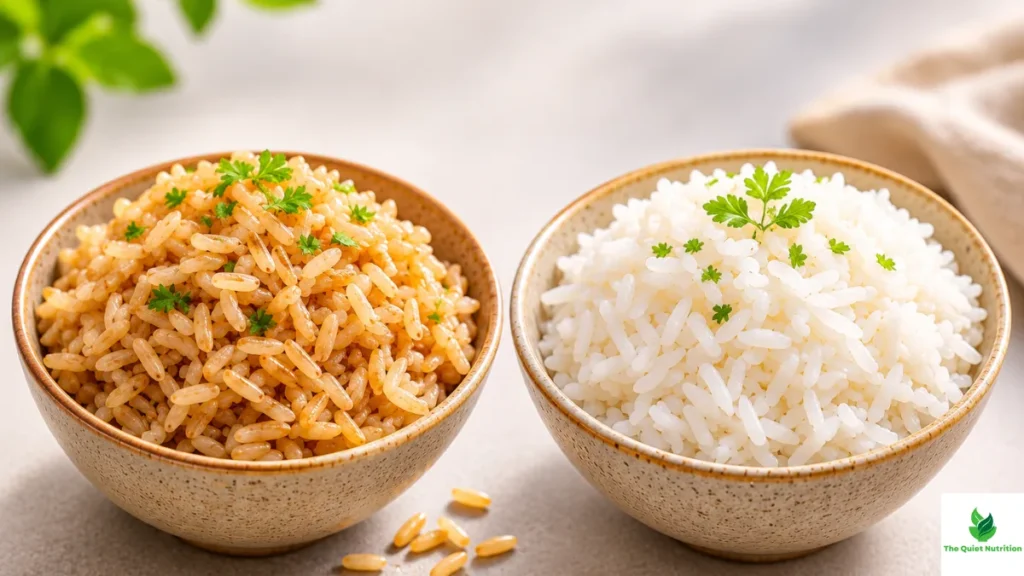
Brown rice is the whole grain with just the inedible hull removed. White rice is the same grain after milling has stripped off the bran and germ, leaving mostly starch. The bran carries most of the fiber and minerals. It also carries a little oil, which is where the crayon smell comes from. More on that in a moment.
Here is how a cooked cup of each compares, using USDA values for long-grain rice:
| Per cooked cup | Brown rice | Enriched white rice |
|---|---|---|
| Calories | 248 | 205 |
| Fiber | 3.2 g | 0.6 g |
| Magnesium | 79 mg | 19 mg |
| Manganese | 2.0 mg | 0.7 mg |
| Folate | 18 mcg | 92 mcg |
Two things are worth reading carefully. First, white rice wins on folate because it’s enriched, with some B vitamins added back after milling. Brown rice doesn’t need enriching, but it doesn’t match that number either.
Second, the calorie gap is partly an illusion of the measuring cup. A cup of cooked brown rice weighs more than a cup of white, about 202 grams against 158. Level the scales and it flips: roughly 123 calories per 100 grams for brown versus 130 for white.
So the real differences are fiber and minerals, and they’re meaningful. Brown rice delivers about five times the fiber per cup and several times the magnesium.
The blood sugar finding, and its fine print
The study most people cite comes from Harvard. Researchers followed nearly 200,000 men and women in three large cohorts for up to 22 years. People eating five or more servings of white rice a week had a 17% higher risk of type 2 diabetes than those eating it less than once a month, while two or more servings of brown rice a week went with an 11% lower risk. The authors estimated that swapping just 50 grams of cooked white rice a day for brown would go with a 16% lower risk. Swapping in whole grains as a group, such as oats, barley and whole wheat, went with a 36% lower risk.
That last number is the quiet headline. Brown rice helped, but other whole grains helped more. Part of the reason is that white rice generally has a higher glycemic index than brown, meaning it raises blood sugar faster.
Now the fine print. This was observational research. People who ate more brown rice were also more physically active, leaner and ate more fruit and vegetables, and lead author Qi Sun acknowledged that brown rice may be a marker of a healthier lifestyle. Few participants ate much brown rice, so the study couldn’t say what happens at much higher intakes.
And brown rice is still rice. If you’re managing diabetes, portion still matters: about a third of a cup of cooked rice counts as one carbohydrate serving, so measure it rather than guess.
The catch most articles skip: arsenic
Rice grows in flooded paddies, which helps it absorb more arsenic from soil and water than other grains do. Arsenic concentrates in the outer layers, so brown rice, with its bran intact, tends to carry more than white.
The topic got fresh attention in July 2026, when Consumer Reports published a new investigation of 52 rice products. It detected inorganic arsenic in every sample, found that brown rice can run higher than white rice of the same type, and that basmati and sushi rice came out lower. By Consumer Reports’ own assessment, more than 40% of the products had enough arsenic that one serving a day, over time, could raise the risk of cancer and type 2 diabetes.
There is a counterweight. Health Canada says arsenic levels in foods sold in Canada are low and have been stable for many years, and when the FDA analyzed more than 1,300 rice samples it concluded the levels weren’t a short-term risk, while advising people to vary their grains. The worry is long-term, high-volume intake, and it matters most for babies and small children.
You don’t have to give up brown rice. A few habits cut the exposure:
- Cook it like pasta. In a test for a BBC program, Queen’s University Belfast researcher Andy Meharg found that cooking rice in five parts water and draining it almost halved the arsenic, and soaking rice overnight cut it by about 80%. Consumer Reports gives the same basic advice: use extra water and discard it.
- Know the trade-off. Draining the water can also wash away some nutrients. A 2020 method of parboiling the rice, draining it, then cooking it in fresh water until absorbed was reported to cut arsenic by more than 50% in brown rice while keeping more nutrients.
- Mix it up. Dartmouth’s arsenic program suggests swapping some brown rice for white, which has about half the arsenic, and rotating in quinoa, bulgur, barley or farro.
- Don’t make rice the default for babies. The FDA noted that rice cereal has no advantage over other grains as a first food.
Back to the crayon smell
Bran contains oil, and oil turns rancid. White rice, with the bran removed, keeps almost indefinitely. Brown rice doesn’t. According to USA Rice, it’s time to toss it after about six months in the pantry, and extension guidance from Utah State notes the shelf life is only a few months, longer in the refrigerator or freezer.
So buy smaller bags than you would for white rice, keep them sealed in a cool spot, or put the opened bag in the freezer. If a bag smells like crayons or paint, trust your nose.
The meal-prep trap, and who should take extra care
Here’s something that applies to all rice but catches brown-rice meal preppers in particular. Raw rice can carry Bacillus cereus spores that survive cooking, and food safety guidance in the UK says cooked rice should be cooled quickly, ideally within an hour, kept in the fridge for no more than one day, and reheated until steaming hot. Rice that’s been contaminated won’t look or smell any different.
A pot cooked on Sunday and eaten through Friday works against that advice. Freezing is the better move: portion it out, cool it fast, and freeze it within an hour of cooking.
Two more groups should think before switching. People with advanced kidney disease are often steered to white rice, because the bran is where most of the potassium and phosphorus sits. DaVita’s dietitians note, though, that the body absorbs only about 40% to 60% of those minerals from plant foods, and that brown rice can fit a kidney diet with attention to portion. That’s a conversation for your kidney dietitian. And as above, parents of babies and toddlers should vary the grains.
Making it worth eating
Brown rice earns its place, with conditions. Buy it fresh and store it cold, soak it if you have the time, cook it in plenty of water, and don’t let it be the only grain you ever eat. Half brown and half white or barley is a perfectly respectable compromise if the chewy texture isn’t for you. Cooking it in broth instead of water helps with flavor.
And the next time you open an old bag and get a whiff of crayons, don’t feel bad about the bin. It’s just the bran, doing what bran does.
This article is for general information and isn’t a substitute for personal medical advice. If you have diabetes or kidney disease, are pregnant, or are feeding rice to a young child, talk to your doctor or a registered dietitian about what’s right for you.
Sources
- Harvard Health Publishing. Brown rice versus white rice: A head-to-head comparison.
- U.S. Department of Agriculture nutrient data for cooked long-grain rice, as reported in Is brown rice or white rice better for you? Dietitians explain, Nutrition Advance and GetFitCraft.
- Sun Q, et al. White rice, brown rice, and risk of type 2 diabetes in US men and women. Archives of Internal Medicine, 2010. Coverage: JAMA Network press release, Baking Business, NBC News/Reuters Health and Nutraceuticals World.
- DaVita. Is Rice an Acceptable Food for a Kidney Diet?, R is for rice, a kidney-friendly staple and Cooking with Rice Tips for a Kidney Diet.
- CP24/CTV News. A new report is warning of heavy levels of arsenic in some rice products. July 9, 2026. (Reporting on a Consumer Reports investigation and Health Canada guidance.)
- U.S. Food and Drug Administration arsenic-in-rice analysis, as reported by The Atlanta Journal-Constitution and NBC News.
- Dartmouth College, Arsenic and You. Arsenic in Rice and Rice Products.
- Meharg A, Queen’s University Belfast, cooking experiments for the BBC, as reported in How we are all cooking rice incorrectly, and a 2020 parboiling study reported by Science Times.
- USA Rice guidance, as reported by TODAY, and Utah State University Extension, Food Storage booklet.
- Royal Borough of Kensington and Chelsea, reproducing UK Food Standards Agency guidance. Rice, poultry and eggs. Freezing advice via The Yorkshire Post.

Aarti Solanki, B.Sc. (Food Science), is a food science writer passionate about making nutrition simple and evidence-based. She creates well-researched, easy-to-understand articles on healthy eating, food science, and nutrition, using information from trusted scientific and public health sources.