
Aging Rarely Announces Itself — It Slips In Quietly
Most people believe aging starts when something obvious happens.
A birthday with a new number.
Gray hair.
Joint pain.
A doctor’s comment.
But biologically, aging doesn’t wait for milestones.
It begins much earlier — often when people still feel energetic, capable, and “young.”
That’s what makes it powerful.
And that’s why most people miss it.
Aging Is a Process, Not an Event
Aging is not something that suddenly turns on.
It’s a gradual shift in priorities inside the body.
Instead of:
- Repairing everything immediately
- Maintaining peak capacity everywhere
The body slowly starts:
- Repairing selectively
- Conserving resources
- Accepting small inefficiencies
These changes often begin in early adulthood.
You don’t feel them — because the body compensates.
Until it can’t.
Biological Aging vs. How Old You Feel
Chronological age is just a number.
Biological age reflects:
- How well tissues repair
- How much muscle is maintained
- How efficiently energy is produced
- How resilient systems remain under stress
Two people of the same age can differ dramatically here.
That difference begins years earlier than most expect.
Research perspectives summarized by institutions like National Institute on Aging emphasize that functional and biological aging often precede visible symptoms by decades.
The First Systems to Age Are the Ones You Don’t Monitor
Aging doesn’t start with wrinkles.
It often starts with:
- Muscle protein turnover slowing
- Metabolic flexibility decreasing
- Hormonal signaling becoming less responsive
- Cellular repair becoming less efficient
These changes are silent.
No pain.
No alarm.
Just small shifts in how the body handles stress, recovery, and maintenance.
Why Muscle Is Often the First Clue
Muscle tissue is metabolically expensive.
When resources are limited or inconsistent, the body trims muscle first.
This can begin surprisingly early.
Signs include:
- Losing strength without weight loss
- Slower recovery from exercise
- Needing more effort to maintain fitness
This isn’t weakness.
It’s resource prioritization.
Guidance summarized by Harvard T.H. Chan School of Public Health highlights muscle preservation as one of the strongest predictors of healthy aging and long-term function.
Metabolism Changes Before Weight Does
Many people assume metabolism only slows when weight increases.
In reality, metabolic changes often occur first.
Early signs:
- Energy dips despite similar habits
- Reduced tolerance for skipped meals
- Blood sugar fluctuations
- Increased fatigue after stress
These are not failures.
They’re signals that the body’s flexibility is narrowing.
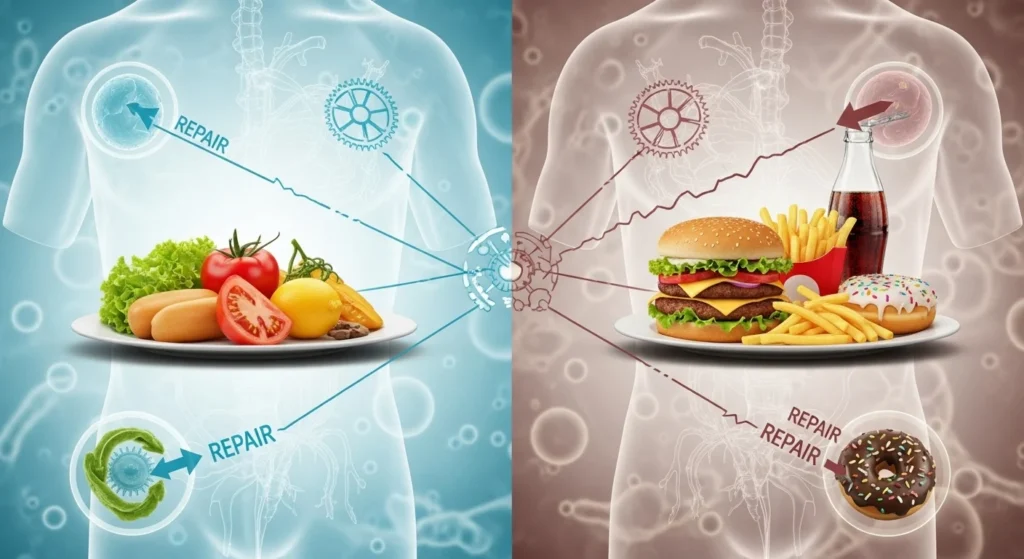
Aging Starts When Repair Can’t Keep Up
Every day, your body experiences damage:
- Cellular stress
- Inflammation
- Mechanical wear
- Oxidative processes
When repair keeps pace, you feel fine.
When repair slows slightly — even by a small margin — aging begins to accumulate.
This is why aging feels sudden later.
It wasn’t sudden.
It was quietly compounding.
Why Lifestyle Factors Accelerate Early Aging
Early aging isn’t caused by age alone.
It’s influenced by:
- Irregular nutrition
- Chronic stress
- Sleep disruption
- Sedentary habits
- Repeated under-recovery
Each factor slightly reduces repair efficiency.
Together, they push aging forward on the timeline.
Public health frameworks referenced by the World Health Organization consistently highlight lifestyle and nutrition as primary determinants of long-term functional aging.
Early Aging vs. Late Awareness
| Early Biological Changes | Late Awareness |
|---|---|
| Reduced repair efficiency | Noticeable fatigue |
| Subtle muscle loss | Strength decline |
| Metabolic shifts | Weight changes |
| Lower resilience | Slower recovery |
| Quiet adaptation | “Feeling old” |
By the time most people notice aging, it’s already been underway for years.
Real-Life Example: “Nothing Changed — But Everything Feels Harder”
Many people in their 30s or 40s say:
“I didn’t change anything… but my body did.”
Often, what changed was not effort — but margin.
The body had less room for:
- Missed meals
- Poor sleep
- Chronic stress
- Nutrient gaps
The compensation phase ended.
Awareness began.
Hidden Mistakes That Make Aging Start Earlier
Even motivated people accelerate aging unintentionally.
Common mistakes:
- Treating under-eating as discipline
- Skipping recovery
- Ignoring declining appetite
- Assuming youth provides protection
- Waiting for symptoms to act
These don’t cause immediate damage.
They shorten the buffer.
Why This Matters Today
Modern life encourages habits that:
- Reduce recovery
- Disrupt nutrition
- Increase stress
At the same time, people are living longer.
This creates a gap:
- Longer lifespan
- Shorter healthspan
Understanding when aging really starts allows earlier support — not late correction.
What You Can Do When You Know Aging Starts Early
The goal isn’t fear.
It’s foresight.
Actionable steps:
- Prioritize consistent nutrition
- Preserve muscle early
- Respect recovery
- Avoid chronic under-fueling
- Build habits you can sustain
Early support delays later decline.
Emotional Relief: Early Aging Is Not a Sentence
Learning that aging starts early can feel unsettling.
But it’s also empowering.
If aging began quietly, it can also be slowed quietly.
Long before anything feels wrong.
Key Takeaways
- Aging is a gradual process that starts earlier than most realize
- Early aging happens silently through reduced repair and resilience
- Muscle and metabolism often change first
- Lifestyle and nutrition strongly influence timing
- Early awareness allows long-term preservation
Frequently Asked Questions
1. Does aging really start in your 20s or 30s?
Biological changes can begin early, even if you feel healthy and energetic.
2. Why don’t we feel early aging?
The body compensates until repair can no longer keep up.
3. Is early aging reversible?
Many early changes respond positively to improved support and consistency.
4. Is aging mostly genetic?
Genetics matter, but lifestyle and nutrition strongly influence timing and speed.
5. Is it too late to slow aging if I’m older?
No. The body responds at any age when support improves.
Aging Isn’t Sudden — Awareness Is
Aging doesn’t suddenly arrive.
It unfolds quietly, long before it’s noticed.
Understanding that truth shifts the goal from fighting aging
to supporting the body early enough that aging stays gradual.
And that changes everything.
Disclaimer: This article is for general educational purposes and does not replace personalized medical or health advice.







Pingback: How Nutrition Shapes the Body’s Baseline Health — The Invisible Foundation That Determines How You Feel Every Day