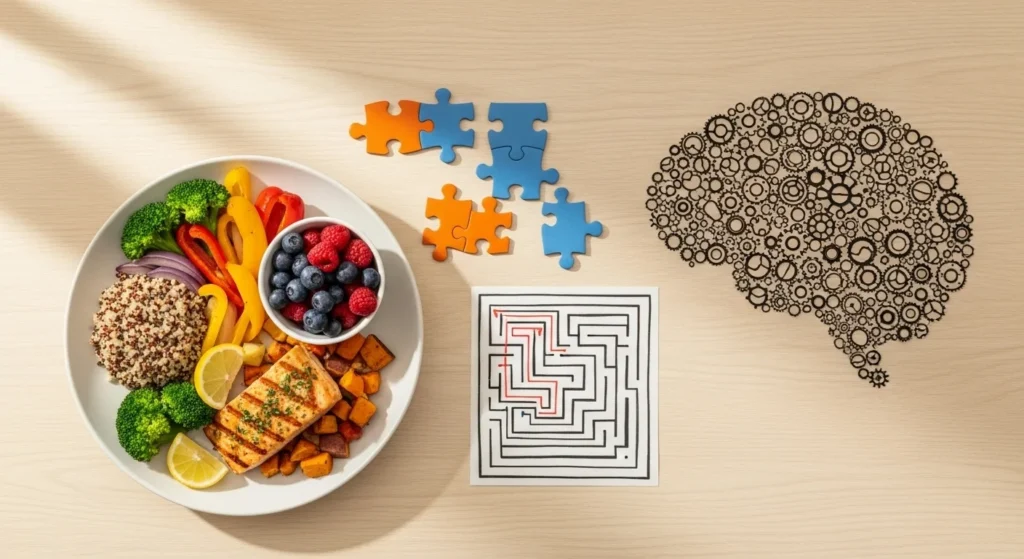
The Invisible Reason Some Days Feel Mentally Harder Than Others
Have you ever noticed this?
On some days, decisions feel simple.
You can:
- stay calm
- focus easily
- respond thoughtfully
- avoid impulsive choices
And then on other days…
Everything feels harder.
Small choices become exhausting.
You feel emotionally reactive.
You crave comfort.
You procrastinate.
Most people assume it’s personality or stress.
But often, it’s something quieter:
Your brain’s decision-making ability depends heavily on stable nourishment.
Stable meals don’t just support the body…
They support cognitive control.
And that may be one of the most underrated nutrition truths.
Decision-Making Is a Biological Process, Not Just Willpower
We like to think decisions come from logic alone.
But decision-making is deeply physical.
It depends on brain systems responsible for:
- impulse control
- attention
- emotional regulation
- planning
- working memory
These functions occur mainly in the prefrontal cortex.
And that region is extremely energy-demanding.
When fuel is unstable, decision quality drops.
Your brain cannot “power through” biology.
The Brain Needs Steady Fuel to Think Clearly
Your brain is only about 2% of body weight…
But it uses roughly 20% of your resting energy.
That’s enormous.
Unlike muscles, the brain can’t store much energy.
It relies on a constant, steady supply of glucose and nutrients.
Stable meals provide:
- predictable energy
- consistent neurotransmitter building blocks
- calmer stress hormone output
Irregular meals create cognitive instability.
Blood Sugar Swings Directly Affect Mental Control
One of the biggest nutritional influences on decision-making is blood sugar.
When glucose drops too low, the brain shifts into emergency mode.
Symptoms include:
- irritability
- poor patience
- impulsive cravings
- mental fog
- emotional reactivity
That’s why people make worse choices when hungry.
It’s not a moral failure.
It’s a fuel shortage.
Stable meals prevent those crashes.
Real-Life Example: The “Afternoon Impulse Spiral”
This is incredibly common:
Someone skips breakfast.
Has coffee.
Eats a light lunch.
By mid-afternoon:
- focus collapses
- mood drops
- cravings spike
- productivity disappears
Then suddenly:
- junk food feels urgent
- scrolling becomes addictive
- emotional decisions increase
That’s not weakness.
That’s unstable fuel impacting executive function.
Stable meals protect the brain’s ability to pause and choose wisely.
Stable Eating Supports the Prefrontal Cortex
The prefrontal cortex is your brain’s “CEO.”
It helps you:
- think ahead
- regulate emotions
- resist impulsive urges
- make long-term choices
But it is sensitive.
When energy is unstable, the brain hands control to survival regions.
That means more reactive decision-making:
- quick comfort choices
- short-term rewards
- reduced patience
Stable meals keep the CEO online.
Comparison Table: Stable Meals vs Unstable Eating for Decision-Making
| Eating Pattern | Brain Effect | Decision Outcome |
|---|---|---|
| Regular balanced meals | Steady glucose + calm focus | Clearer choices, better control |
| Skipping meals often | Energy drops + stress rises | Impulsive decisions |
| Sugar-heavy snacking | Spike then crash | Brain fog, emotional eating |
| Protein + fiber meals | Slow sustained fuel | Better patience, planning |
| Late irregular eating | Poor sleep + cortisol shifts | Reduced mental clarity |
Nutrients That Improve Cognitive Control Over Time
Stable meals don’t only stabilize glucose…
They provide consistent nutrients for brain chemistry.
Key decision-support nutrients include:
- Protein → neurotransmitter building blocks
- Omega-3 fats → brain cell communication
- Magnesium → calming neural signaling
- B vitamins → energy metabolism in neurons
- Iron → oxygen delivery and dopamine pathways
Poor nutrition reduces cognitive endurance.
Good nutrition builds mental resilience slowly.
Hidden Tip: Most “Low Motivation” Days Are Energy Instability Days
People often say:
“I just wasn’t disciplined today.”
But discipline is harder when the brain is under-fueled.
Stable meals reduce:
- internal stress
- dopamine chasing
- emotional volatility
The result is a calmer brain that makes better choices naturally.
Nutrition shapes behavior more than people realize.
Common Mistakes That Undermine Decision-Making
Mistakes to avoid:
- skipping meals to “save calories”
- relying on caffeine instead of food
- eating mostly refined carbs without protein
- long gaps followed by overeating
- inconsistent daily meal timing
These habits create decision fatigue faster.
Actionable Steps: Eating for Better Daily Decisions
You don’t need a perfect diet.
You need stable anchors.
1. Eat a Protein-Rich First Meal
This reduces morning glucose volatility.
Examples:
- eggs
- Greek yogurt
- tofu scramble
- oats with nuts
2. Build Balanced Meals, Not Snack Cycles
A stable plate includes:
- protein
- fiber
- healthy fat
- slow carbs
3. Avoid the “Emergency Hunger Zone”
Don’t wait until you’re starving.
That’s when the brain becomes reactive.
4. Hydrate Early
Even mild dehydration worsens mental clarity and patience.
5. Keep Meal Timing Predictable
Regular rhythms help hormones and focus.
Why This Matters Today (Evergreen Truth)
Modern life demands constant decisions:
- work tasks
- notifications
- relationships
- money choices
- health habits
Decision fatigue is real.
Stable meals reduce cognitive load by supporting the brain’s control centers.
In a world of mental overload…
Nutrition stability is quiet mental protection.
Key Takeaways
- Decision-making depends on brain energy stability, not just willpower
- Blood sugar crashes increase impulsivity and emotional choices
- Stable meals keep the prefrontal cortex functioning effectively
- Protein, fiber, and healthy fats support calm cognition
- Consistent eating rhythms improve clarity over time
FAQ: Stable Meals and Decision-Making
1. Can skipping meals really affect my choices?
Yes. Hunger reduces executive function and increases impulsivity.
2. Why do I crave junk food when stressed?
Stress plus unstable fuel activates survival reward pathways.
3. What’s the best meal pattern for mental clarity?
Regular meals with protein, fiber, and slow carbs.
4. Does breakfast improve decision-making?
For many people, yes. It provides an early stable fuel signal for the brain.
5. How fast do stable meals help mentally?
Many people notice improved mood and focus within 1–2 weeks of consistent meal structure.
Conclusion: Clear Decisions Start With Stable Fuel
Your best decisions aren’t just about mindset.
They’re about physiology.
The brain is an energy-demanding organ.
When meals are stable, the brain stays steady.
When fuel is chaotic, thinking becomes reactive.
So if life feels mentally harder than it should…
Don’t only ask what’s wrong with your motivation.
Ask a quieter, kinder question:
Is my brain properly fueled today?
Because stable meals don’t just support health…
They support clarity, patience, and better choices.


Pingback: Why the Brain Responds Poorly to Extreme Diets — The Hidden Mental Cost of Restriction