
There’s a version of a bad day that has nothing to do with what actually happened. Nothing went wrong, exactly. You just couldn’t think straight, couldn’t hold your attention on one task, and felt vaguely irritable or flat without any real reason for it. Ask someone to describe that kind of day and they’ll usually reach for three separate words: foggy, unfocused, and off. Three different complaints, treated as three different problems.
They’re usually not separate problems. Mental clarity, sustained focus, and mood are three different symptoms of the same underlying variable: how stable your blood sugar has been over the last few hours. Treat them as one connected system, and a surprising number of “bad days” start to look a lot more predictable — and a lot more fixable.
One Fuel Line, Three Symptoms
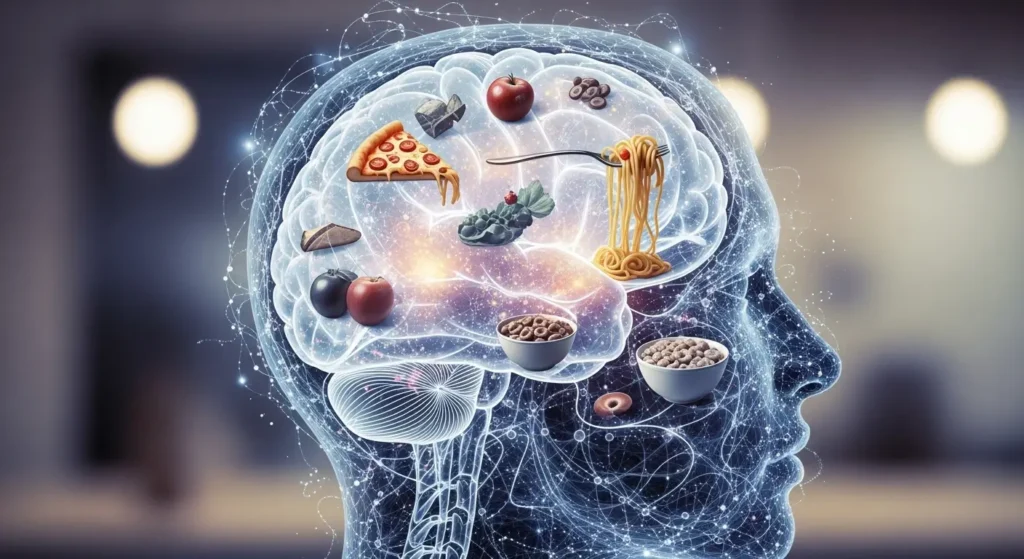
It helps to think of blood sugar stability less like a single health metric and more like a power supply feeding three different systems at once. Clarity, focus, and mood all draw from that same supply, which is why they tend to rise and fall together rather than independently.
This isn’t a loose metaphor — it shows up directly in controlled research. Studies on glycemic load, a measure of how much and how fast a food raises blood sugar, consistently find effects across all three domains rather than just one. That’s a meaningful detail, because it means the “can’t focus” version of a bad afternoon and the “in a bad mood” version often share the exact same root cause, even though they feel like completely different experiences from the inside.
What Instability Does to Focus
Start with attention, because it’s the domain researchers have studied most directly using controlled feeding experiments.
A 2022 meta-analysis pulled together findings across multiple studies comparing low-glycemic-load and high-glycemic-load breakfasts, specifically looking at how each affected cognitive performance over the following hours. The results showed that meals with a lower glycemic load predicted meaningfully better sustained attention, particularly on harder, more demanding tasks — the kind of focused effort a difficult work project or a long meeting actually requires. The protective effect wasn’t limited to the first hour after eating, either: a lower-glycemic-load breakfast appeared to guard against a decline in episodic memory and attention accuracy well into the later postprandial period, roughly two hours or more after the meal.
In practice, this maps directly onto a familiar experience. A pastry and coffee might feel perfectly fine for the first thirty minutes. But if attention specifically degrades in the hour or two after eating — rather than staying flat or improving — that’s consistent with what a fast, unstable glucose response does to sustained focus, according to this research.
What Instability Does to Mood
The mood connection is where the research gets more striking, because the effect sizes are large enough to be hard to dismiss as background noise.
In a controlled feeding study published in the journal Appetite, researchers put 82 healthy adults through a randomized crossover trial, feeding each person both a high-glycemic-load diet and a low-glycemic-load diet for several weeks apiece, with the two diets otherwise matched for calories and macronutrients. The primary finding was direct: compared to the low-glycemic-load diet, the high-glycemic-load diet produced significantly higher scores on standardized mood questionnaires for total mood disturbance, fatigue and inertia, and depressive symptoms. A separate review of this same research area, published in the journal Metabolism, summarized the magnitude of that difference in concrete terms — the high-glycemic-load diet was linked to roughly a third higher depressive-symptom score, more than half again as much total mood disturbance, and about a quarter more fatigue and inertia compared to the lower-glycemic-load diet.
That same review pointed to a related finding on breakfast composition specifically: in a study of young adult men, breakfasts weighted heavily toward carbohydrates with very little protein were linked to an increase in adverse social behaviors compared to breakfasts with a more balanced carbohydrate-to-protein ratio. Put together, this body of research suggests mood isn’t just loosely associated with diet in some vague, hand-wavy way — a meal’s blood sugar profile appears to have a measurable, same-day effect on how irritable, fatigued, or emotionally flat a person reports feeling.
Why “Stability” Matters More Than “Low”
It’s tempting to hear all this and conclude the goal is simply eating less sugar. That’s part of it, but it misses the more useful framing that researchers and clinicians increasingly use: stability, not just avoidance.
In diabetes care, this idea has a name — “time in range” — which refers to the percentage of the day someone’s blood sugar spends inside a healthy target window, rather than swinging up into a spike or down into a dip. Cleveland Clinic describes this as one of the most informative modern measures of glucose control, precisely because it captures the full pattern of a day rather than a single average number that can hide a lot of volatile swings underneath it. A person can have a perfectly normal average blood sugar reading while still spending large chunks of the day swinging between highs and lows — and it’s that swinging, not the average, that tends to track most closely with how someone feels hour to hour.
This reframing matters for anyone without diabetes, too. The goal isn’t zero carbohydrates or a diet built entirely around avoiding sugar. It’s minimizing the spike-and-crash pattern that pulls clarity, focus, and mood down together. Harvard Health has described this directly: eating balanced meals and snacks that combine protein, fat, and carbohydrates helps maintain steadier blood sugar levels throughout the day, which in turn keeps energy levels — and by extension, mental clarity — far more consistent than relying on fast-digesting carbohydrates eaten on their own.
Building a Day That Protects All Three at Once
Because clarity, focus, and mood are drawing from the same underlying supply, the fixes overlap almost completely. You don’t need three separate strategies — you need one strategy for blood sugar stability that happens to protect all three outcomes simultaneously.
Build meals around a combination, not a single food group. Pairing carbohydrates with protein, fat, or fiber slows the rate at which glucose enters the bloodstream, which is the mechanism behind nearly every finding above — steadier absorption, steadier mood, steadier attention.
Pay attention to the two-hour mark, not just the first bite. Because the research shows effects on attention and memory extending well past the first hour after eating, a meal that feels fine going down but leaves you foggy ninety minutes later is worth reconsidering, not explaining away as unrelated fatigue.
Treat a irritable mood as a data point, not just a feeling. Given how directly glycemic load has been linked to fatigue, mood disturbance, and depressive-symptom scores in controlled research, an unexplained dip in mood is worth mentally cross-referencing against your last meal before assuming it’s purely situational.
Don’t chase “zero sugar” — chase “no big swings.” The time-in-range concept is a useful mental model even without a glucose monitor: the goal is avoiding the spike-and-crash cycle, not eliminating carbohydrates from your life entirely.
Notice patterns across a week, not a single day. One high-glycemic meal isn’t going to derail your mood or focus in a lasting way. A pattern of relying on fast-digesting carbohydrates as your daily default is what the research consistently links to worse outcomes across all three domains.
The Bigger Picture
It’s easy to treat a foggy head, a wandering mind, and a short temper as three unrelated complaints — one for a doctor, one for a productivity app, one for nobody in particular. The research suggests a simpler, more useful story: they’re often three windows into the same variable, and that variable responds directly to how your last meal was built. Stabilize the fuel line, and there’s a good chance all three symptoms start improving together, because they were never really separate problems to begin with.
Sources
- PMC (National Institutes of Health) – Breymeyer et al., “Subjective Mood and Energy Levels of Healthy Weight and Overweight/Obese Healthy Adults on High- and Low-Glycemic Load Experimental Diets,” Appetite (2016)
- ScienceDirect – The Impact of Glycaemic Load on Cognitive Performance: A Meta-Analysis and Guiding Principles for Future Research (2022)
- Cleveland Clinic – Time in Range (TIR) for Diabetes: What It Is & Target
- Harvard Health – The Case for Watching Your Blood Sugar
- Metabolism – Clinical and Experimental (ScienceDirect) – Continuous Glucose Monitoring in a Healthy Population: Understanding the Post-Prandial Glycemic Response in Individuals Without Diabetes Mellitus

Aarti Solanki, B.Sc. (Food Science), is a food science writer passionate about making nutrition simple and evidence-based. She creates well-researched, easy-to-understand articles on healthy eating, food science, and nutrition, using information from trusted scientific and public health sources.







Pingback: What Food Labels Are Really Designed to Do — And the Truth They Never Promise You
Pingback: How Daily Food Choices Quietly Shape Your Long-Term Health (More Than You Realize)
Pingback: Why Your Body Treats Food as Information, Not Just Fuel — The Hidden Signals That Shape Your Health Every Day
Pingback: How the Body Uses Food to Maintain Balance — The Quiet Intelligence Behind Every Meal
Pingback: Why Your Brain Loses Focus Even When You Eat “Healthy”
Pingback: Why Your Brain Runs Out Before You Do — The Nutrition–Cognition Connection
Pingback: Your Body Never Forgets What You Eat — How Nutritional Memory Shapes Health Over Time
Pingback: The Quiet Power of Boring Meals: How Routine Builds Real Health
Pingback: How Your Eating Schedule Quietly Controls Energy, Sleep, and Hunger
Pingback: How Nutrition Affects Mental Processing Speed — The Hidden Fuel Behind a Faster Brain
Pingback: Why Oranges Support Your Immune System So Well (The Science Behind This Everyday Fruit)
Pingback: What Really Happens to Your Body When You Eat Apples Every Day (Most People Don’t Expect This)
Pingback: Why Pineapple Helps Digestion More Than You Think (The Science-Backed Benefits Inside This Tropical Fruit)
Pingback: Guava Benefits Explained: What Happens When You Eat It Weekly
Pingback: Strawberries Are More Powerful Than You Think—Here’s What They Do Inside Your Body