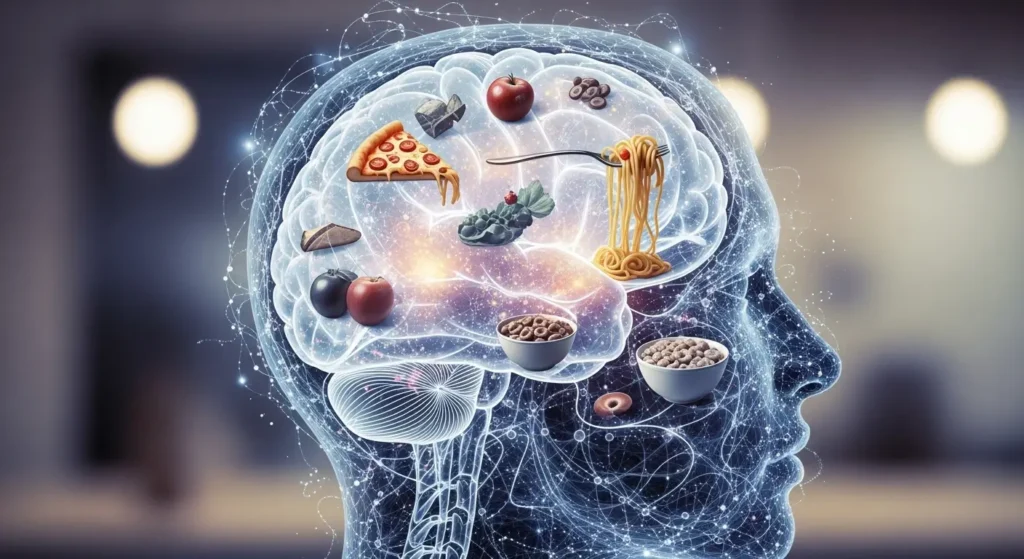
Mental fog rarely announces itself with a single cause. It builds slowly, shaped by years of small daily choices rather than any one bad meal. A growing body of long-term research on diet and cognition shows that what you eat consistently over months and years quietly rewires how efficiently your brain functions — sometimes by years’ worth of measurable difference.
Diet Patterns, Not Single Foods, Predict Brain Outcomes
The strongest research in this space doesn’t focus on individual “superfoods.” It focuses on overall dietary patterns sustained over time — particularly the Mediterranean diet, the DASH diet, and a brain-specific hybrid called the MIND diet. A narrative review synthesizing 18 studies conducted between 2013 and 2023 found that the Mediterranean diet showed the most consistent cognitive benefits among middle-aged and older adults, including improved memory and processing speed, with the potential to delay cognitive aging by as much as 3.5 years.
The Effect Shows Up as a Measurable Age Gap
One of the more striking findings comes from long-term observational research on the MIND diet specifically. Participants who adhered more closely to the diet showed slower cognitive decline and better memory function over time — scoring the equivalent of 7.5 years younger in cognitive performance compared to those with poor adherence. That’s not a subjective sense of feeling sharper; it’s a measurable gap in cognitive test performance tied directly to years of dietary pattern.
Even Modest Diet Changes Show Up on Brain Scans and Tests
This isn’t limited to elderly populations already showing decline. A six-month randomized controlled trial in healthy older adults found that following a Mediterranean dietary pattern produced measurable improvements across a battery of cognitive tests compared to a habitual diet control group. Separately, a large prospective study tracking over 6,600 adults with cardiovascular risk factors found that stronger adherence to the Mediterranean diet was associated with better outcomes on general cognitive screening and executive function tests over a two-year follow-up period, while MIND diet adherence was specifically linked to improvements in working memory.
The Longer the Adherence, the Bigger the Protective Effect
Time appears to matter as much as the diet itself. One long-term study following participants for 12 years found that strong adherence to the MIND diet was associated with as much as a 53 percent lower risk of cognitive decline. This kind of sustained protective effect doesn’t show up in short-term studies — it only becomes visible when researchers track eating patterns across a meaningful stretch of a person’s life, reinforcing that brain efficiency responds to consistency over time rather than any single dietary decision.
What These Diets Actually Deliver to Your Brain
The common thread across the Mediterranean, DASH, and MIND diets is a shared nutrient profile: high intake of monounsaturated fats from olive oil, omega-3 fatty acids from fish, antioxidants and flavonoids from leafy greens and berries, and a range of B vitamins, vitamin E, and folate — alongside low intake of red meat, dairy, and processed foods. Researchers believe these nutrients support cognitive function through several overlapping mechanisms: reducing chronic inflammation, lowering oxidative stress, and supporting the biological processes that maintain brain structure over time.
Berries and Leafy Greens Carry Outsized Weight
Within these broader dietary patterns, certain foods appear to matter more than others for brain-specific benefits. The MIND diet’s particular emphasis on berries and dark green leafy vegetables is backed by findings showing that people who consumed more berries had significantly slower rates of cognitive decline, while a separate large study found that adults who ate more dark-green vegetables scored notably higher on memory-related cognitive tests. These foods are especially rich in anthocyanidins, flavonoid compounds with strong antioxidant and anti-inflammatory properties tied to brain health.
Mental Clarity and Mental Health Are More Connected Than They Seem
The relationship between long-term diet and brain function isn’t limited to memory and cognitive decline in older age. A systematic review of 25 clinical nutrition trials across the lifespan found that Mediterranean-style dietary patterns reduced depressive symptoms by roughly 32 to 45 percent across most studies — an effect researchers attribute to the diet’s polyphenols, omega-3 fatty acids, and fiber lowering systemic inflammation, supporting gut microbial diversity, and improving the brain’s regulation of dopamine and serotonin. The same research notes that reducing sugar and heavily processed foods appears to help restore mental clarity, suggesting the quiet fog many people attribute to stress or poor sleep may also carry a dietary component.
The Gut-Brain Connection Adds Another Layer
Emerging research on the gut-brain axis offers a mechanistic explanation for why dietary patterns matter so much more than individual nutrients. Diets rich in antioxidants and anti-inflammatory compounds appear to influence cognitive health partly through their effect on gut bacteria composition, which in turn interacts with the brain through inflammatory and neurochemical pathways. This helps explain why an overall eating pattern sustained for years tends to outperform any single “brain food” eaten occasionally — the benefit compounds through a biological system, not a single nutrient hit.
The Research Isn’t Perfectly Consistent — And That’s Worth Knowing
It’s worth noting that not every study finds the same effect size, and some research on individual diets like DASH has found no measurable link to cognitive health in certain populations. Researchers attribute this variability to differences in study design, adherence measurement, and population characteristics. The overall pattern across the research remains consistent even when individual studies diverge, but the science is still refining exactly how strong these effects are across different groups of people.
The Bottom Line
Mental clarity isn’t something you can eat your way into overnight, and no single meal will reverse years of dietary habits. But the long-term research is remarkably consistent on one point: sustained dietary patterns rich in vegetables, berries, fish, and healthy fats — and low in processed foods and added sugar — are associated with measurably better cognitive performance over years and decades. Brain efficiency, it turns out, is less about any single choice and more about what you consistently choose to eat, meal after meal, for years at a time.
Sources
- MDPI (Nutrients) – Dietary Patterns and Brain Health in Middle-Aged and Older Adults: A Narrative Review
- PMC (NIH) – Effects of the MIND Diet on the Cognitive Function of Older Adults: A Systematic Review
- MDPI – Dietary Patterns and Mental Health Across the Lifespan: A Systematic Review of Randomized Clinical Trials
- PMC (NIH) – The Mediterranean Diet and Cognitive Function Among Healthy Older Adults (MedLey Study)
- PMC (NIH) – Mediterranean, DASH, and MIND Dietary Patterns and Cognitive Function: 2-Year Longitudinal Changes
- PMC (NIH) – The Intricate Interplay Between Dietary Habits and Cognitive Function: Insights from the Gut-Brain Axis
- Nature Scientific Reports – The Long-Term Neuroprotective Effect of MIND and Mediterranean Diet on Patients with Alzheimer’s Disease

Aarti Solanki, B.Sc. (Food Science), is a food science writer passionate about making nutrition simple and evidence-based. She creates well-researched, easy-to-understand articles on healthy eating, food science, and nutrition, using information from trusted scientific and public health sources.