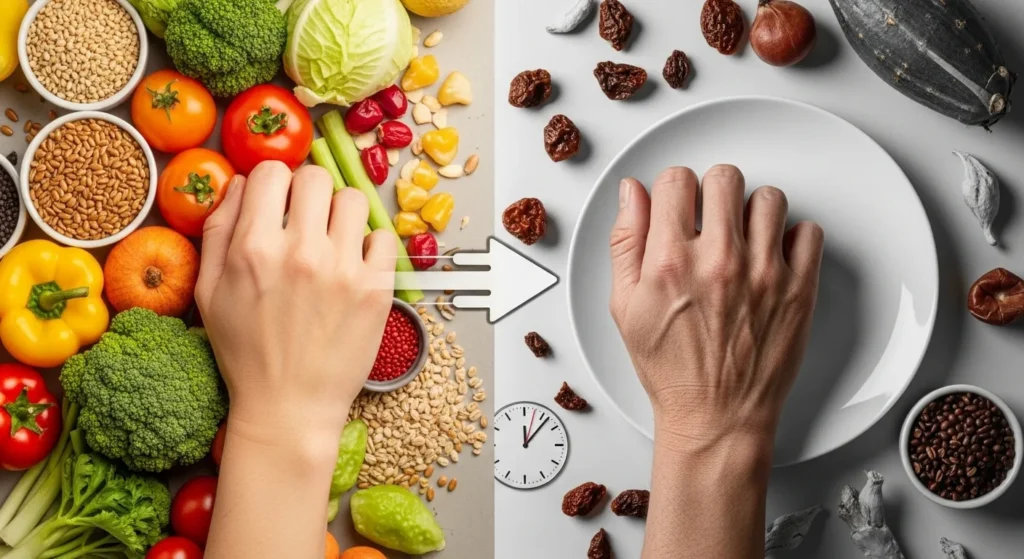
Aging Often Feels Sudden — But the Trigger Starts Much Earlier
Most people don’t wake up one day and feel old.
They notice it slowly:
- Recovery takes longer
- Energy feels unreliable
- Muscle seems harder to keep
- Small stresses feel bigger
The common explanation is age.
But biologically, something else is often at work first:
Nutritional stress.
Not starvation.
Not extreme dieting.
Just long-term under-support.
When the body operates under nutritional stress, aging doesn’t simply continue — it accelerates.
What Nutritional Stress Really Means (And Why It’s So Common)
Nutritional stress isn’t about eating “bad food” occasionally.
It’s about resource uncertainty.
It happens when:
- Meals are skipped regularly
- Protein intake is inconsistent
- Calories are chronically too low
- Micronutrients fluctuate week to week
- Stress suppresses appetite
Calories may still exist.
But availability for repair does not.
This kind of stress is incredibly common — especially with busy schedules, dieting culture, and modern convenience foods.
The Body’s First Response to Nutritional Stress: Survival Mode
Your body doesn’t panic under nutritional stress.
It adapts.
It switches priorities:
- Preserve vital organs
- Reduce long-term repair
- Limit muscle maintenance
- Slow non-essential renewal
This is an intelligent response.
But when survival mode lasts too long, it comes at a cost.
That cost is accelerated aging.
Why Survival Mode Looks Like Aging
When nutrition is unreliable, the body conserves energy by:
- Breaking down muscle tissue
- Slowing metabolic rate
- Reducing hormone output
- Allowing low-grade inflammation to persist
Over time, these adaptations appear as:
- Sarcopenia (muscle loss)
- Fatigue
- Stiff joints
- Slower healing
- Reduced resilience
None happen overnight.
They accumulate quietly.
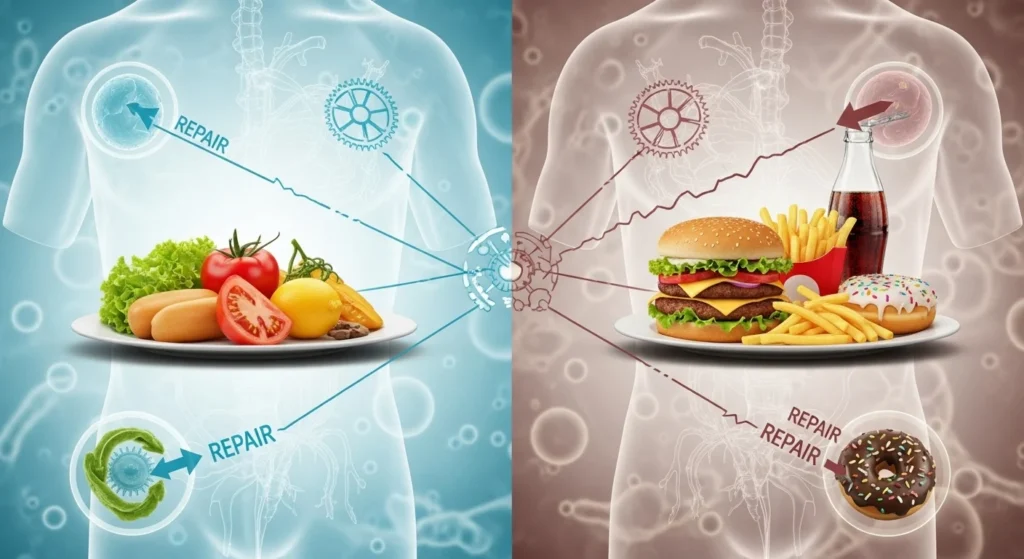
Nutritional Stress Disrupts the Body’s Repair Timeline
It requires:
- Protein
- Micronutrients
- Energy
- Predictability
Under nutritional stress, repair gets delayed.
Delayed repair leads to:
- Accumulated tissue damage
- Lingering inflammation
- Structural weakness
Research perspectives summarized by National Institute on Aging consistently show that inadequate nutrition accelerates functional decline and reduces recovery capacity with age.
Repair delayed is repair denied — eventually.
Protein Stress: The Fastest Way to Age Faster
Protein is one of the first things the body sacrifices under stress.
When protein intake is inconsistent:
- Muscle breakdown increases
- Immune repair slows
- Enzyme production declines
Many adults unintentionally eat less protein as they age, not more.
Nutrition research from Harvard T.H. Chan School of Public Health highlights adequate protein intake as essential for preserving muscle, metabolism, and healthy aging.
Protein stress doesn’t hurt immediately.
It erodes strength quietly.
Micronutrient Stress: The Invisible Aging Accelerator
Micronutrients don’t announce their absence.
But without them:
- DNA repair slows
- Collagen production weakens
- Cellular energy drops
- Inflammation lingers
Common stress-related deficiencies include:
- Magnesium
- Zinc
- B vitamins
- Iron (especially in women)
These deficiencies often coexist with “normal” bloodwork — making them easy to miss.
The body survives.
But it ages faster.
Inflammation Thrives Under Nutritional Stress
Inflammation is supposed to resolve.
Under nutritional stress, it doesn’t.
Poor nutrient availability:
- Impairs antioxidant defenses
- Delays inflammatory resolution
- Keeps tissues in a semi-repaired state
This creates chronic low-grade inflammation, one of the strongest drivers of accelerated aging.
Food patterns — not single foods — determine whether inflammation resolves or lingers.
Aging With Stability vs. Aging Under Nutritional Stress
| Stable Nutrition | Chronic Nutritional Stress |
|---|---|
| Efficient repair | Delayed repair |
| Preserved muscle | Gradual muscle loss |
| Flexible metabolism | Slowed metabolism |
| Lower inflammation | Persistent inflammation |
| Resilience over time | Fragility over time |
The difference is not age.
It’s nutritional security.
Real-Life Example: Why “Healthy” People Burn Out
Many people aging faster under nutritional stress look healthy on the outside.
They:
- Exercise regularly
- Eat “clean” foods
- Maintain weight
But they also:
- Skip meals
- Under-eat protein
- Fear calories
- Push through fatigue
Over time, they feel worn down.
Not because they’re unhealthy — but because they’re under-fueled.
Hidden Habits That Create Chronic Nutritional Stress
Even well-intentioned habits can backfire.
Common mistakes:
- Skipping meals to “reset”
- Eating lightly during stress
- Over-relying on supplements
- Treating hunger as weakness
- Restricting fat unnecessarily
None feel dangerous.
Together, they keep the body in survival mode.
Why This Matters Today
Modern life creates constant stress:
- Mental load
- Irregular schedules
- Convenience food reliance
At the same time, diet culture encourages under-eating.
This combination makes nutritional stress widespread.
Public health guidance from the World Health Organization consistently emphasizes adequate, regular nutrition as a foundation for healthy aging and resilience.
Yet consistency is what many people lose first.
Actionable Ways to Reduce Nutritional Stress
You don’t need more discipline.
You need more support.
Focus on:
- Eating regularly, even when busy
- Protein at every main meal
- Avoiding long fasting gaps unintentionally
- Fueling recovery after stress or exercise
- Choosing consistency over restriction
The body relaxes when food becomes predictable.
Emotional Relief: Aging Faster Is Not a Personal Failure
Many people blame themselves for aging changes.
But accelerated aging is often the result of:
- Chronic under-fueling
- Nutrient insecurity
- Survival adaptation
Not laziness.
Not lack of willpower.
When nutritional stress is removed, the body shifts out of survival — and aging slows.
Key Takeaways
- Nutritional stress pushes the body into survival mode
- Survival mode accelerates aging and slows repair
- Protein and micronutrient gaps are major drivers
- Inflammation worsens when nutrition is unstable
- Consistent nourishment restores resilience over time
Frequently Asked Questions
1. Can nutritional stress really speed up aging?
Yes. It limits repair, increases inflammation, and accelerates tissue breakdown.
2. Is eating fewer calories always bad for aging?
Chronic under-eating without nutrient support increases aging risk.
3. Do supplements fix nutritional stress?
They can help gaps, but consistent food intake matters more.
4. Why does recovery worsen under stress?
Stress increases nutrient demand while appetite often drops.
5. Is it too late to reverse nutritional stress?
No. The body responds positively once support becomes consistent.
Aging Faster Is Often a Signal — Not a Sentence
The body ages fastest when it’s unsure resources will arrive.
When nutrition becomes reliable, the body does something remarkable:
It stops rushing toward survival
and starts investing in maintenance again.
That shift doesn’t stop aging —
but it slows it to the pace it was meant to take.
Disclaimer: This article is for general educational purposes and does not replace personalized medical or nutritional advice.







Pingback: Why Aging Starts Earlier Than Most People Think — The Quiet Changes That Begin Long Before You Feel “Old”