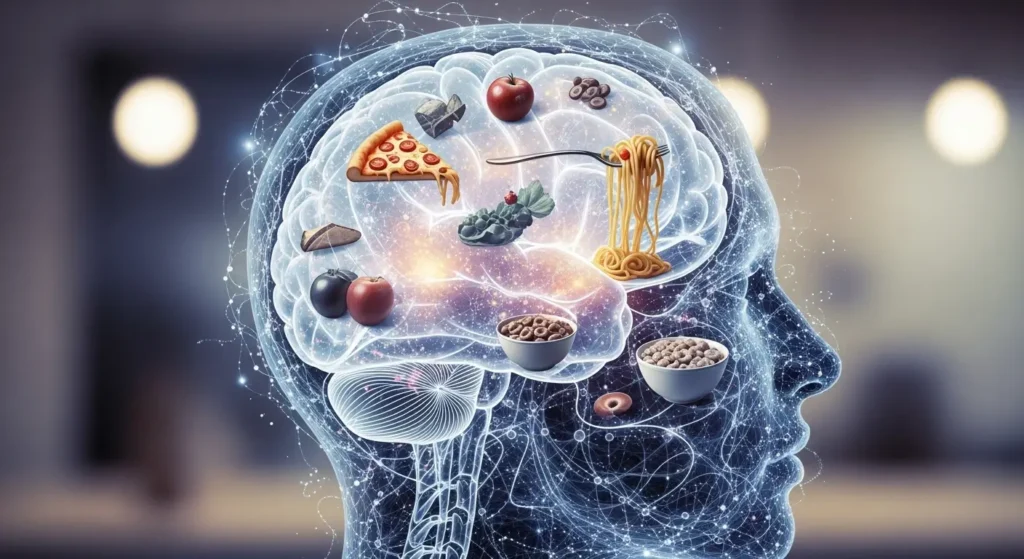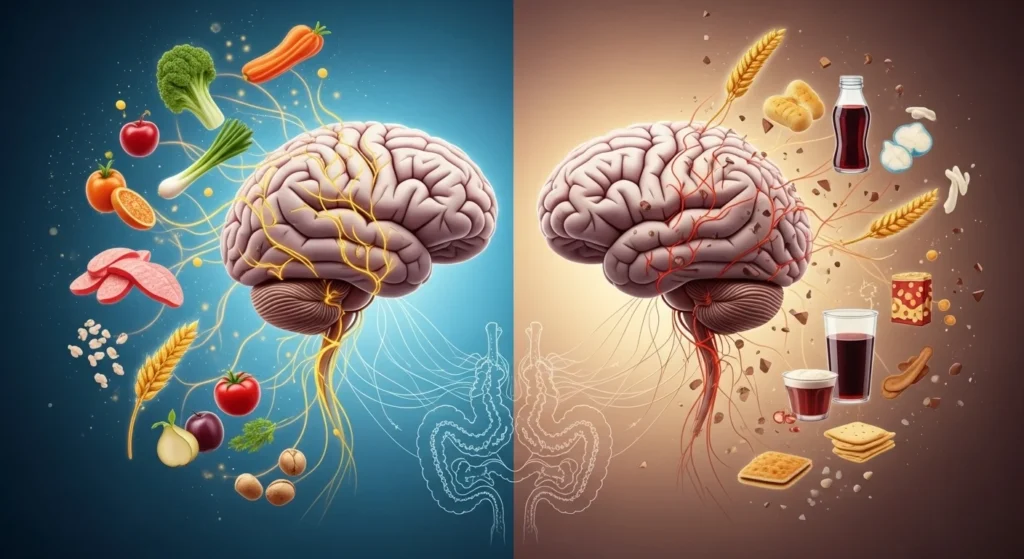
The Mental Breakdown That Often Starts With Food
Most people think nutritional stress shows up in the body first.
Weight changes.
Weakness.
Obvious deficiency symptoms.
But very often, the first place nutrition stress appears…
Is the brain.
You may notice:
- brain fog
- irritability
- low motivation
- anxious restlessness
- intense cravings
- poor concentration
And you might assume it’s just stress or lack of sleep.
But sometimes, the deeper truth is simpler:
The brain is extremely sensitive to nutritional instability because it has the highest energy demand in the body and the least tolerance for fluctuation.
Let’s explore why this matters so much.
The Brain Is the Most Energy-Hungry Organ You Have
The brain makes up only about 2% of body weight…
But it uses roughly 20% of the body’s resting energy.
That’s a staggering metabolic cost.
Unlike muscle, the brain cannot rest.
- maintaining attention
- regulating emotions
- coordinating movement
- controlling hormones
- managing memory
That constant demand makes it uniquely vulnerable.
When nutrition becomes inconsistent, the brain feels it first.
Nutritional Stress Isn’t Starvation — It’s Instability
Nutritional stress doesn’t require extreme deprivation.
It can come from everyday patterns like:
- skipping breakfast
- long gaps between meals
- under-eating protein
- frequent blood sugar swings
- constant ultra-processed snacking
The brain interprets these patterns as uncertainty.
And uncertainty triggers stress responses.
So nutritional stress is often about rhythm, not just quantity.
Blood Sugar Swings Are a Direct Brain Stressor
The brain depends heavily on glucose.
But it needs steady delivery, not spikes and crashes.
When eating patterns create unstable blood sugar:
- focus drops
- irritability rises
- anxiety-like symptoms increase
- cravings become urgent
That’s why people often feel mentally shaky when they haven’t eaten.
It’s not weakness.
It’s neurobiology.
The brain reacts quickly because it cannot store much fuel.
Real-Life Example: The “Hangry” Brain Is Real
Almost everyone has experienced this:
You skip lunch.
By mid-afternoon, suddenly:
- everything feels irritating
- concentration disappears
- you feel emotionally reactive
- you crave sugar immediately
That’s not personality.
That’s nutritional stress hitting the brain.
The brain becomes protective when fuel is uncertain.
It pushes you toward fast energy.
That’s why cravings are often a brain emergency signal, not a willpower issue.
The Brain Prioritizes Survival Over Productivity
When nutrition becomes unstable, the brain shifts modes.
Instead of higher thinking, it leans into survival circuitry.
That means:
- decision-making gets harder
- impulse control weakens
- mood becomes more reactive
- reward pathways intensify
This is why dieting often feels mentally exhausting.
The brain interprets restriction as threat.
And threat reduces cognitive flexibility.
Comparison Table: Stable Fuel vs Nutritional Stress in the Brain
| Brain State | Stable Nutrition Pattern | Nutritional Stress Pattern |
|---|---|---|
| Focus | Smooth and steady | Scattered, foggy |
| Mood | More resilient | Irritable, anxious |
| Cravings | Moderate and manageable | Urgent and intense |
| Sleep regulation | Better melatonin rhythm | Disrupted, restless |
| Productivity | Higher cognitive function | Survival-driven thinking |
Micronutrients Shape Neurochemistry
The brain doesn’t only need calories.
It needs nutrients that build neurotransmitters.
Examples:
- B vitamins support energy metabolism in neurons
- Iron supports oxygen delivery and dopamine function
- Magnesium supports calming nervous system signals
- Omega-3 fats support brain cell membranes
- Zinc supports neurotransmitter regulation
Even subtle deficiencies can show up as:
- low mood
- poor concentration
- mental fatigue
The brain is sensitive because it has high nutrient turnover.
Hidden Tip: The Brain Feels Deficiency Before the Body Does
The body can conserve nutrients for organs like the heart.
But brain chemistry changes quickly.
That’s why nutritional gaps often appear as:
- brain fog
- emotional flatness
- anxiety
- restless sleep
Long before lab values look extreme.
The brain is an early warning system.
Why Ultra-Processed Foods Increase Nutritional Stress
Highly processed foods often create a paradox:
High calories, low stability.
They can cause:
- rapid glucose spikes
- quick crashes
- poor satiety
- dopamine-driven overeating loops
The brain becomes overstimulated, then under-fueled.
This rollercoaster is stressful neurologically.
Stable meals reduce that chaos.
Common Mistakes That Trigger Brain Nutritional Stress
Mistakes to avoid:
- skipping meals to “be good”
- relying on caffeine instead of food
- eating mostly refined carbs without protein
- dieting too aggressively
- inconsistent eating patterns
- ignoring early hunger cues
The brain does best with predictability.
Actionable Steps to Reduce Nutritional Stress on the Brain
Here are practical, science-aligned ways to support mental energy.
1. Eat Protein at Breakfast or First Meal
Protein reduces glucose volatility and supports neurotransmitter building.
Examples:
- eggs
- Greek yogurt
- tofu
- nut-rich oatmeal
2. Avoid Long Gaps Without Fuel
Even a small balanced snack helps prevent cognitive crashes.
3. Build Meals Around Fiber + Fat + Protein
This slows digestion and stabilizes brain energy.
4. Hydrate More Than You Think
Even mild dehydration increases fatigue and mental fog.
5. Stop Treating Cravings as Weakness
Cravings often signal instability.
The solution is steadier nourishment, not harsher restriction.
Why This Matters Today (Evergreen Truth)
Modern life increases brain nutritional stress:
- busy schedules
- skipped meals
- constant stimulation
- ultra-processed convenience foods
Many people feel mentally drained…
Not because they’re broken.
But because the brain is constantly managing fuel uncertainty.
When nutrition becomes steady, the mind becomes steadier too.
Key Takeaways
- The brain uses about 20% of resting energy and needs stable fuel
- Nutritional stress often appears first as brain fog, mood shifts, and cravings
- Blood sugar instability is a major cognitive stressor
- Micronutrients support neurotransmitters and mental resilience
- Consistent balanced eating reduces brain-driven survival cravings
FAQ: Brain Sensitivity to Nutritional Stress
1. Why does the brain react so fast to missed meals?
Because it cannot store much fuel and depends on steady glucose delivery.
2. Can nutrition really affect anxiety and mood?
Yes. Blood sugar swings and nutrient gaps influence neurotransmitters and stress hormones.
3. Why do cravings feel urgent during dieting?
Restriction activates survival circuits and increases reward signaling for fast-energy foods.
4. What foods support stable brain energy best?
Balanced meals with protein, fiber, and healthy fats provide slow, steady fuel.
5. How quickly can steady eating improve focus?
Many people notice improvements within 1–2 weeks of more regular balanced meals.
Conclusion: The Brain Needs Calm Nutrition, Not Chaos
Your brain is not being dramatic.
It’s being protective.
It runs your entire life…
And it requires the most consistent nourishment of any organ.
So when food becomes unstable, the brain signals distress quickly:
- cravings
- fog
- irritability
- anxiety
The answer isn’t more discipline.
It’s more stability.
Because the brain doesn’t thrive on restriction…
It thrives on reliable fuel.
And when nutrition becomes steady…
So does the mind.