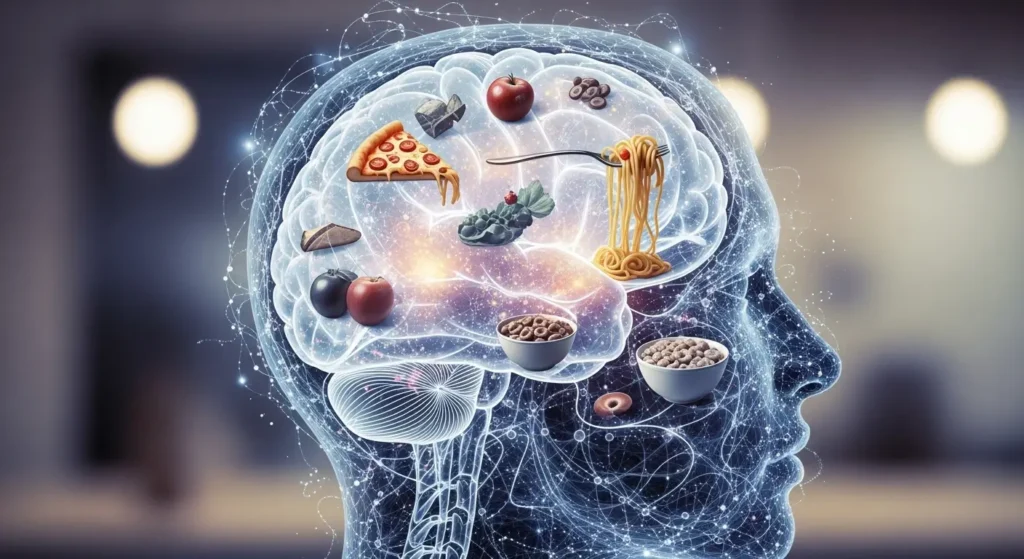
Your Brain Is Paying Attention to Every Meal You Repeat
You may not remember what you ate three weeks ago.
But your brain does.
Every repeated eating pattern—when you eat, how much you eat, and what you eat—quietly trains your brain to expect, predict, and adapt.
This is why:
- Energy dips show up at the same time every day
- Hunger feels automatic rather than responsive
- Focus improves or crashes on a schedule
These aren’t coincidences. They’re learned biological responses.
Understanding how the brain adapts to repeated eating patterns explains why some habits feel impossible to break—and why others suddenly feel effortless.
The Brain Is a Prediction Machine, Not a Passive Observer
The brain’s primary job is survival through prediction.
It constantly asks:
- When is food coming?
- How reliable is energy supply?
- How much should we conserve?
Repeated eating patterns give the brain data.
Over time, it adjusts:
- Hunger hormones
- Energy output
- Cognitive alertness
- Stress response
This adaptation happens automatically—without conscious control.
The brain doesn’t wait for problems to arise. It prepares in advance.
Why Consistency Matters More Than Perfection
The brain adapts to patterns, not isolated days.
One skipped meal won’t rewire anything.
But repeated behavior will.
Patterns the brain responds to include:
- Chronic low energy intake
- Frequent meal skipping
- Late-night eating
- Highly irregular schedules
Once a pattern is established, the brain reshapes metabolism and behavior to match it.
This is why people often say:
“My body just expects this now.”
How Repeated Low Intake Trains the Brain to Conserve
When energy intake is consistently low, the brain adapts defensively.
It assumes:
- Food supply is uncertain
- Energy must be conserved
- Non-essential functions should be reduced
The result is not immediate exhaustion—but gradual change.
The brain reduces:
- Mental sharpness
- Motivation
- Emotional range
- Cognitive endurance
This feels like mental fatigue—but it’s actually learned efficiency.
Why Repeated Over-Restriction Feels Harder Over Time
Many people believe restriction becomes easier.
Physiologically, the opposite often happens.
With repeated restriction:
- The brain increases hunger signaling
- Food thoughts become louder
- Energy drops earlier in the day
This isn’t lack of discipline. It’s the brain protecting survival.
The more predictable the restriction, the stronger the adaptation.
Meal Timing: How the Brain Learns When to Expect Fuel
The brain learns when food arrives—not just if it does.
Repeated timing patterns create:
- Anticipatory hunger
- Predictable energy dips
- Focus windows tied to meals
For example:
- Skipping breakfast repeatedly trains the brain to delay alertness
- Eating late trains the brain to stay wired at night
These adaptations feel natural—but they’re learned.
Real-Life Example: The Afternoon Slump That Never Moves
Someone eats lunch at 2 p.m. every day.
By 1:30 p.m., they feel:
- Foggy
- Distracted
- Mentally tired
Even on days they eat earlier, the slump still appears.
Why?
Because the brain has learned the pattern and prepares for low energy in advance.
This isn’t weakness—it’s predictive adaptation.
How Repeated Eating Patterns Shape Cravings
Cravings aren’t just about food quality. They’re about expectation.
The brain learns:
- Which foods arrive when energy is low
- Which foods follow stress
- Which foods signal relief
Repeated pairing strengthens neural pathways.
Over time:
- Cravings feel automatic
- Desire feels urgent
- Choice feels limited
This is habit wiring, not moral failure.
Brain Adaptation vs Body Adaptation: Key Differences
| Area | Brain Adaptation | Body Adaptation |
|---|---|---|
| Speed | Fast | Gradual |
| Trigger | Repetition | Prolonged exposure |
| Primary Goal | Prediction | Efficiency |
| Early Sign | Mental fatigue | Physical changes |
| Reversibility | High with consistency | Slower |
The brain adapts first—and often quietly.
Hidden Mistake: Changing Food Without Changing Patterns
Many people switch foods but keep the same structure.
They may:
- Eat “healthier”
- Reduce processed foods
- Improve quality
But still:
- Skip meals
- Eat too little
- Eat inconsistently
The brain responds to structure more than ingredients.
Without pattern change, adaptation remains.
Why This Matters Today
Modern eating is often:
- Rushed
- Irregular
- Mentally disconnected
Yet the brain thrives on predictable energy availability.
When patterns are chaotic or restrictive, the brain compensates—often by lowering performance.
Understanding this helps people stop blaming themselves and start working with their biology.
How to Gently Retrain the Brain Through Eating Patterns
The brain adapts quickly—but it also re-adapts.
Practical Steps That Work
- Eat at consistent times for several weeks
- Avoid chronic under-eating
- Support mentally demanding days with fuel
- Reduce extreme variability
- Focus on reliability, not perfection
Consistency sends safety signals to the brain.
Mistakes That Slow Re-Adaptation
Avoid these common traps:
- Frequent pattern changes
- Large swings in intake
- Overcorrecting after “off” days
- Expecting instant results
The brain needs repetition to relearn trust.
Subtle Signs Your Brain Has Adapted to Your Eating Pattern
Watch for:
- Predictable energy crashes
- Hunger that appears on a schedule
- Focus that fades at the same time daily
- Emotional changes tied to meals
These are not random—they’re learned responses.
Key Takeaways
- The brain adapts to repeated eating patterns, not single meals
- Consistency trains hunger, energy, and focus
- Chronic restriction teaches the brain to conserve
- Meal timing shapes alertness and cravings
- Patterns can be retrained with steady input
Frequently Asked Questions
1. Can eating patterns really change how my brain works?
Yes. The brain adapts its energy regulation and expectations based on repeated behavior.
2. How long does brain adaptation take?
Often weeks—not months—especially with consistent patterns.
3. Is this why cravings feel automatic?
Yes. Repetition strengthens neural pathways tied to expectation and reward.
4. Can irregular eating affect focus?
Absolutely. Inconsistent energy delivery disrupts cognitive stability.
5. Can the brain unlearn old patterns?
Yes. With consistency, the brain is highly adaptable.
Conclusion: Your Brain Is Learning From You Every Day
Your brain is not judging your food choices.
It’s studying them.
Every repeated pattern teaches it what to expect—and how to prepare.
When eating patterns support reliability, the brain relaxes, focus stabilizes, and energy becomes more predictable.
Change doesn’t require perfection.
It requires consistent signals of safety and fuel.
Disclaimer: This article is for general educational purposes only and does not replace personalized medical or nutrition advice.



Pingback: Why What You Eat Can Quiet an Overactive Mind