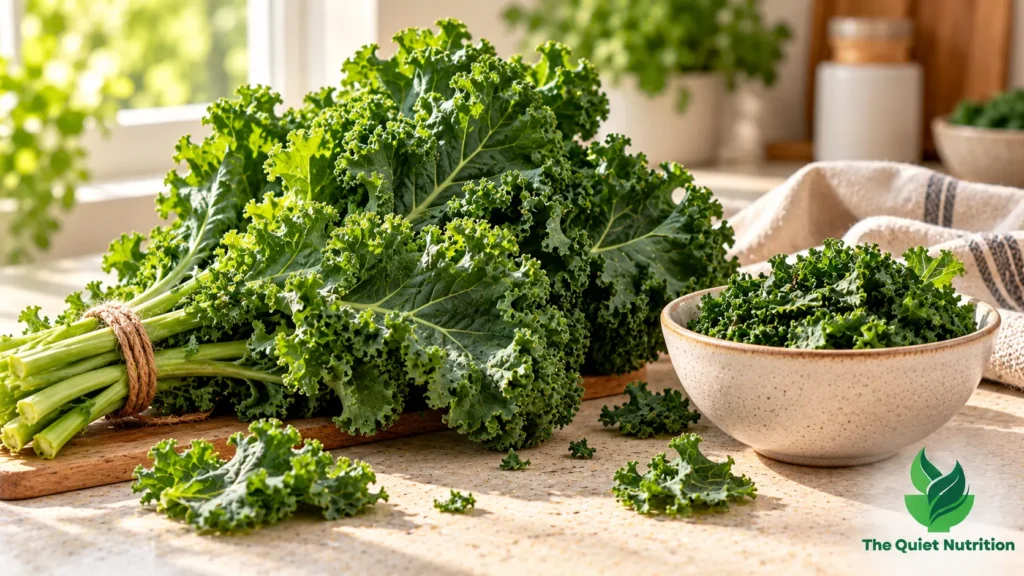
Some vegetables provide plenty of water and a modest amount of nutrients. Others deliver a surprisingly broad range of vitamins, minerals and plant compounds in relatively few calories. Kale belongs firmly in the second category.
A 100-gram portion of raw kale provides around 35 calories, approximately 4 grams of fiber, and substantial amounts of vitamins K and C. It also supplies carotenoids, including beta-carotene, lutein and zeaxanthin, which have important roles in normal body function.
That nutritional density explains kale’s reputation. But it does not automatically make kale better than every other leafy green, nor does it mean eating it regularly will prevent disease.
The more useful question is what makes kale nutritionally distinctive, which benefits are supported by research, and how to get the most out of it without turning an ordinary vegetable into a health obsession.
What makes kale nutritionally different?
Kale belongs to the cruciferous vegetable family, alongside broccoli, cabbage, cauliflower and Brussels sprouts. Its dark leaves contain several nutrients that support different functions in the body.
The interesting feature is the combination. Kale supplies vitamins that support blood clotting, collagen formation and normal vision, alongside fiber and plant chemicals that researchers continue to investigate.
Kale nutrition at a glance
The following figures are approximate values for 100 grams of raw kale, based on USDA food composition data. A typical serving may be considerably smaller.
| Nutrient | Approximate amount | Why it matters |
|---|---|---|
| Calories | 35 kcal | Provides nutrients with relatively little energy |
| Dietary fiber | 4.1 g | Supports normal digestion |
| Vitamin C | 93 mg | Supports collagen formation and immune function |
| Vitamin K | 390 mcg | Essential for normal blood clotting and bone-related proteins |
| Calcium | 254 mg | Supports bones, teeth and muscle function |
| Potassium | 350 mg | Helps regulate fluid balance and normal muscle function |
| Protein | 2.9 g | Contributes to tissue maintenance |
| Beta-carotene | Approximately 2.9 mg | Can be converted into vitamin A |
Values can vary with cultivar, growing conditions, preparation and the specific food database entry. Raw and cooked kale also differ in nutrient concentration by weight.
One detail deserves attention: 100 grams of raw kale is a fairly generous serving of leafy greens. The figures above should not be mistaken for the nutrition provided by a small handful.
1. Kale provides an unusually concentrated source of vitamin K
Vitamin K receives less attention than vitamins C and D, but it performs an essential job: it helps activate proteins involved in normal blood clotting.
It is also involved in proteins associated with bone metabolism.
Kale is particularly rich in vitamin K1, the form commonly found in green leafy vegetables. A relatively modest amount can therefore make a meaningful contribution to daily intake.
This is one of kale’s clearest nutritional advantages. You do not need to eat a large bowl to obtain a substantial amount of this vitamin.
However, more is not automatically better. Healthy people generally do not need to pursue exceptionally high vitamin K intake to obtain its normal benefits.
An important safety point: People taking warfarin should keep their vitamin K intake reasonably consistent. Suddenly eating much more or much less kale can affect how the medication works. This does not mean kale must automatically be avoided; discuss major dietary changes with your clinician or anticoagulation service.
2. Its vitamin C content supports collagen and normal immune function
Vitamin C is needed for collagen production, the process through which the body makes a structural protein found in skin, blood vessels, cartilage and other tissues.
It also helps the body absorb non-heme iron, the form of iron found in plant foods, and contributes to normal immune function.
Raw kale is a particularly useful source of vitamin C. A 100-gram portion can provide roughly 93 milligrams, although the amount in your meal depends on the variety, storage and cooking method.
This is where preparation matters.
Vitamin C is sensitive to heat and can be lost during cooking, particularly with prolonged boiling. If retaining as much as possible is a priority, raw kale, lightly steamed kale or briefly sautéed leaves are reasonable choices.
You do not need to eat kale raw every day, though. Cooking can improve its texture and make it easier for some people to eat a useful portion. A varied diet matters more than preserving every milligram in every meal.
3. Kale contains carotenoids that support eye health
The deep green colour of kale reflects the presence of chlorophyll, but it also signals a mixture of other plant pigments.
Among these are beta-carotene, lutein and zeaxanthin.
Beta-carotene can be converted into vitamin A, which is necessary for normal vision and several other functions. Lutein and zeaxanthin are carotenoids that accumulate in the retina, including the macula, a region involved in central vision.
These compounds are one reason dark-green vegetables are valuable additions to a varied diet.
However, there is an important distinction between supporting normal eye function and claiming that a particular vegetable prevents eye disease. Kale provides relevant nutrients, but eating it alone has not been established as a way to prevent cataracts or age-related macular degeneration.
For everyday nutrition, including kale alongside other colourful vegetables is a sensible approach. Different vegetables contain different combinations of carotenoids and other nutrients, so variety remains useful.
4. Its cruciferous plant compounds are scientifically interesting
Kale contains compounds called glucosinolates, which are characteristic of cruciferous vegetables.
When plant tissue is chopped, chewed or otherwise disrupted, glucosinolates can be broken down into several products, including isothiocyanates and indole compounds. Researchers have investigated these substances for their effects on cellular processes related to inflammation, oxidative stress and the body’s handling of certain chemicals.
This research helps explain why cruciferous vegetables attract attention in nutrition science.
But the evidence requires careful interpretation.
Some findings come from laboratory experiments or animal studies. These can help researchers identify biological mechanisms, but they do not establish that eating kale produces the same effects in humans or prevents a particular disease.
Human studies examining cruciferous vegetables and cancer risk have produced mixed results. Observational research sometimes identifies associations, but it cannot reliably establish that kale itself caused a lower risk.
Kale is therefore a useful source of naturally occurring plant compounds, not a proven cancer-prevention treatment.
The practical lesson is to include cruciferous vegetables regularly as part of a varied eating pattern rather than relying on one vegetable to deliver a specific medical outcome.
5. Kale contributes fiber without adding many calories
Fiber is one of the less glamorous reasons to eat leafy greens, but its practical value is substantial.
A 100-gram serving of raw kale provides approximately 4 grams of fiber. That contributes to the daily intake needed for normal bowel function and can help make meals more filling.
Fiber also forms part of a broader dietary pattern associated with better long-term health. Its effects depend on the type of fiber, the foods supplying it and the rest of the diet.
Kale is not the only way to increase fiber intake, of course. Beans, lentils, oats, whole grains, fruit, nuts and seeds all contribute.
Its advantage is that it can add fiber while also supplying vitamins, minerals and carotenoids. For people trying to improve meal quality without adding many calories, that combination can be helpful.
If you are not accustomed to eating many vegetables, begin with a manageable portion. A sudden increase in fiber can cause gas or bloating, particularly when several high-fiber foods are introduced at once.
6. Kale may contribute to heart health, but the human evidence is still limited
Kale supplies fiber, potassium and other nutrients that fit well into a heart-conscious eating pattern.
Potassium helps regulate fluid balance and supports normal blood pressure regulation. Fiber is also a useful component of a diet designed to support cardiovascular health.
There is some direct research on kale itself.
A small 2008 study investigated 150 millilitres of kale juice daily for 12 weeks in 32 men with elevated cholesterol. The researchers reported improvements in several blood lipid measurements, including lower LDL cholesterol and higher HDL cholesterol.
Those results are interesting, but they should not be treated as definitive evidence.
The study was small, involved a specific group of men and used a concentrated juice intervention. Its before-and-after findings cannot establish that eating ordinary portions of whole kale will produce the same changes in other populations.
Nor does a change in cholesterol measurements automatically prove that a food reduces heart attacks or strokes.
For now, kale’s strongest practical role is as one component of an overall dietary pattern that includes vegetables, fruits, whole grains, legumes, nuts and other minimally processed foods. It should not replace prescribed treatment for high cholesterol or high blood pressure.
7. Its nutrients can support bone health
Kale supplies vitamin K and calcium, both of which have roles in maintaining healthy bones.
Vitamin K participates in the activation of proteins involved in bone metabolism. Calcium is a major structural component of bones and teeth.
Kale can therefore contribute to a diet that supports normal bone health, especially when eaten alongside other calcium-containing foods.
However, nutrient content is not the same as demonstrated disease prevention. Eating kale does not guarantee stronger bones or eliminate the risk of osteoporosis.
Bone health also depends on factors such as overall calcium intake, vitamin D status, physical activity, age and individual health circumstances.
Kale is best viewed as one useful source of bone-related nutrients rather than a substitute for a balanced diet or medical care when needed.
Is kale better than spinach?
Both kale and spinach are nutrient-dense leafy greens. Neither deserves to be declared the universal winner.
Kale is particularly notable for its vitamin K and vitamin C content, while spinach provides substantial folate and other nutrients. Exact amounts depend on the serving size and whether the vegetables are raw or cooked.
| Feature | Kale | Spinach |
|---|---|---|
| Vitamin K | Very high | Very high |
| Vitamin C | High when raw | Present, but generally lower than raw kale by weight |
| Folate | Provides some | Particularly useful source |
| Carotenoids | Beta-carotene, lutein and zeaxanthin | Beta-carotene, lutein and zeaxanthin |
| Texture | Firm, hearty leaves | Generally softer leaves |
| Best practical use | Salads, roasting, soups and sautéing | Salads, omelettes, soups and quick cooking |
Spinach also contains oxalates, which can reduce the absorption of some of its calcium. Kale generally has lower oxalate levels, making its calcium more bioavailable in comparison.
That does not mean kale should replace spinach entirely. Eating both provides variety, different flavours and a broader range of nutrients.
The strongest strategy is not to choose one green and abandon the others. It is to make dark leafy vegetables a regular part of your meals.
How to eat kale to get more from it
Kale can be nutritious and still go uneaten if its texture or bitterness makes it unpleasant. The best preparation method is the one that helps you include it consistently.
For salads: Remove the tough central stems, slice the leaves thinly and massage them briefly with a little olive oil and lemon juice. This softens their texture and makes the leaves easier to chew.
For cooked meals: Add chopped kale to soups, bean stews, omelettes or whole-grain dishes. Brief cooking softens the leaves without requiring a complicated recipe.
For smoothies: Blend a small handful with fruit, plain yogurt and liquid of your choice. Remember that blending does not remove the vegetable’s calories or nutrients, and smoothies can become energy-dense when large quantities of fruit juice or sweeteners are added.
For better carotenoid absorption: Pair kale with a source of fat, such as olive oil, avocado, nuts or seeds. Lutein, zeaxanthin and beta-carotene are fat-soluble compounds, so including some dietary fat can help their absorption.
For easier eating: If raw kale feels too tough, lightly steam or sauté it. There is no nutritional requirement to eat every vegetable raw.
How often should you eat kale?
There is no established daily kale dose required to obtain its benefits. Eating it several times a week is a reasonable way to include it, but other leafy greens and vegetables should remain part of the rotation.
A small handful in a salad, a serving alongside dinner or a portion added to soup can all contribute. The amount you need depends on your overall diet and preferences.
Common mistakes that make kale less useful
- Assuming more is always better. Very large portions are unnecessary when your diet already contains a range of vegetables.
- Eating only kale. No single green supplies every nutrient in the ideal amount.
- Relying on kale juice as a treatment. Juice studies do not establish that concentrated kale products can treat high cholesterol or prevent cardiovascular disease.
- Adding large amounts of high-calorie toppings. Cheese, creamy dressings, croutons and oils can substantially increase a salad’s energy content. They are not inherently bad, but portion sizes still matter.
- Avoiding cooked kale because raw is supposedly superior. Different preparation methods have different effects on nutrients. Both raw and cooked kale can be useful.
- Ignoring medication considerations. People taking warfarin should maintain a consistent vitamin K intake and seek advice before making major dietary changes.
Frequently asked questions
Is it healthy to eat kale every day?
For most people, kale can be part of a healthy daily diet. There is no requirement to eat it every day, however, and rotating it with spinach, broccoli, cabbage and other vegetables helps provide variety.
Is raw kale healthier than cooked kale?
Neither is universally better. Raw kale can retain more heat-sensitive vitamin C, while cooking softens the leaves and changes the availability of some nutrients. Both are nutritious options.
Does kale detox the body?
Kale contains nutrients and plant compounds involved in normal physiological processes, but there is no good evidence that eating kale performs a special detoxification treatment. The body already has organs, including the liver and kidneys, that process and eliminate waste products.
Can kale prevent cancer?
No single food has been established as a reliable way to prevent cancer. Cruciferous vegetables contain compounds being investigated for potential protective effects, but human research has produced mixed results. Kale is best included as part of a varied diet.
Can people with thyroid problems eat kale?
Normal dietary consumption of cruciferous vegetables is generally compatible with a healthy diet. Very high intakes, particularly of raw cruciferous vegetables, may be a concern in certain circumstances involving iodine deficiency or impaired thyroid function. People with thyroid conditions or specific dietary restrictions should discuss individual concerns with their clinician rather than automatically eliminating kale.
Key takeaways
- Kale supplies substantial vitamin K and vitamin C, alongside carotenoids, fiber and several minerals.
- Its glucosinolates are scientifically interesting, but laboratory findings should not be confused with proven health outcomes in humans.
- Small studies suggest potential effects on cholesterol-related measurements, but stronger evidence is needed to establish meaningful clinical benefits from ordinary kale consumption.
- Both raw and cooked kale can contribute to a nutritious diet.
- Eating kale alongside a variety of other vegetables is more sensible than treating it as a uniquely powerful food.
Kale deserves a place on the plate because it provides a broad range of nutrients in relatively few calories. Its strongest advantage is not a miraculous effect or an ability to replace medical care. It is the simple nutritional value of a leafy green that can make everyday meals more varied and nutrient-rich.

Aarti Solanki, B.Sc. (Food Science), is a food science writer passionate about making nutrition simple and evidence-based. She creates well-researched, easy-to-understand articles on healthy eating, food science, and nutrition, using information from trusted scientific and public health sources.