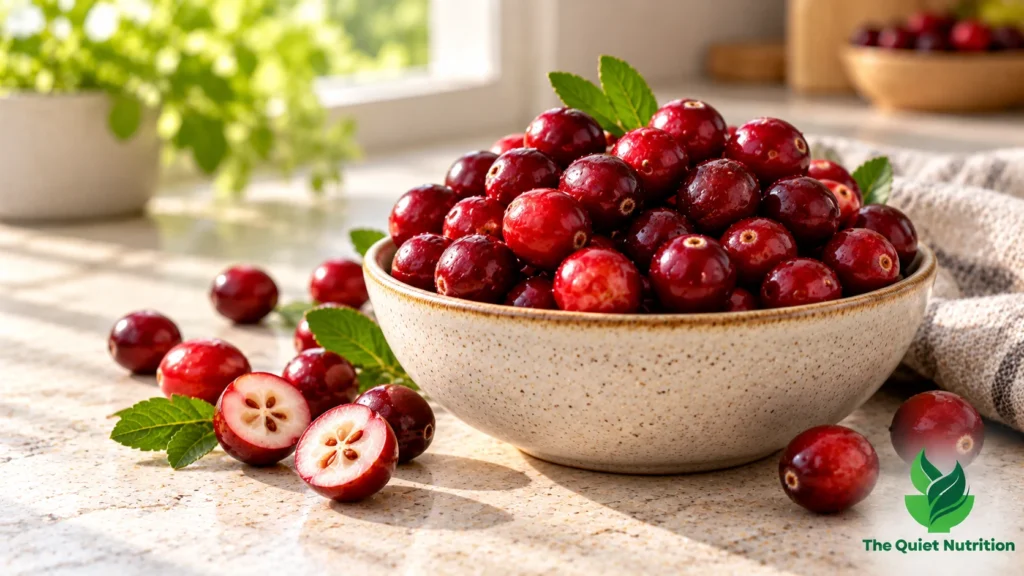
Cranberries are among the few fruits whose most distinctive health benefits have been studied in the context of a specific medical problem: urinary tract infections. Their deep red color, sharp acidity and naturally occurring plant compounds make them nutritionally interesting, but the science behind their reputation is more specific than many wellness claims suggest.
The most compelling evidence concerns cranberry products and the prevention of certain recurrent urinary tract infections. Researchers have also investigated their effects on cholesterol, blood sugar, blood pressure and the gut microbiome. Some findings are promising, but they are not equally well established.
Understanding what makes cranberries special means looking at both sides of the evidence: what their natural compounds can do and what studies in people have actually demonstrated.
What Makes Cranberries Different From Other Fruits?
Cranberries provide dietary fiber, vitamin C and a variety of plant compounds known as polyphenols. Their particularly tart flavor comes partly from their natural acidity and the balance of sugars and organic acids in the fruit.
Unlike sweeter fruits that are commonly eaten fresh, cranberries are often consumed as juice, dried fruit, sauces or supplements. That difference matters because processing can change the amount of fiber, sugar and other components in a serving.
Fresh raw cranberries are relatively low in calories. A 100-gram portion provides approximately 46 calories, around 4.6 grams of fiber and roughly 14 milligrams of vitamin C. Exact values vary with the product and preparation method.
Cranberries are not exceptionally rich in every vitamin or mineral, nor do they provide a unique combination of nutrients that the body cannot obtain elsewhere. Their distinctive nutritional interest comes largely from their polyphenols, particularly a group of compounds called proanthocyanidins.
These compounds help explain why cranberries have attracted attention in research on urinary tract health.
The Plant Compounds Behind Cranberries’ Reputation
Cranberries contain several types of polyphenols, including anthocyanins, flavonols and proanthocyanidins. Polyphenols are naturally occurring compounds produced by plants, where they contribute to functions such as pigmentation and defense.
Anthocyanins help give cranberries their characteristic red color. Proanthocyanidins, often abbreviated as PACs, have received particular attention because some cranberry PACs have a structure that may interfere with the ability of certain bacteria to adhere to the lining of the urinary tract.
This is a different proposed mechanism from simply killing bacteria.
Some bacteria that cause urinary tract infections, especially certain strains of Escherichia coli (E. coli), use surface structures to attach to cells lining the urinary tract. Attachment helps them establish an infection. Research suggests that specific cranberry compounds can interfere with this process under appropriate conditions.
However, cranberry PACs are not a substitute for antibiotics when treatment is needed. Laboratory findings about bacterial adhesion also do not, by themselves, prove that a person who consumes cranberries will avoid an infection.
The important question is whether these mechanisms translate into meaningful benefits in people. For cranberry products and urinary tract infection prevention, clinical trials provide encouraging evidence.
Cranberries and Urinary Tract Infection Prevention
Urinary tract infections, commonly called UTIs, occur when microorganisms enter and multiply within the urinary tract. They can cause symptoms such as painful urination, frequent urination and discomfort in the lower abdomen.
Cranberry juice and cranberry supplements have been studied for years as possible ways to reduce the likelihood of recurring infections.
A major update to the Cochrane systematic review, published in 2023, assessed 50 randomized controlled trials involving 8,857 participants. The researchers found that cranberry products reduced the risk of symptomatic, culture-verified UTIs in several groups, including women with recurrent infections, children and people susceptible to infections following certain urinary tract interventions.
For women with recurrent UTIs, the pooled analysis included eight studies involving 1,555 participants. Cranberry products were associated with a relative reduction in risk, although the effect varied between studies.
The review did not find convincing evidence of the same benefit in every population. For example, it did not establish a clear preventive effect among pregnant women, elderly people living in institutional settings or adults with certain bladder-emptying problems.
These differences matter because cranberry products should not be treated as universally effective for everyone who might develop a UTI.
The review also found insufficient evidence to determine whether cranberry products were more or less effective than antibiotics or probiotics for preventing further infections.
Source: Williams G, et al. Cranberries for preventing urinary tract infections. Cochrane Database of Systematic Reviews, 2023. https://www.cochrane.org/evidence/CD001321_cranberries-preventing-urinary-tract-infections
Can cranberries treat an existing UTI?
No. Evidence supporting cranberry products for prevention should not be confused with evidence for treating an active infection.
A separate Cochrane review published in 2023 found no randomized controlled trials providing adequate evidence that cranberry juice treats an existing UTI. Cranberry products should therefore not replace medical assessment or prescribed treatment.
Anyone experiencing symptoms such as painful urination, fever, back or side pain, or worsening urinary symptoms should seek appropriate medical advice. Fever or pain in the back or side can indicate a more serious infection that requires prompt assessment.
Does the type of cranberry product matter?
Cranberries are sold in many forms, including juice, dried fruit, powders, tablets and capsules. These products do not necessarily provide equivalent amounts of the compounds studied in clinical trials.
Cranberry juice cocktails may contain substantial amounts of added sugar, while dried cranberries often have sugar added to offset their naturally tart taste. Supplements can vary in their concentration and standardization of PACs.
Although PACs are central to much of the proposed preventive mechanism, there is no universally established regimen that makes every cranberry product interchangeable. The amount of PACs listed on a label, the formulation and the evidence for the specific product all matter.
For someone interested in UTI prevention, it is more useful to understand the limitations of the evidence and discuss recurrent infections with a healthcare professional than to assume that any cranberry drink or capsule will provide the same effect.
What About Cranberries and Heart Health?
Cranberries have also been investigated for their possible effects on cardiovascular health. Researchers are interested in whether their polyphenols influence blood pressure, cholesterol, inflammation or other processes associated with cardiovascular disease.
Some studies have reported favorable changes in individual measurements, but results across trials have not been consistent.
A 2020 systematic review and meta-analysis examined randomized controlled trials of cranberry supplementation and cardiovascular or metabolic risk factors. The pooled results suggested reductions in systolic blood pressure and body mass index, but the researchers did not find statistically significant overall changes in several other measurements, including total cholesterol, LDL cholesterol, fasting blood glucose and diastolic blood pressure.
The authors concluded that further high-quality research was needed to confirm the findings.
A later systematic review and meta-analysis, published in 2023, examined randomized trials of blueberry and cranberry supplementation in people with cardiometabolic diseases. The pooled results did not show statistically significant reductions in systolic or diastolic blood pressure.
These reviews do not necessarily contradict one another in every respect. They examined different groups of participants and sets of studies, and the later review focused specifically on people with cardiometabolic diseases.
The overall message is that cranberry compounds may have interesting biological effects, but evidence that cranberry consumption reliably improves cardiovascular outcomes remains limited.
A change in blood pressure or cholesterol in a short-term study would also not automatically establish that a food prevents heart attacks or strokes.
Sources:
Pourmasoumi M, et al. The effects of cranberry on cardiovascular metabolic risk factors: A systematic review and meta-analysis. Clinical Nutrition, 2020. https://pubmed.ncbi.nlm.nih.gov/31023488/
The effects of blueberry and cranberry supplementation on blood pressure in patients with cardiovascular diseases: A systematic review and meta-analysis of randomized clinical trials. 2023. https://pubmed.ncbi.nlm.nih.gov/37963472/
Do Cranberries Affect Blood Sugar or Cholesterol?
Researchers have investigated whether cranberry consumption affects glucose regulation, insulin resistance and blood lipid levels. These questions are important because polyphenols can interact with biological pathways involved in metabolism.
A 2024 systematic review and meta-analysis of 16 studies examined cranberry consumption and glycemic and lipid measurements in humans. It reported improvements in the total cholesterol-to-HDL cholesterol ratio and a measure of insulin resistance called HOMA-IR.
However, the analysis did not find significant overall effects on several other outcomes, including total cholesterol, LDL cholesterol, triglycerides, fasting blood glucose and HbA1c.
HOMA-IR is a calculated measure used in research to estimate insulin resistance. It is not the same as demonstrating that participants experienced fewer cases of diabetes or other clinical complications.
The distinction is important. A favorable change in one metabolic marker can be scientifically interesting without proving that a food prevents or treats a disease.
The review also included different cranberry formulations, doses and study populations. Findings from cranberry supplements cannot automatically be applied to a small serving of fresh cranberries or a sweetened cranberry drink.
At present, cranberries are best viewed as a possible contributor to a healthy dietary pattern, not as a stand-alone method for controlling blood sugar or cholesterol.
Source: Li X, et al. The Effects of Cranberry Consumption on Glycemic and Lipid Profiles in Humans: A Systematic Review and Meta-Analysis of Randomized Controlled Trials. Nutrients, 2024. https://pmc.ncbi.nlm.nih.gov/articles/PMC10974925/
Cranberries and the Gut Microbiome
The gut microbiome is the community of microorganisms living in the digestive tract. It responds to many aspects of diet, including the types of fiber and plant compounds that reach the large intestine.
Cranberries contain polyphenols that are not completely absorbed in the upper digestive tract. Some can reach the colon, where microorganisms transform them into smaller metabolites.
Researchers are investigating whether this interaction influences the composition or activity of gut bacteria and whether the resulting metabolites have measurable effects on human health.
A double-blind, placebo-controlled crossover study published in 2020 examined cranberry juice consumption and the gut microbiome in 17 healthy young women. Researchers assessed participants after three days and 21 days of cranberry juice or placebo consumption.
The study reported changes in aspects of the gut microbiome and relationships between microbial changes and metabolites measured in biological samples.
However, the trial was small and involved a specific group of participants. Its findings do not establish that cranberry consumption produces the same effects in everyone, nor do they demonstrate that cranberries treat digestive disorders.
A further challenge is that a change in microbial composition is not automatically a health benefit. Researchers must establish which changes are meaningful and whether they translate into improvements in symptoms or long-term health.
For now, cranberries provide an interesting example of how plant compounds may interact with gut microorganisms, but the clinical significance of these interactions remains under investigation.
Source: Changes of Human Gut Microbiome Correlated with Metabolomics After Cranberry Juice Consumption in a Double-Blinded, Placebo Controlled, Crossover Study. 2020. https://pmc.ncbi.nlm.nih.gov/articles/PMC7258519/
Fresh, Dried or Juiced: Which Cranberry Form Is Best?
The most suitable form of cranberry depends on how you intend to eat it and what you want from the food.
Fresh cranberries provide fiber and naturally occurring plant compounds, but their tartness can make them difficult to eat in large quantities without preparation. They can be cooked into sauces, added to oatmeal or combined with other fruits.
Unsweetened frozen cranberries are another practical option. Freezing makes them easier to store and use throughout the year without automatically removing their nutritional value.
Dried cranberries are convenient for snacks, salads and cereals. However, many commercial products contain added sugar. Check the ingredient list and serving size rather than assuming that all dried cranberries have the same nutritional profile.
Cranberry juice varies considerably. Some products are unsweetened, some are diluted, and others are cranberry juice cocktails containing added sugars or other fruit juices.
Juice may provide cranberry polyphenols, but it generally contains much less fiber than whole fruit. Drinking a cranberry beverage is therefore not nutritionally equivalent to eating whole cranberries.
Cranberry supplements introduce another consideration: the amount and composition of the active compounds can vary across products. Evidence from one formulation should not be assumed to apply to all supplements.
There is no single cranberry product that is best for every purpose. For everyday nutrition, choose a form that fits your preferences and dietary needs. For UTI prevention, pay particular attention to the evidence for the specific product and remember that no universally established PAC dose guarantees protection.
Are Cranberries Safe for Everyone?
Cranberries are generally well tolerated as foods, but concentrated products and large amounts may not suit everyone.
Some people experience stomach discomfort or diarrhea after consuming large amounts of cranberry juice or supplements. Sweetened products can also add considerable sugar to the diet, depending on the serving size.
People taking warfarin, an anticoagulant medication, should discuss regular or high-dose cranberry consumption with their healthcare professional because potential interactions have been reported and the evidence is not entirely consistent.
Anyone with recurrent UTIs, kidney-related concerns or other medical conditions should seek individualized advice before relying on concentrated supplements.
Most importantly, cranberry products should not delay treatment for a suspected urinary tract infection. Prevention and treatment are different clinical questions, and the evidence for one cannot be used to establish the effectiveness of the other.
What the Science Tells Us—and What It Does Not
The evidence around cranberries is unusually specific in one area and much less settled in others.
What research supports:
- Cranberries contain polyphenols, including proanthocyanidins, that have been investigated for their effects on bacterial adhesion.
- Randomized trials support the use of certain cranberry products to help prevent recurrent symptomatic UTIs in some populations, particularly women with recurrent infections.
- Cranberry consumption has been studied in relation to cardiovascular risk factors, glucose regulation and gut microbiota.
- Cranberries can contribute fiber and plant compounds to a varied diet, depending on the form consumed.
What remains uncertain:
- Whether cranberries independently prevent cardiovascular disease or diabetes.
- Whether cranberry consumption produces consistent, clinically meaningful changes in the human gut microbiome.
- Which cranberry formulation and PAC dose are most effective for UTI prevention.
- Whether findings from concentrated supplements can be applied to ordinary servings of fresh fruit or juice.
These distinctions are essential. A plausible biological mechanism can explain why researchers investigate a food, but it does not guarantee a health outcome. Clinical trials help establish whether the proposed effect occurs in people, while systematic reviews show how consistent the findings are across studies.
The Practical Takeaway
Cranberries stand out because their plant compounds have been studied for a specific purpose: helping prevent certain recurrent urinary tract infections. That evidence is more convincing than many of the broader wellness claims associated with the fruit.
Their potential effects on cardiovascular risk factors, blood sugar and the gut microbiome are scientifically interesting, but they remain less conclusive. Cranberries should not be promoted as a treatment for existing infections or as a substitute for established medical care.
For everyday eating, fresh or frozen cranberries can add variety to a diet, while dried cranberries and juice can be convenient when their added sugars and fiber content are considered.
The most useful way to think about cranberries is neither as a miracle food nor as an ordinary fruit with nothing special to offer. They are a source of distinctive plant compounds with a meaningful but specific area of supporting clinical evidence—and several other promising research questions that still need better answers.

Aarti Solanki, B.Sc. (Food Science), is a food science writer passionate about making nutrition simple and evidence-based. She creates well-researched, easy-to-understand articles on healthy eating, food science, and nutrition, using information from trusted scientific and public health sources.