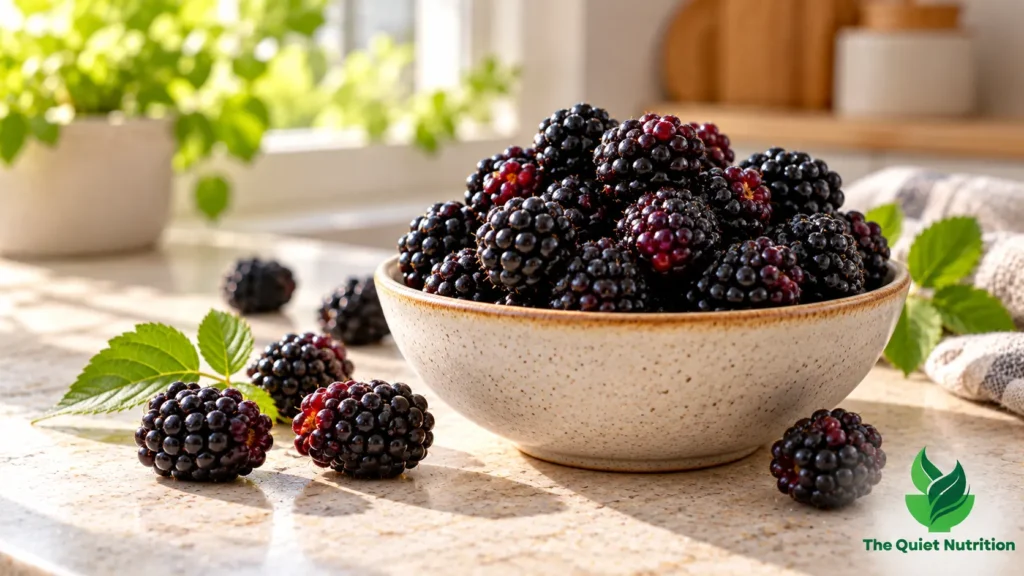
Blackberries have a quality that makes them especially interesting from a nutrition perspective: much of what makes them valuable is not fully broken down in the small intestine. Their fiber and some of their plant compounds continue into the large intestine, where they can interact with the trillions of microorganisms living there.
That interaction is one reason researchers have become interested in berries and digestive health. It also explains why blackberries deserve attention beyond their vitamin content or the familiar advice to eat more fruit.
A cup of raw blackberries provides fiber, water and naturally occurring compounds called polyphenols. These components may contribute to a gut-friendly eating pattern in different ways, from supporting normal bowel movements to providing material that intestinal bacteria can use.
However, there is an important distinction between what we know about blackberries’ nutritional composition and what researchers are still investigating about their effects on the human gut microbiome. The evidence makes blackberries a sensible fruit to include in a varied diet, but it does not establish that eating them will correct an imbalance in gut bacteria or treat a digestive condition.
Blackberries Provide a Substantial Amount of Fiber
One of the clearest reasons to include blackberries in your diet is their fiber content.
According to USDA food-composition data, 100 grams of raw blackberries provides approximately 43 calories, 5.3 grams of dietary fiber and 88 grams of water. A typical cup of blackberries, weighing around 144 grams, supplies approximately 7.6 grams of fiber.
That is a meaningful contribution from a relatively low-calorie fruit.
Fiber is the part of plant foods that human digestive enzymes cannot completely break down. Different types behave differently in the digestive tract, but many contribute to stool formation, digestive regularity or the activity of intestinal microorganisms.
How blackberry fiber supports digestion
Some fiber helps retain water and contributes to stool softness, while other components add bulk to digestive contents. Together, these properties can help support regular bowel movements.
For someone who struggles to eat enough fiber, blackberries offer a convenient option. They can be added to breakfast cereal, oatmeal, yogurt or a snack without requiring much preparation.
The effect of fiber depends on a person’s overall diet, fluid intake and digestive health. Eating one serving of blackberries does not guarantee relief from constipation, and people who suddenly increase their fiber intake may initially experience gas or bloating.
A gradual increase in fiber-rich foods is often more comfortable than making a large dietary change overnight.
What Happens to Blackberries After They Reach the Gut?
The digestive journey of a blackberry does not end when the fruit leaves the stomach.
Some of its carbohydrates and other components are digested or absorbed in the small intestine. Other materials, including certain fibers and polyphenols, pass further along the digestive tract.
The large intestine contains a diverse community of microorganisms collectively known as the gut microbiota. These organisms use some of the material that escapes digestion, producing compounds that can influence the intestinal environment.
This process helps explain why the nutritional effects of a plant food cannot always be understood by looking only at the nutrients absorbed into the bloodstream.
The role of fermentable fiber
When gut bacteria ferment certain types of dietary fiber, they produce short-chain fatty acids, including acetate, propionate and butyrate.
These compounds have several functions. Butyrate, for example, is an important energy source for cells lining the colon. Short-chain fatty acids also participate in processes involved in maintaining the intestinal environment and communicating with other tissues.
Blackberries provide fiber and other nondigestible plant materials that may contribute to this fermentation process.
However, not all dietary fiber is fermented in the same way or to the same extent. The amount and type of material available to gut bacteria depend on the food’s composition, how it is processed and the individual’s microbial community.
It would therefore be inaccurate to claim that blackberries always increase butyrate production or produce the same changes in every person’s gut.
Blackberries Contain Polyphenols That Interact With Gut Bacteria
The dark purple-black color of blackberries comes largely from plant pigments called anthocyanins, a subgroup of polyphenols. These compounds are widely studied for their potential biological effects.
Blackberries also contain other phenolic compounds, including ellagitannins and ellagic acid.
What makes these substances interesting is that their journey through the digestive tract can be quite different from that of conventional nutrients.
Why some plant compounds reach the colon
Many dietary polyphenols are not absorbed completely in their original form. Some are transformed during digestion, while others reach the large intestine, where microorganisms can break them down into smaller metabolites.
The relationship works in both directions: gut bacteria can transform compounds from berries, and those compounds and their metabolites may influence microbial activity.
A 2023 review in Current Nutrition Reports examined evidence on berries, gut microbiota and health. It described how berry-derived fibers and polyphenols interact with intestinal microorganisms and how their breakdown products may influence the body’s metabolic and gastrointestinal processes.
The review included research on several berries, including blackberries. However, it combined evidence from different research settings, including laboratory experiments, animal studies and human research. Findings from the different settings cannot be treated as equally conclusive.
The important point is that blackberries provide compounds that participate in the complex relationship between diet and gut microorganisms. Researchers are still determining which changes matter most for human health and whether eating particular berries produces consistent clinical benefits.
Can Blackberries Help Support a Diverse Gut Microbiome?
The gut microbiome is not simply a collection of good bacteria that should be increased as much as possible. It is a complex ecosystem containing many different microorganisms, whose effects depend on their species, activity, location and interactions with one another.
A healthy gut microbiome is generally discussed in terms of its functions and relationship with the host, rather than a single ideal list of bacteria.
Diet can influence this ecosystem. Different foods provide different nutrients and substrates for microbial activity, which is one reason dietary variety is often encouraged.
Blackberries contribute to that variety by supplying fiber and several classes of polyphenols.
What the research actually shows
In a 2021 study published in Food Chemistry, researchers investigated whole blackberries using simulated gastrointestinal digestion followed by laboratory fermentation involving gut microorganisms.
They found that some blackberry components remained available for microbial fermentation. Under the experimental conditions, fermentation increased short-chain fatty acid production and changed the composition of the microbial community.
These findings offer a plausible explanation for how blackberry components might interact with the gut environment.
But the study did not demonstrate that eating blackberries produces the same changes in living people. Laboratory fermentation models cannot fully reproduce the complexity of the human digestive system, including differences in intestinal transit, immune activity, diet and microbial composition.
Human research on berries and gut bacteria remains limited and inconsistent. A 2022 systematic review of randomized clinical trials found only three eligible trials examining both berry interventions and gut microbiota outcomes. The interventions involved berries such as strawberries, raspberries, cloudberries, aronia berries and bilberries, rather than blackberries specifically. The trials did not show a significant overall effect on both blood pressure and gut microbiota.
This does not mean berries have no relevance to gut health. It means that promising mechanisms and laboratory findings have not yet translated into consistent evidence of specific microbiome changes in human trials.
For now, blackberries are best viewed as one useful component of a fiber-rich, plant-diverse diet rather than a targeted treatment for the microbiome.
Do Blackberry Seeds Contribute to Their Gut-Friendly Qualities?
Blackberries have numerous small seeds, which some people find less appealing than the smooth texture of other fruits. From a nutritional perspective, however, the seeds are part of the fruit’s structure and contain their own plant components.
Research on blackberry seeds has identified polyphenols, including ellagitannins and ellagic acid. Some laboratory experiments have investigated how extracts from blackberry seeds interact with gut microorganisms.
A 2020 study published in Food Science & Nutrition examined extracts from cold-pressed blackberry seed flour. The researchers observed changes in bacterial populations under laboratory conditions.
The distinction is important: the study investigated a concentrated seed-flour extract, not ordinary servings of whole blackberries eaten by people. It cannot establish that blackberry seeds independently improve the human gut microbiome.
There is also no need to chew every seed deliberately or purchase blackberry seed supplements to obtain the fruit’s nutritional benefits. Eating the whole fruit is a straightforward way to consume its natural combination of fiber and plant compounds.
Are Blackberries Good for Bowel Regularity?
Blackberries can help increase dietary fiber intake, which is relevant to bowel regularity. But it is more accurate to describe them as a useful fiber-rich food than as a constipation remedy.
Fiber works as part of the overall diet. Someone who eats blackberries but consumes little fiber from other foods may still fall short of their daily needs. Conversely, someone who already eats plenty of whole grains, legumes, vegetables and fruit may benefit from blackberries as one additional source.
Adequate fluid intake also matters, particularly when increasing fiber.
If constipation is persistent, severe or accompanied by symptoms such as unexplained weight loss, blood in the stool or significant abdominal pain, dietary changes should not replace medical evaluation.
Blackberries can support a healthy eating pattern, but they are not a substitute for assessing the cause of ongoing digestive symptoms.
Whole Blackberries or Blackberry Juice: Which Is Better for the Gut?
The form in which you consume blackberries can change their nutritional value.
Whole blackberries retain their natural structure, including their seeds, skin and fiber. Juice may contain some of the fruit’s polyphenols and other nutrients, but processing and straining can remove much of the fiber.
This matters because fiber is one of the most straightforward nutritional reasons to choose blackberries.
Whole fruit also requires chewing and is generally more filling than drinking an equivalent amount of fruit in liquid form. Juice can make it easier to consume fruit sugars quickly without obtaining the same amount of fiber.
Frozen blackberries are another useful option. Freezing does not automatically make fruit less nutritious, and frozen berries can be a convenient way to include fruit when fresh berries are expensive or out of season. Check the ingredient list for added sugars when purchasing packaged products.
For most everyday purposes, fresh or frozen whole blackberries are the simplest choice.
How to Eat Blackberries Without Overcomplicating Your Diet
You do not need a special routine or a large daily serving to benefit from including blackberries in your diet.
Try adding them to plain yogurt, oatmeal or whole-grain cereal. They also work well with nuts and seeds, or as part of a fruit salad containing several varieties of fruit.
If you enjoy smoothies, blending whole blackberries retains their fiber, although the resulting drink may be consumed more quickly than the intact fruit. Adding yogurt or another source of protein can make the smoothie more substantial.
People who are sensitive to fiber or experience bloating after eating berries may prefer to start with a smaller portion and see how they respond. Individual tolerance varies, and a food that suits one person’s digestive system may not suit another’s.
The broader goal is dietary variety. Blackberries can contribute fiber and polyphenols, while oats, legumes, vegetables, nuts and other fruits provide different combinations of fermentable carbohydrates and plant compounds.
No single food supplies everything the gut microbiome needs.
What the Science Tells Us—and What It Does Not
The strongest case for blackberries as a gut-friendly fruit rests on their nutritional composition and the known role of dietary fiber in digestive health.
What the evidence supports:
- Blackberries provide a substantial amount of dietary fiber relative to their calorie content.
- Their fiber and other nondigestible components can be used by gut microorganisms under appropriate conditions.
- Blackberries contain anthocyanins and other polyphenols that are metabolized during digestion and microbial fermentation.
- Whole blackberries are a practical way to add fruit, fiber and plant compounds to a varied diet.
What remains uncertain:
- Whether eating blackberries consistently produces specific beneficial changes in the human gut microbiome.
- Whether those changes translate into meaningful improvements in digestive symptoms or long-term health.
- Whether blackberries have distinct gut-health effects beyond those expected from their fiber and polyphenol content.
- What serving size, if any, produces a measurable microbiome benefit.
These distinctions matter because a food’s biological plausibility is not the same as proof of a clinical benefit. Laboratory findings can help researchers identify mechanisms worth studying, but controlled human studies are needed to establish what happens when people regularly eat the food.
The Practical Takeaway
Blackberries deserve a place in a gut-conscious diet for a straightforward reason: they provide fiber, water and a varied mix of plant compounds in a convenient whole fruit.
Their fiber can contribute to normal bowel function, while some of their nondigestible components and polyphenols interact with gut microorganisms. Those interactions are scientifically interesting, but research has not yet established that eating blackberries reliably changes the human microbiome in a particular beneficial way.
You do not need to eat blackberries every day or treat them as a special gut-health intervention. Enjoy them fresh or frozen, keep them whole when practical, and combine them with other fiber-rich plant foods.
A varied diet provides a broader range of substrates for intestinal microorganisms than relying on any single fruit. Blackberries can be a useful part of that pattern without needing to be a miracle food.
Sources:
- USDA food-composition data — Raw blackberries. Nutritional values for fiber, energy and water. View the data.
- Komarnytsky S, Wagner C, Gutierrez J, Shaw OM. (2023). Berries in Microbiome-Mediated Gastrointestinal, Metabolic, and Immune Health. Current Nutrition Reports. PubMed.
- In vitro digestion of the whole blackberry fruit: bioaccessibility, bioactive variation of active ingredients and impacts on human gut microbiota. (2021). Food Chemistry. PubMed.
- The Effects of Berry Polyphenols on the Gut Microbiota and Blood Pressure: A Systematic Review of Randomized Clinical Trials in Humans. (2022). PubMed.
- Choe U, et al. (2020). Chemical composition of cold-pressed blackberry seed flour extract and its potential health-beneficial properties. Food Science & Nutrition. Full text.
- Shu C, et al. (2023). Health benefits of anthocyanin-containing foods, beverages, and supplements have unpredictable relation to gastrointestinal microbiota: A systematic review and meta-analysis of randomized clinical trials. Nutrition Research. PubMed.

Aarti Solanki, B.Sc. (Food Science), is a food science writer passionate about making nutrition simple and evidence-based. She creates well-researched, easy-to-understand articles on healthy eating, food science, and nutrition, using information from trusted scientific and public health sources.