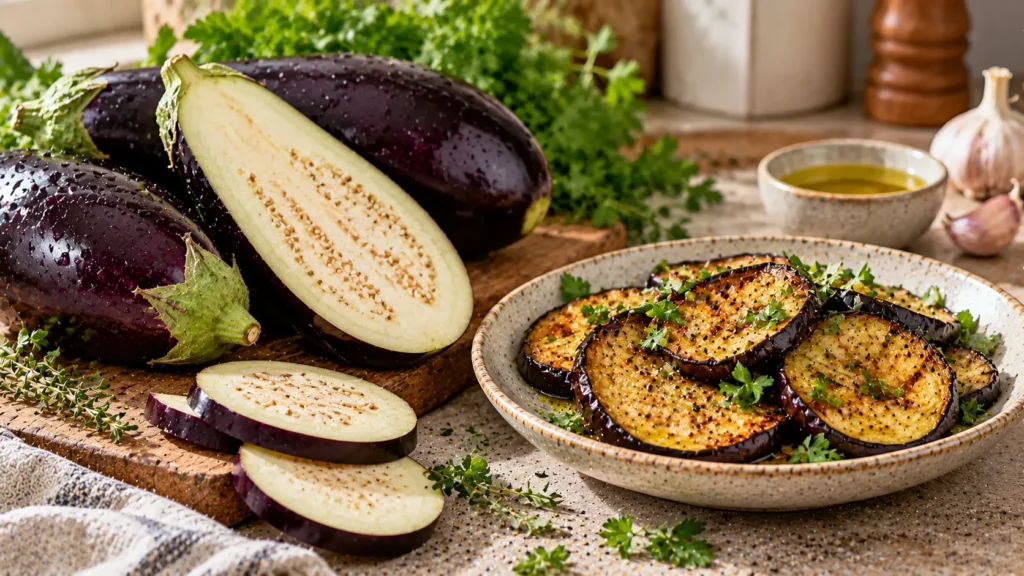
Eggplant has an unusual advantage in the kitchen: it can take on the flavours of the ingredients around it while adding very little energy of its own. A roasted slice can replace part of a heavier side dish, while cubed eggplant can bring texture and substance to a tomato-based stew.
That flexibility is relevant to heart health, but the nutritional story goes beyond cooking. Eggplant provides dietary fibre, potassium and naturally occurring plant compounds, including purple pigments concentrated in the skin. Those features make it a useful addition to a varied, vegetable-rich eating pattern.
There is an important distinction, though, between a food that fits a heart-healthy diet and a food proven to protect the heart independently. Eggplant has attracted research interest because of its plant compounds, yet direct human evidence that eating it lowers cholesterol or prevents cardiovascular disease remains limited.
Understanding that difference makes it easier to appreciate eggplant for what it genuinely offers, without expecting one vegetable to do the work of an entire dietary pattern.
Eggplant provides fibre with relatively few calories
Raw eggplant contains approximately 25 calories and 3 grams of dietary fibre per 100 grams, according to USDA food-composition data. It also supplies potassium and smaller amounts of other vitamins and minerals. Exact values can vary with the variety and preparation method.
Its low calorie content is one practical advantage. Eggplant can add considerable texture and volume to meals without contributing much energy when prepared with modest amounts of oil.
The fibre is useful, too. Dietary fibre contributes to normal bowel function, and fibre-rich eating patterns are associated with several benefits relevant to cardiovascular health. Some types of fibre can help lower LDL cholesterol, the form of cholesterol commonly associated with the buildup of fatty deposits in artery walls. However, the effects depend on the type and amount of fibre consumed.
Eggplant should not be described as a particularly powerful cholesterol-lowering food on the strength of its fibre content alone. It provides a modest contribution, rather than the concentrated amounts of certain cholesterol-lowering fibres found in foods such as oats, barley and some legumes.
The more useful role for eggplant is as part of a broader combination of vegetables, fruit, legumes and whole grains. The American Heart Association’s updated 2026 dietary guidance continues to emphasise a varied intake of vegetables and fruit, whole grains, suitable protein sources and foods rich in unsaturated fats, while recommending less sodium, added sugar and highly processed food.
Eggplant fits naturally into that approach. It helps make vegetable-rich meals more varied and satisfying without needing to be treated as a special heart-health remedy.
The purple skin contains compounds worth understanding
The deep purple skin of many eggplants contains anthocyanins, a group of naturally occurring pigments found in foods such as blueberries, blackberries and purple cabbage.
One anthocyanin associated with eggplant skin is nasunin. Scientists have studied this compound for its antioxidant activity and other biological properties. Laboratory research has found that nasunin can interact with reactive molecules involved in oxidative processes.
Oxidative stress occurs when the production of reactive molecules exceeds the body’s capacity to manage them. Researchers investigate oxidative stress because it is involved in various biological processes, including those related to cardiovascular disease.
However, this is where the evidence needs careful interpretation. Showing that a compound has antioxidant activity in a laboratory does not prove that eating eggplant prevents oxidative damage in the human body or reduces the likelihood of a heart attack.
The amount consumed, digestion, absorption, metabolism and interactions with other components of the diet all influence what happens after a food is eaten.
Research on eggplant’s anthocyanins is interesting, but it has not established a specific cardiovascular benefit from eating ordinary servings of the vegetable.
A sensible takeaway is to enjoy the purple skin as part of the whole food rather than treating nasunin as a reason to take supplements or seek out concentrated extracts. Eggplant offers several nutritional features together, and its skin contributes to that overall composition.
Does eggplant actually lower cholesterol?
Claims about eggplant lowering cholesterol have been around for years. The idea has some biological appeal because eggplant contains fibre and plant compounds, but direct human research is limited and has not established a reliable cholesterol-lowering effect from eating it.
A small clinical study published in 2000 examined an eggplant infusion in 38 people with high cholesterol. Participants received either the infusion or a placebo over five weeks. Although some within-person reductions in total and LDL cholesterol were observed in the infusion group, the researchers did not find significant differences between the treatment and control groups. They concluded that the effect was modest and temporary. [6]
The preparation is also important: the study tested an infusion made from powdered eggplant, not simply the effect of eating roasted or steamed eggplant as part of a normal diet.
A second clinical study, published in 2004, compared an eggplant extract preparation with lovastatin and a control group in 21 people with high cholesterol. The researchers found no significant improvement in cholesterol levels in the eggplant group, while the medication group experienced reductions in total and LDL cholesterol. The authors concluded that the extract should not be regarded as an alternative to statin treatment.
These were small studies of particular preparations, so they do not settle every question about eggplant. But they do illustrate why confident claims that eggplant itself lowers cholesterol are not justified.
It is reasonable to include eggplant in a heart-healthy diet. It is not reasonable to expect it to replace treatments that have demonstrated benefits, especially when someone has been prescribed medication for high cholesterol.
For people looking to improve their overall dietary pattern, the more established strategy is to eat a variety of vegetables, increase suitable sources of fibre and replace saturated fats with unsaturated fats where appropriate.
What about eggplant’s potassium content?
Potassium is an essential mineral involved in nerve transmission, muscle contraction and normal fluid balance. It also plays a role in the regulation of blood pressure.
Raw eggplant contains approximately 229 milligrams of potassium per 100 grams in USDA reference data. That is a useful contribution, but it is not an exceptionally concentrated source compared with foods such as potatoes, beans and some other vegetables.
The relationship between potassium and cardiovascular health is better established than any specific heart-protective effect of eggplant. Adequate potassium intake, as part of an appropriate overall diet, can help support normal blood pressure. The effect of an individual food depends on the amount consumed and the rest of the diet.
Eggplant can contribute to potassium intake alongside other foods, but eating it does not guarantee lower blood pressure.
There is also an important qualification for people with chronic kidney disease or those taking certain medicines that affect potassium levels. Their healthcare team may recommend an individual approach to potassium intake, so increasing potassium-rich foods is not automatically appropriate for everyone.
For most people, variety is the useful principle. Eggplant can appear alongside beans, fruit, leafy greens and other vegetables, each contributing a different combination of nutrients.
How you cook eggplant can change its role in a meal
Eggplant is naturally low in fat, but its texture allows it to absorb oil readily during cooking. This makes preparation especially relevant when considering the overall nutritional profile of a dish.
Deep-fried eggplant can contain considerably more energy than steamed or roasted eggplant, depending on the amount of oil absorbed. Breaded versions may also contain extra refined carbohydrates and sodium. Neither preparation is automatically forbidden, but they can produce a very different meal from one made with lightly roasted eggplant.
Roasting or grilling with a modest amount of olive oil is one straightforward option. These methods develop a rich flavour and tender texture without requiring the vegetable to be submerged in oil. Sautéing or braising eggplant with tomatoes, garlic and herbs also works well.
The choice of oil matters as well. The American Heart Association recommends replacing saturated-fat sources with unsaturated fats as part of a heart-healthy dietary pattern. Using olive oil or another suitable liquid plant oil instead of large amounts of butter can help align a recipe with that guidance.
Sodium is worth considering when eggplant is prepared with heavily salted sauces, cured ingredients or large amounts of cheese. Eggplant itself is naturally low in sodium, but the finished dish may not be.
Cooking changes eggplant’s texture and energy content more dramatically than its basic role as a vegetable. Rather than searching for a single perfect cooking method, focus on the ingredients that accompany it and how the complete meal fits into your diet.
Does keeping the skin on matter?
The purple skin is one of eggplant’s most distinctive features, and it contains anthocyanins such as nasunin. Peeling removes much of that outer layer, so eating the skin can preserve the contribution of these pigments.
Leaving the skin on can also reduce food waste and make preparation simpler. When eggplant is fresh, the skin is generally edible, although some larger or older varieties can have a tougher texture.
Cooking method and variety can affect how the skin feels in the finished dish. Thin slices may soften during roasting, while larger cubes can retain more structure.
There is no need to force yourself to eat the skin if its texture is unpleasant. Nor is there evidence that leaving it on produces a guaranteed reduction in heart disease risk. The practical benefit is that it preserves more of the vegetable’s natural composition, including some of its purple pigments.
The same principle applies to eating the vegetable as a whole rather than seeking out isolated compounds. Food composition is only one part of nutrition, and laboratory measurements of individual molecules do not establish the health effects of an entire diet.
How eggplant can make heart-healthy meals more satisfying
One of eggplant’s strongest practical advantages is its ability to take on flavour and provide substance in vegetable-based meals.
Roasted eggplant can be combined with chickpeas, tomatoes and whole grains. Grilled slices work well in sandwiches alongside other vegetables and a suitable protein source. Cubed eggplant can be simmered into a stew with beans, herbs and spices.
For a simple dinner, try roasted eggplant with lentils, tomatoes and a small amount of olive oil, served with a whole grain. This combination provides vegetable variety, fibre from several sources and protein from the lentils. It is the overall meal—not an isolated property of eggplant—that makes the combination useful.
Eggplant can also be incorporated into pasta sauces, curries and soups. These dishes can vary widely in their nutritional profiles, so the amount of oil, salt, cheese and other ingredients still matters.
The broader aim is to make vegetable-rich food enjoyable enough to appear regularly. A nutritious meal is more useful when it is affordable, convenient and satisfying than when it follows a complicated set of rules.
Eggplant supports that goal through its texture, flavour and versatility. It gives cooks another way to build meals around vegetables without relying on the same ingredients every day.
What the evidence really says about eggplant and heart health
Eggplant offers several qualities that make it a sensible part of a varied diet: relatively few calories in its plain form, dietary fibre, potassium and naturally occurring anthocyanins in the purple skin. These are useful nutritional features, but they should not be confused with proof that eggplant independently prevents cardiovascular disease.
Laboratory and animal studies have identified biological effects that warrant further investigation. Small human studies of eggplant extracts and infusions, however, have not established a dependable cholesterol-lowering effect. More rigorous research would be needed to determine whether eating eggplant itself produces measurable cardiovascular benefits beyond those associated with an overall healthy dietary pattern.
For everyday eating, the conclusion is straightforward. Keep the skin on when you enjoy its texture, use cooking methods that suit your preferences and pay attention to the amount of oil and salt added. Combine eggplant with legumes, whole grains, other vegetables and appropriate sources of protein.
Eggplant does not need to lower cholesterol on its own to be worth eating. Its practical value is that it makes a varied, vegetable-rich, heart-conscious diet easier to enjoy.
Sources:
[1] U.S. Department of Agriculture, Agricultural Research Service. FoodData Central: Eggplant, raw. Reference for calorie, fibre, potassium and other nutrient values. https://fdc.nal.usda.gov/food-search/?query=eggplant%20raw
[2] National Institute of Diabetes and Digestive and Kidney Diseases. Eating, Diet, & Nutrition for Constipation. Explains fibre’s role in digestion and provides practical guidance on fibre intake. https://www.niddk.nih.gov/health-information/digestive-diseases/constipation/eating-diet-nutrition
[3] American Heart Association. 2026 Dietary Guidance to Improve Cardiovascular Health. Updated scientific guidance recommending a varied intake of vegetables and fruit, whole grains and suitable protein sources, alongside reduced sodium and added sugar and a preference for unsaturated over saturated fats. https://professional.heart.org/en/science-news/2026-dietary-guidance-to-improve-cardiovascular-health/top-things-to-know
[4] Sato T, et al. Antioxidant activity of nasunin, an anthocyanin in eggplant peels. Toxicology. 2002. Research into the antioxidant activity of nasunin isolated from eggplant skin, providing biochemical evidence rather than proof of cardiovascular benefits in people. https://pubmed.ncbi.nlm.nih.gov/10962130
[5] Nasunin, an Amazing Chemical Constituent in Eggplants (Solanum melongena L.): A Review of Its Major Properties and Health-Promoting Effects. ACS Food Science & Technology. 2024;4(1):16–35. DOI: 10.1021/acsfoodscitech.3c00582. Reviews research on nasunin, its properties and potential biological effects, while highlighting the research interest in eggplant pigments. https://doi.org/10.1021/acsfoodscitech.3c00582
[6] Guimarães PR, et al. Eggplant (Solanum melongena) infusion has a modest and transitory effect on hypercholesterolemic subjects. Brazilian Journal of Medical and Biological Research. 2000;33(9):1027–1036. DOI: 10.1590/S0100-879X2000000900006. A small clinical trial of an eggplant infusion that found no significant differences compared with control. https://pubmed.ncbi.nlm.nih.gov/10973133
[7] Praça JM, Thomaz A, Caramelli B. Eggplant (Solanum melongena) extract does not alter serum lipid levels. Arquivos Brasileiros de Cardiologia. 2004;82(3):269–276. Examined an eggplant extract in a small clinical study and did not find significant lipid improvement in the eggplant group. The authors concluded it should not be treated as an alternative to statins. https://pubmed.ncbi.nlm.nih.gov/15073652
[8] National Institutes of Health, Office of Dietary Supplements. Potassium: Fact Sheet for Health Professionals. Explains potassium’s role in normal nerve and muscle function and discusses its relationship to blood pressure and health. https://ods.od.nih.gov/factsheets/Potassium-HealthProfessional

Aarti Solanki, B.Sc. (Food Science), is a food science writer passionate about making nutrition simple and evidence-based. She creates well-researched, easy-to-understand articles on healthy eating, food science, and nutrition, using information from trusted scientific and public health sources.