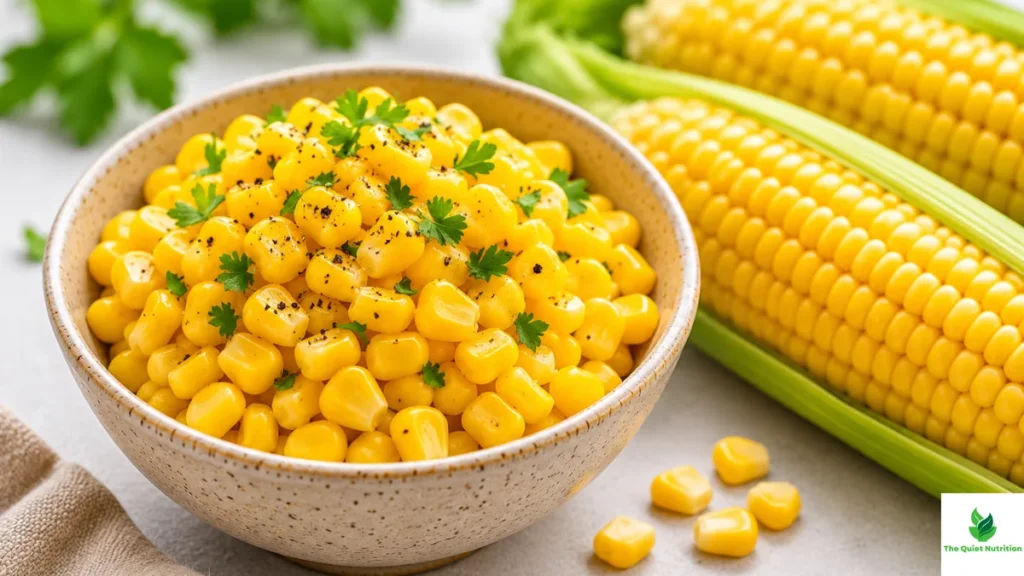
Corn is the one vegetable that leaves evidence. Eat a cob on Sunday and by Monday morning there it is, bright yellow and apparently untouched, as if the kernel skipped the whole journey.
Most people assume that means something went wrong. Nothing did. That little yellow speck is actually a clue to how corn works in your body, and it explains why the usual advice about corn is “in moderation” rather than “avoid” or “eat all you like.”
So let’s follow a kernel from the first bite to the other end, then work out what a sensible amount of corn actually looks like.
Following one kernel through
Each kernel is a small package: a starchy centre wrapped in a tough outer skin. An animal-nutrition scientist at Pioneer describes that fibrous wall as the seed’s protection, built to shield the embryo and its starch until conditions suit sprouting. It is very good at that job.
Your teeth get the first go at it. Chewing cracks the skin so that digestive juices can reach the starch inside, which is why corn swallowed in a hurry is the likeliest to turn up later looking intact. Once the starch is exposed, your enzymes chop it into glucose and the small intestine absorbs it. The skin is a different story. As Harvard Health notes about fibre in general, the human digestive tract can’t break it down, so the hull keeps moving.
That leftover hull isn’t dead weight. A University of Florida extension fact sheet points out that sweet corn’s fibre is mostly the insoluble kind, which may help prevent constipation, and that cooked-and-cooled corn also holds resistant starch. That’s starch your own enzymes skip, but gut bacteria can ferment it.
As for timing, Healthline’s explainer on undigested food says food typically takes one to three days to pass through, and that spotting whole-looking corn is usually just the outer shell. It adds one useful caveat: if it keeps showing up alongside persistent diarrhoea, weight loss or other changes in your bowel habits, that’s worth raising with a doctor.
What’s actually in the bowl
Corn sits in an odd spot. Botanically it’s a grain, but it’s harvested young, at the “milk” stage, and the USDA files sweet corn with the starchy vegetables, next to potatoes and green peas, according to the UF/IFAS sweet corn fact sheet. Here’s how a few common forms stack up:
| Form | Typical serving | What it gives you |
|---|---|---|
| Canned or frozen kernels | ½ cup | About 55 calories, 12 g carbohydrate, 2 g protein |
| Fresh corn on the cob | 1 medium cob | About 2 g fibre, 275 mg potassium, 1 g fat |
| Plain popcorn | 3 cups popped | Counts as one serving of whole grains, with about 3 g fibre |
The fibre is the quiet headline, but the pigment is the more unusual part. Yellow corn carries lutein and zeaxanthin, the carotenoids that collect in the macula at the centre of the retina. Corn and corn products are the main source of zeaxanthin in the American diet, and higher intakes of these two pigments are associated with a lower risk of macular degeneration. That’s an association from observational studies, not proof that corn protects your eyes.
Keep the scale in mind too. A cup of canned sweet corn supplies about 1.1 mg of lutein and zeaxanthin, a respectable contribution, but the same source notes that peas, kale and spinach provide more. If you’re eating corn for your eyes, it works as one of several sources, not the only one. A North Dakota State University eye-health sheet adds a practical tip: cooking vegetables can improve how well your body absorbs these pigments.
The blood sugar question
Corn’s reputation here is mixed, and the numbers show why. Harvard Health puts corn in its moderate glycemic index band (56 to 69), alongside white rice and potatoes. The UF/IFAS fact sheet takes a friendlier view of the fresh vegetable: medium glycemic index, and lower than many popular breads and cereals.
Both can be true, because form changes everything. One health explainer that draws on Harvard’s glycemic index table lists corn tortillas at 46, sweet corn at 52, popcorn at 65 and cornflakes at 81. The pattern is simple: the more refined the corn, the less fibre is left to slow things down, and the higher the number climbs. It’s no accident that Harvard’s own swap list suggests trading cornflakes for bran flakes.
Then there’s the part the glycemic index leaves out. Harvard stresses that the amount of carbohydrate matters just as much, and that a huge plate of a low-GI food like spaghetti can still send blood sugar soaring. UF’s worked example makes it concrete: a cob with a GI of 62, 27 grams of carbohydrate and 3 grams of fibre delivers roughly 15 grams of carbohydrate that count toward blood glucose. One cob is a reasonable side. Three cobs, plus buttered cornbread, is a different meal.
Two small habits help. Check canned corn for added sugar, which the same fact sheet flags as a way the glycemic index can creep up. And do what the extension team’s own recipes do, which is pair corn with beans, salad vegetables or other protein rather than eating it alone.
What “in moderation” looks like on a real plate
There’s no official corn quota, but there is a useful yardstick. The Dietary Guidelines for Americans, as summarised in the UF/IFAS sweet corn fact sheet, suggest adults eat about 5 cups of starchy vegetables a week. That bucket is shared with potatoes, peas and the rest, so corn is one way to fill it, not a daily obligation.
In practice, that could mean:
- A cob, or half a cup to a cup of kernels, a few times a week.
- Plain popcorn as a snack now and then. Three cups counts as a whole-grain serving, as long as you go easy on the butter and salt.
- Corn as one ingredient rather than the whole plate: stirred into a bean salad, a soup or a stir-fry.
The word “moderation” does its real work at the processed end. A University of Michigan nutrition professor quoted in this NZ Herald piece draws the line clearly: sweet yellow corn has little in common with processed corn byproducts. Corn on the cob and plain kernels are one thing. Sugary cereals, heavily salted chips and corn syrup are another, and they don’t deserve the benefit of the doubt that a cob gets.
One last practical note. If you don’t usually eat much fibre, don’t go from zero to three cobs. Harvard Health’s advice on fibre is to ease in, because too much too soon can mean gas, bloating and cramps, and to drink water as you go.
When to be a little more careful
If you manage blood sugar
Corn isn’t off the menu, but portion size carries more weight for you than for most people. Stick to a measured serving, pair it with protein or beans, and avoid the refined end, such as cornflakes and sweetened canned corn. Your care team can tell you how much starchy vegetable fits your plan.
If you have IBS
Fresh sweet corn contains the sugar alcohol sorbitol, one of the fermentable carbohydrates that Monash University researchers linked to IBS symptoms such as bloating and pain. A dietitian-reviewed low-FODMAP guide suggests keeping fresh or frozen sweet corn to about half a cob or half a cup during the elimination phase, and FODMAP Everyday puts the Monash-tested figure for fresh corn at roughly 38 grams, around half a cob. Serving sizes get re-tested over time, so check the current Monash app rather than relying on any article, this one included.
If salt is a concern
Many brands of canned corn contain added salt. The UF/IFAS fact sheet recommends choosing “low sodium” or “no salt added” versions, and says draining and rinsing salted canned kernels helps reduce the sodium.
So what does corn actually do?
Eaten in sensible amounts, corn gives you starch for energy, a few grams of fibre, folate, potassium and a pigment your eyes put to use, while the hull adds bulk on its way out. Eaten in huge, refined or heavily salted quantities, it becomes a blood sugar and sodium problem instead, which is where the “moderation” advice comes from.
So the next time yesterday’s corn waves back at you, you’ll know what you’re looking at: a hull doing exactly the job it was built for, long after the useful part has been absorbed.
This article is general information, not personal medical advice.
Sources
- University of Florida IFAS Extension, Shopping for Health: Sweet Corn (2026)
- Harvard Health Publishing, Choosing good carbs with the glycemic index
- Harvard Health Publishing, Fabulous fiber
- Healthline, Undigested food in stool
- Pioneer, The corn kernel and starch digestion
- Whole Grains Council, Popcorn as a whole grain
- Nutrition Advance, Sweet corn: nutrition, potential benefits and drawbacks
- North Dakota State University Extension, Eating for your eye health
- NZ Herald, How healthy is sweetcorn?
- Lark Health, Is corn healthy? (cites Harvard’s glycemic index table)
- Monash University FODMAP, Research behind the low FODMAP diet
- A Little Bit Yummy, Sweet corn on the low FODMAP diet
- FODMAP Everyday, Low FODMAP corn pudding

Aarti Solanki, B.Sc. (Food Science), is a food science writer passionate about making nutrition simple and evidence-based. She creates well-researched, easy-to-understand articles on healthy eating, food science, and nutrition, using information from trusted scientific and public health sources.