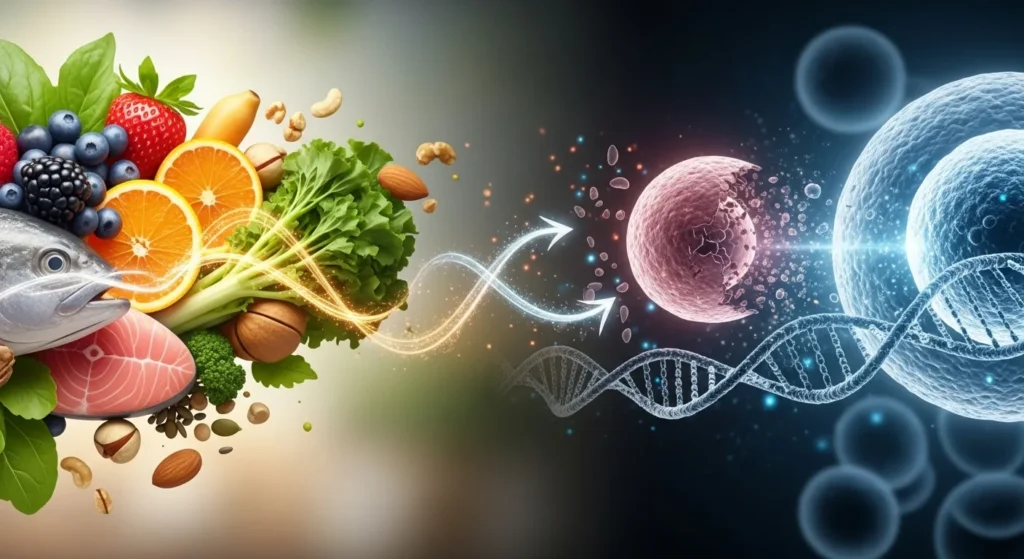
Aging is usually described as something that just happens — a slow accumulation of wear, like a car racking up miles. That framing turns out to be incomplete in a fairly specific way. Deep in the biology of aging, researchers have identified a set of molecular systems whose entire job is to sense how much food is available and adjust the body’s growth and repair activity accordingly. These systems don’t just respond to nutrients. They appear to actively influence how fast the aging process itself unfolds.
Aging Research Has Identified Nutrient Sensing as a Core Driver, Not a Side Effect
In the influential framework researchers use to organize the biology of aging, known as the Hallmarks of Aging, deregulated nutrient sensing is listed as one of the central drivers of the aging process itself — alongside things like genomic instability and cellular senescence. That’s a striking claim: not that nutrition merely influences how healthily someone ages, but that the body’s system for detecting and responding to nutrients is itself one of the core mechanisms driving the aging process forward.
Four specific pathways make up this nutrient-sensing network: the insulin and insulin-like growth factor (IGF-1) pathway, mTOR, sirtuins, and AMPK. Each one is tuned to detect a different aspect of nutrient availability — sugar, amino acids, cellular energy status — and each one, when its signaling drifts out of balance over time, has been linked to accelerated aging in research across multiple organisms.
The Growth Signal That Seems to Come at a Cost
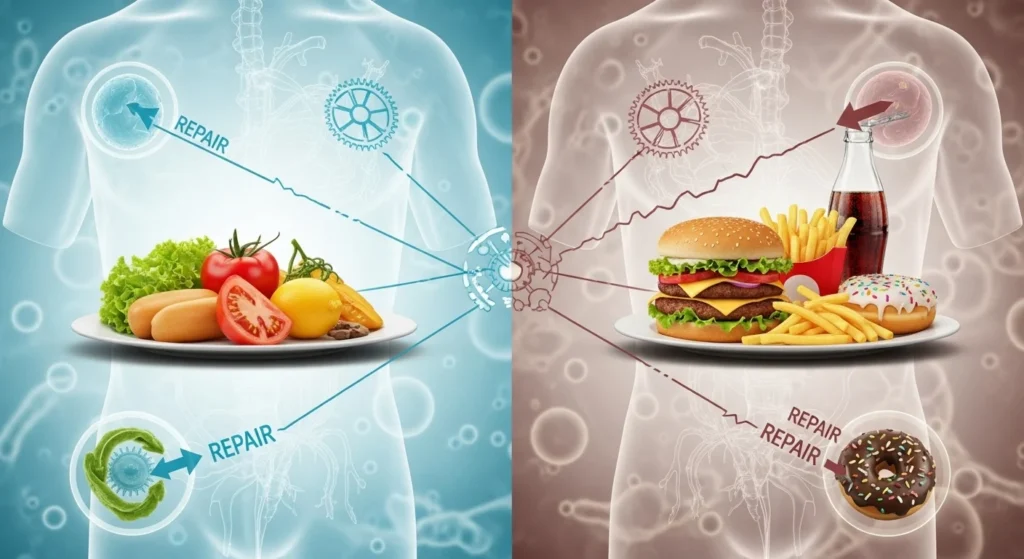
Two of these pathways, insulin/IGF-1 signaling and mTOR, share a common theme: they activate in response to abundant nutrients, particularly sugar and protein, and they push cells toward growth, division, and energy storage rather than maintenance and repair. This makes sense as a short-term survival strategy — when food is plentiful, growing and reproducing is the priority. But research across many organisms has found that chronically elevated activity in these growth-oriented pathways is associated with a faster pace of aging, while reduced activity in the same pathways is consistently linked to extended lifespan.
The pattern shows up clearly with caloric restriction, one of the most extensively studied interventions in aging research. Caloric restriction reliably extends lifespan across a wide range of species, and researchers have found it works specifically by acting through these same nutrient-sensing pathways — not through some separate, unrelated mechanism. Pharmacological approaches that specifically inhibit mTOR, most notably the drug rapamycin, have reproducibly delayed aging and reduced age-related disease across multiple studied organisms, reinforcing that this particular pathway isn’t just associated with aging — deliberately dialing it down appears to causally slow it.
AMPK and Sirtuins Work the Opposite Direction — Toward Repair
Where insulin/IGF-1 and mTOR signal abundance and growth, AMPK and sirtuins signal energy scarcity and activate maintenance-oriented processes instead. AMPK activation enhances autophagy — the cellular process of clearing out damaged components — and supports mitochondrial function, both of which are associated with slower aging in research. This pathway responds to the same triggers associated with longevity interventions broadly: caloric restriction, exercise, and periods without food.
Sirtuins operate similarly, functioning as a family of enzymes dependent on a molecule called NAD+ that helps regulate stress response and metabolism, with activity that researchers have linked to how cells manage aging-related stress. Notably, NAD+ itself naturally declines with age, which is part of why some current research interest centers on whether restoring it might help preserve some of this maintenance-oriented signaling later in life.
Why Human Evidence Is More Complicated Than Animal Studies
It’s worth being honest about where the certainty starts to thin out. Much of the strongest evidence for these mechanisms comes from model organisms — yeast, worms, flies, and mice — where lifespan is short enough to directly test interventions across a full lifetime. Translating this cleanly to humans is harder. Research specifically looking at IGF-1 in human aging has found genuine paradoxes: lower circulating IGF-1 is associated with greater longevity in some studies, and IGF-1 naturally declines with age anyway, yet IGF-1 therapy has shown benefits for certain age-related conditions in other contexts. The relationship isn’t as clean in humans as the underlying biology in simpler organisms might suggest.
There’s also a real tradeoff worth naming: prolonged, aggressive suppression of mTOR — the same pathway linked to slower aging when reduced — has also been shown to impair immune function and reduce muscle mass in some research contexts. The system that drives aging when overactive is the same system your body needs at least some of, particularly for maintaining muscle and immune resilience, especially in older age. This isn’t a case where “less is simply better” across the board.
What This Means in Practical Terms
None of this points toward extreme dietary restriction as a shortcut to longevity — the human evidence doesn’t support that kind of aggressive intervention, and the tradeoffs around muscle and immune function are real. What the research does support is a more moderate framing: dietary patterns that avoid chronically maxing out these growth-signaling pathways — consistent overeating, especially of rapidly digested sugars, alongside long stretches without any period of lower intake — appear to work against the balance these pathways are built around. Patterns that include some variation, like periods of lighter eating alongside adequate protein and regular physical activity, align with the mechanisms researchers currently believe support the maintenance side of this system rather than only the growth side.
Aging was never just a passive accumulation of damage happening to you. Down at the molecular level, at least part of it appears to be an active, ongoing negotiation between growth and repair — one your body has been running every single time you eat, for your entire life.
Sources:
- Lifespan Research Institute — Deregulated Nutrient Sensing
- PubMed — Nutrient Sensing, Signaling and Ageing: The Role of IGF-1 and mTOR in Ageing and Age-Related Disease
- NCBI/PMC — Lifespan-Extending Endogenous Metabolites
- Oxford Longevity Project — Hallmark 6: Dysregulated Nutrient Sensing

Aarti Solanki, B.Sc. (Food Science), is a food science writer passionate about making nutrition simple and evidence-based. She creates well-researched, easy-to-understand articles on healthy eating, food science, and nutrition, using information from trusted scientific and public health sources.