A friend who works in emergency medicine once described her brain, off the clock, as a browser with forty tabs open and no idea which one is playing music. She’s not anxious in the clinical sense — no diagnosis, no panic attacks. She’s just relentlessly, exhaustingly on, even at midnight, even on vacation, replaying conversations and rehearsing tomorrow’s decisions while trying to fall asleep. She assumed this was just her personality, or her job. What she didn’t expect was that adjusting what she ate would do more to quiet that noise than any amount of trying to just relax ever did.
This isn’t a small or fringe idea anymore. The link between diet and mental noise — that racing, overstimulated quality some brains default to — has a real physiological basis, and it has less to do with willpower or personality than most people assume.
The Nervous System Runs on the Same Fuel as the Mind
An overactive mind is, at a basic level, a nervous system stuck partly in a state of activation. The sympathetic nervous system — the “alert and ready” branch responsible for the fight-or-flight response — doesn’t just switch on during actual danger. It responds to blood sugar volatility, caffeine load, and even certain food sensitivities as though they were threats, keeping cortisol and adrenaline elevated even in a completely safe, quiet room.
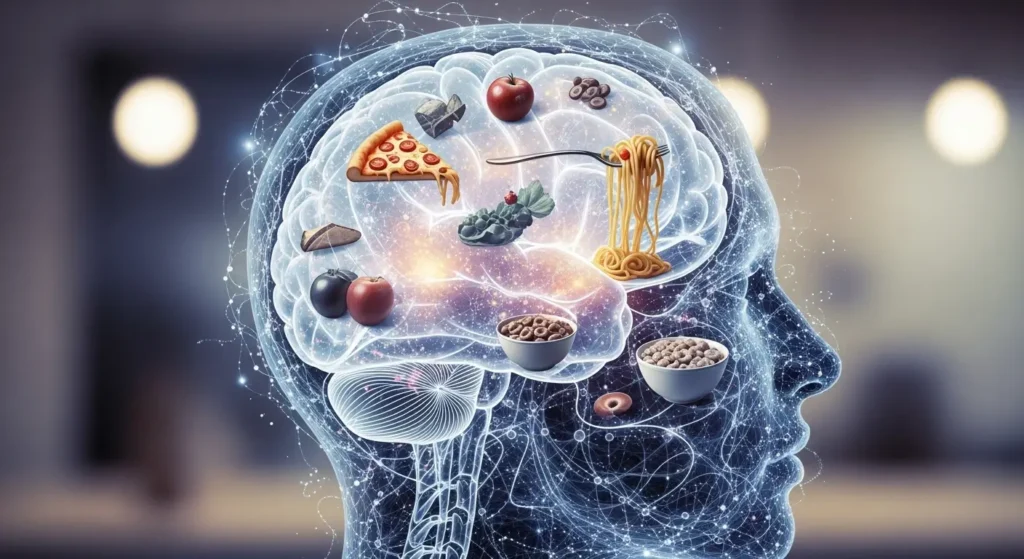
This is where the racing-brain feeling and diet intersect more than people expect. A blood sugar spike followed by a crash triggers a stress response almost identical to the one produced by genuine anxiety — cortisol rises to mobilize glucose, adrenaline follows, and the nervous system tips toward alertness. Someone eating a diet with frequent sugar spikes and crashes may be chemically simulating a low-grade stress response several times a day without ever registering it as diet-related. It just feels like a mind that won’t slow down.
GABA, Serotonin, and the Chemistry of Calm
The brain relies on specific neurotransmitters to create a felt sense of calm, and both are directly built from dietary components. GABA, the primary inhibitory neurotransmitter, essentially acts as the brain’s brake pedal, and its production depends on adequate levels of vitamin B6 and magnesium. Serotonin, closely tied to mood stability, is synthesized from tryptophan, an amino acid obtained through diet, and its conversion depends on steady blood sugar and adequate carbohydrate availability to help tryptophan cross into the brain efficiently.
A diet chronically low in magnesium — surprisingly common, since modern soil depletion and processed food have reduced average intake — leaves this braking system running less effectively. The result isn’t a dramatic symptom. It’s a background hum of restlessness, a mind that has trouble settling even when nothing is objectively wrong, precisely the sensation my friend had been describing as “just how I am.”
Caffeine Is Doing More Than People Admit
Caffeine deserves particular mention here, mostly because its role tends to get minimized. It blocks adenosine, the neurotransmitter responsible for the felt sense of tiredness, which is exactly why it works. But in someone already prone to an overactive nervous system, caffeine — especially in the volume and frequency most people consume it — can push an already-alert brain further into overstimulation, and its six-hour-plus half-life means a 2 p.m. coffee is still meaningfully active in the system at bedtime, quietly working against the very calm someone might be trying to find that evening.
My friend, notably, drank coffee almost continuously through her twelve-hour shifts. Cutting the volume in half, and moving the cutoff earlier in the day, did more for her evening racing-mind than any relaxation technique she’d tried.
The Gut’s Quiet Influence on Mental Noise
The gut-brain axis adds another layer here. A meaningful share of the body’s serotonin is produced in the gut, and gut microbial diversity appears to influence the vagus nerve’s signaling to the brain in ways that affect mood and reactivity. Diets low in fiber diversity and high in processed food are associated with reduced microbial diversity, and some research links this imbalance to increased anxiety-like symptoms, independent of any diagnosed condition. It’s not a stretch to say the gut is participating in the same overactivation the mind is expressing — just from a different location.
What Actually Helped
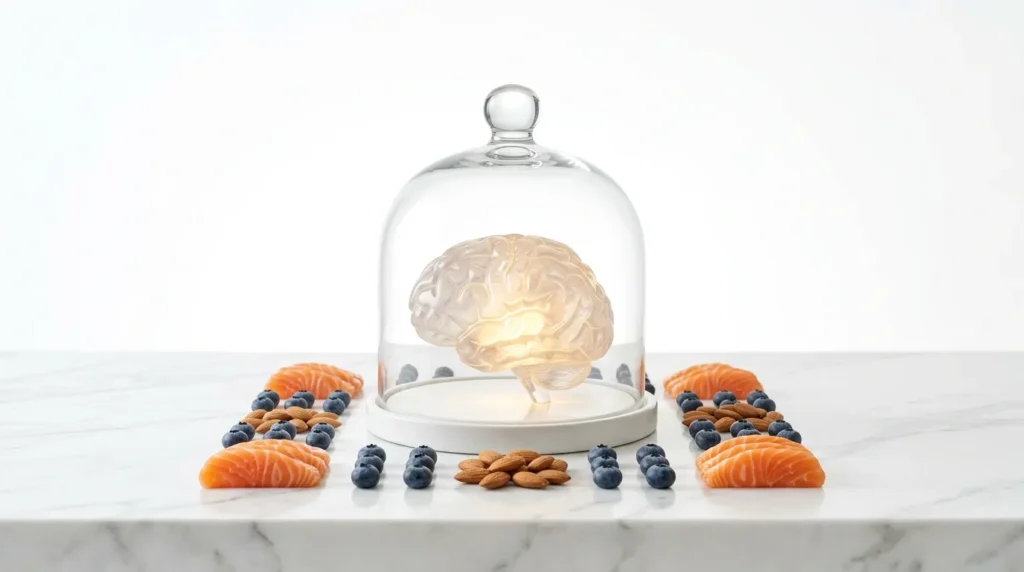
For my friend, nothing about the fix was dramatic. Protein and fiber added to breakfast instead of skipping it or grabbing something sugary between patients. Caffeine capped and moved earlier. More magnesium-rich foods — leafy greens, nuts, seeds — worked in deliberately rather than left to chance. Within a few weeks, she described the change not as feeling calm exactly, but as the volume on the noise finally turning down enough that she could actually hear herself think, and eventually sleep, without the forty tabs all shouting for attention at once.
None of this replaces genuine anxiety treatment when that’s what’s actually needed, and it’s worth being honest about that distinction. But for a lot of people whose minds simply won’t quiet down, the explanation isn’t always psychological. Sometimes it’s sitting quietly on the plate, several times a day, shaping the nervous system’s baseline long before any thought ever reaches conscious awareness.
Sources:
- Harvard T.H. Chan School of Public Health — Nutrition Source: https://www.hsph.harvard.edu/nutritionsource/
- National Institute of Mental Health — Anxiety Disorders: https://www.nimh.nih.gov/health/topics/anxiety-disorders
- National Institutes of Health — Office of Dietary Supplements (Magnesium): https://ods.od.nih.gov/factsheets/Magnesium-Consumer/
- Sleep Foundation — Caffeine and Sleep: https://www.sleepfoundation.org/nutrition/caffeine-and-sleep
- Mayo Clinic — Gut-Brain Connection: https://www.mayoclinic.org/healthy-lifestyle/stress-management

Aarti Solanki, B.Sc. (Food Science), is a food science writer passionate about making nutrition simple and evidence-based. She creates well-researched, easy-to-understand articles on healthy eating, food science, and nutrition, using information from trusted scientific and public health sources.