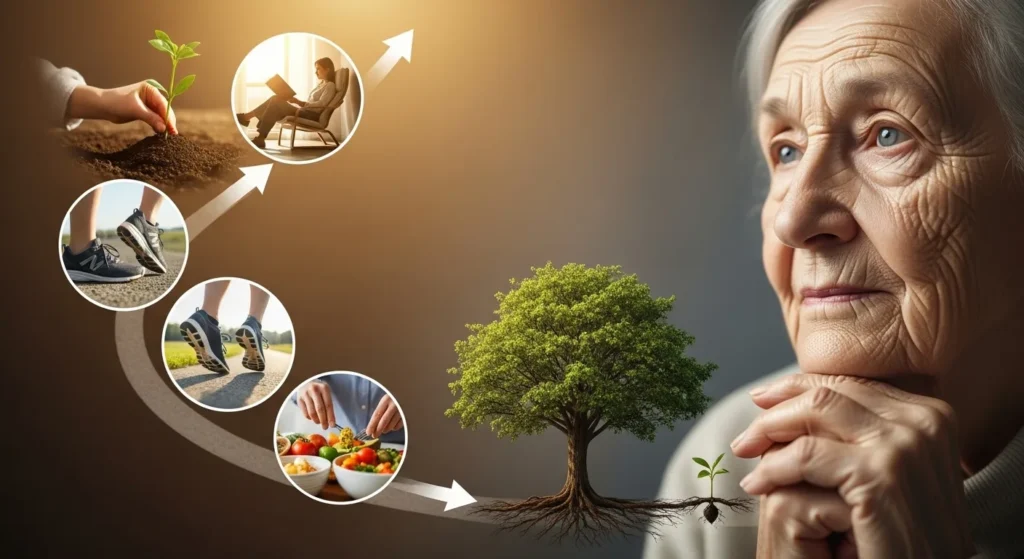
There’s a comforting story a lot of people tell themselves about aging: it’s mostly genetics, mostly luck, and mostly out of anyone’s hands. Some families just live long. Some people just don’t. It’s an appealing narrative because it removes responsibility — but it’s also considerably less accurate than most people assume, and newer research is making that gap even clearer.
What the Genetics Actually Say
For decades, the standard answer from twin studies was that genetics explained a relatively modest slice of how long someone lives — roughly 20 to 25 percent, according to earlier twin research, with some large pedigree studies suggesting figures as low as 6 percent. That would mean the vast majority of lifespan variation came down to environment, behavior, and chance.
A more recent analysis, published in the journal Science, revisited this question and found that once confounding factors like accidents and infections were properly separated out, the heritability of human lifespan due to intrinsic aging processes came out above 50 percent. This is a meaningfully higher estimate than before, and it’s worth taking seriously rather than dismissing.
But even accepting the higher figure, the math still tells an important story: genetics explaining roughly half of lifespan variation means the other half is shaped by something else — largely the accumulated effect of environment, behavior, and daily habits repeated over decades. One of the study’s lead researchers noted that this roughly 50 percent split is similar to what’s found across most human physiological traits, not just lifespan specifically. Genetics sets meaningful boundaries. It doesn’t write the whole story.
Why “Sudden Decline” Is Usually an Illusion
Even within that non-genetic half, aging rarely announces itself as a single dramatic event. What looks like a sudden decline — a health scare, a noticeable drop in stamina, an injury that “never really healed right” — is typically the visible endpoint of a much longer, quieter process that had been building for years beforehand. The event feels sudden because it’s the first moment the decline became impossible to ignore, not because it was actually sudden biologically.
This matters because it reframes how people should think about their own trajectory. A single bad week of eating, one missed workout, or one poor night’s sleep changes essentially nothing about long-term aging. But the pattern those single instances belong to, repeated consistently across years, is doing an enormous amount of quiet, compounding work in the background the entire time.
The Habits That Actually Show Up in the Data
Large-scale health research consistently identifies a fairly short, unglamorous list of habits with an outsized cumulative effect on healthy aging: consistent physical activity, adequate and varied nutrition, avoiding tobacco, moderate or no alcohol use, sufficient sleep, and maintained social connection. None of these are exotic interventions. What separates people who tend to age well isn’t usually access to some secret protocol — it’s the compounded effect of ordinary habits, maintained with unusual consistency over an unusually long stretch of time.
The compounding nature of this is easy to underestimate because none of these habits produce a noticeable result on any single day. A well-slept night doesn’t feel dramatically different from a poorly-slept one in terms of long-term consequences — until you consider what a decade of consistently poor sleep versus a decade of consistently adequate sleep actually does to cardiovascular health, cognitive function, and metabolic regulation over that entire stretch.
Reframing “Bad Luck”
Genuine bad luck exists — certain diseases and events aren’t preventable through lifestyle, and genetics does set real limits that no amount of good habits can fully overcome. It would be dishonest to suggest otherwise. But a lot of what gets attributed to bad luck in casual conversation is actually the delayed consequence of years of small, compounding choices that simply hadn’t shown their effects yet. The gap between cause and visible effect can be so long that the connection becomes genuinely hard to see without looking at the pattern over a much longer timeframe than any single year.
What This Actually Means Day to Day
None of this requires treating every meal or workout as high-stakes. The entire point of the compounding model is that no single day carries much weight on its own — what matters is the direction and consistency of the pattern over years. This is, if anything, a more forgiving framework than the all-or-nothing mindset many people bring to health habits, since it means recovering from a bad stretch and returning to a reasonable baseline matters far more than any individual lapse.
Aging isn’t a single dice roll decided at birth, and it isn’t a sudden cliff edge either. It’s closer to a long, slow accumulation — genetics setting some of the terrain, and years of small, repeated choices determining a great deal of the rest.
Sources
- Science – Heritability of Intrinsic Human Life Span Is About 50% When Confounding Factors Are Addressed
- The Conversation – What New Twins Study Reveals About Genes, Environment and Longevity
- World Health Organization – Ageing and Health Fact Sheet
- National Institute on Aging – Healthy Aging Research
- Harvard T.H. Chan School of Public Health – The Nutrition Source

Aarti Solanki, B.Sc. (Food Science), is a food science writer passionate about making nutrition simple and evidence-based. She creates well-researched, easy-to-understand articles on healthy eating, food science, and nutrition, using information from trusted scientific and public health sources.





Pingback: How Daily Food Choices Quietly Shape Your Long-Term Health (More Than You Realize)
Pingback: Why Aging Is a Gradual Nutritional Process (And Not Just Time Catching Up With You)