Aging Doesn’t Start With Wrinkles — It Starts With Food
Most people think aging is about time.
Years pass.
Bodies slow down.
Health fades.
But aging doesn’t begin with birthdays.
It begins with daily inputs—especially food quality.
Two people can eat the same number of calories for decades and age very differently.
One stays energetic, mobile, and mentally sharp.
The other struggles with fatigue, inflammation, and chronic disease.
The difference isn’t luck.
It’s food quality.
What you eat doesn’t just fuel you for today.
It quietly shapes how your body will function years from now.
What “Aging Trajectory” Really Means
Aging isn’t a single event.
It’s a direction.
Your aging trajectory refers to:
- How fast systems lose efficiency
- How resilient your metabolism stays
- How much inflammation accumulates
- How well repair mechanisms function
Food quality determines whether aging feels:
- Gradual and manageable
- Or accelerated and overwhelming
This isn’t about extremes.
It’s about patterns repeated over time.
Calories vs Food Quality: The Critical Difference
Calories tell you how much energy you’re eating.
Food quality tells you what information you’re giving your body.
High-quality foods provide:
- Micronutrients that support repair
- Stable energy signals
- Anti-inflammatory compounds
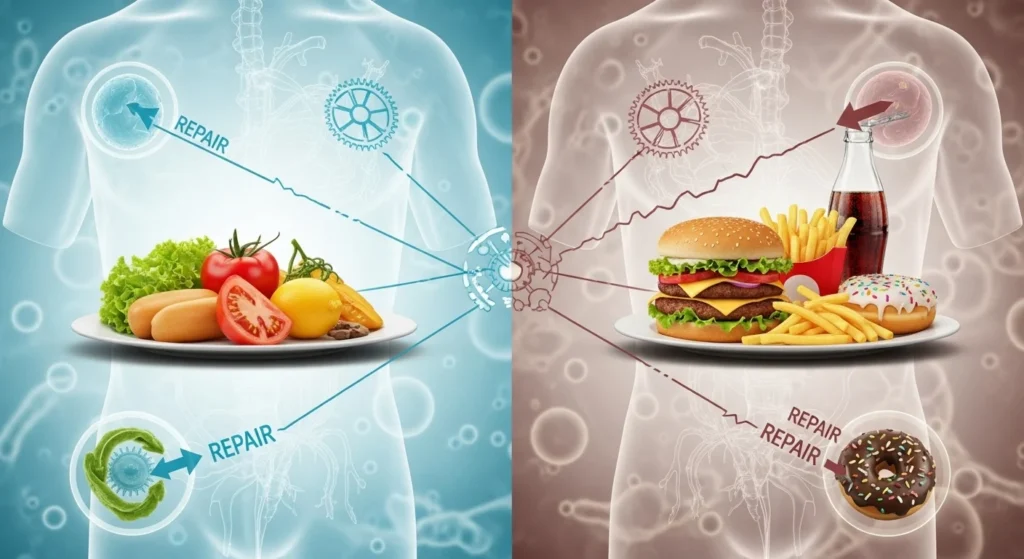
Low-quality foods send different signals:
- Blood sugar spikes
- Inflammatory responses
- Poor nutrient delivery
The body reacts accordingly.
Why the Body Interprets Food as Signals, Not Just Fuel
Every meal sends messages.
Food tells your body:
- Whether to store fat or build muscle
- Whether to increase inflammation or reduce it
- Whether to repair tissues or conserve energy
Highly processed foods confuse these signals.
Whole, nutrient-dense foods clarify them.
Over time, signal clarity shapes aging speed.
Ultra-Processed Foods and Accelerated Aging
Ultra-processed foods are engineered for convenience and taste—not longevity.
They are typically:
- Low in micronutrients
- High in refined carbohydrates
- High in industrial fats
- Easy to overconsume
Research consistently links high intake of ultra-processed foods with:
- Increased inflammation
- Insulin resistance
- Faster biological aging markers
The body works harder for less return.
That’s efficiency loss.
Nutrient Density: The Anti-Aging Advantage
Nutrient-dense foods deliver more biological value per bite.
These foods support:
- Cellular repair
- Hormone balance
- Mitochondrial efficiency
- Muscle maintenance
Examples include:
- Eggs
- Fish
- Fruits and vegetables
- Nuts and seeds
- Minimally processed whole foods
Quality reduces metabolic strain.
Why Aging Bodies Need Better Food, Not Less Food
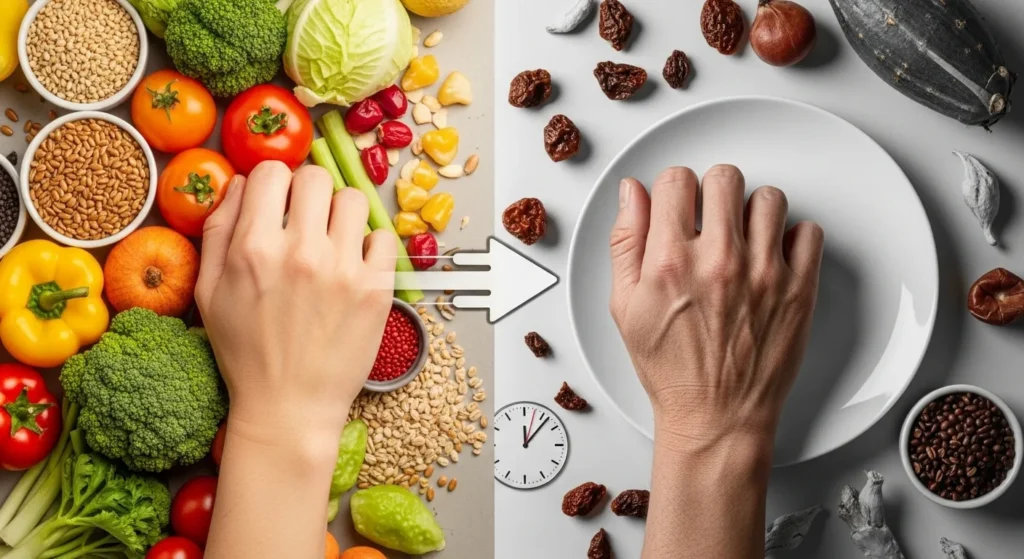
A common mistake is eating less as we age.
But aging bodies:
- Absorb nutrients less efficiently
- Repair tissues more slowly
- Lose muscle more easily
This means food quality becomes more important, not less.
Restriction without nutrient density accelerates decline.
Blood Sugar Stability and Aging Speed
Frequent blood sugar spikes:
- Increase inflammation
- Damage blood vessels
- Accelerate cellular aging
Food quality directly affects:
- Insulin sensitivity
- Energy stability
- Cognitive clarity
High-quality meals create smoother glucose responses.
Low-quality meals create metabolic chaos.
Inflammation: Where Food Quality Leaves Its Mark
Chronic inflammation is one of the strongest drivers of aging.
Food quality influences:
- How long inflammation stays active
- How easily the body resolves stress
Diets rich in whole foods tend to:
- Lower inflammatory markers
- Improve tissue recovery
Highly processed diets do the opposite.
Food Quality and Muscle Preservation
Muscle loss isn’t inevitable with age.
But poor-quality diets accelerate it by:
- Reducing protein utilization
- Increasing inflammation
- Impairing muscle repair signals
High-quality protein sources support:
- Strength
- Balance
- Long-term independence
This directly affects aging trajectory.
Aging Trajectory: A Side-by-Side Comparison
| Factor | Low Food Quality Diet | High Food Quality Diet |
|---|---|---|
| Inflammation | Chronic, unresolved | Lower, well-regulated |
| Energy | Frequent crashes | Stable throughout day |
| Muscle mass | Gradual loss | Better preservation |
| Insulin sensitivity | Declines faster | Maintained longer |
| Aging speed | Accelerated | Slower, steadier |
Real-Life Example: Same Calories, Different Futures
Two adults eat 2,000 calories daily.
Person A:
- Mostly ultra-processed foods
- Low nutrient density
- Frequent snacking
Person B:
- Whole foods
- Balanced meals
- Adequate protein
After 20 years, outcomes differ dramatically.
Not because of calories.
Because of food quality.
Hidden Tip: Consistency Beats Perfection
Food quality doesn’t require:
- Organic everything
- Expensive superfoods
- Perfect diets
It requires:
- Repeated good choices
- Fewer ultra-processed foods
- More whole foods over time
Consistency shapes trajectory.
Mistakes That Quietly Damage Aging Outcomes
Avoid these common traps:
- Focusing only on calories
- Ignoring micronutrients
- Over-restricting food
- Assuming supplements replace food
- Treating aging decline as inevitable
Each mistake compounds over years.
Actionable Steps to Improve Food Quality Today
Start small and sustainable:
- Build meals around whole foods
- Include protein at every meal
- Reduce ultra-processed snacks
- Eat regular, balanced meals
- Prioritize variety over restriction
These steps improve efficiency—not just weight.
Why This Matters Today
People live longer than ever.
But many spend those extra years managing fatigue, pain, and chronic disease.
Food quality determines whether longevity feels:
- Empowering
- Or exhausting
Your aging trajectory is shaped quietly—meal by meal.
Key Takeaways
- Food quality shapes aging speed more than calories
- Nutrient density supports repair and efficiency
- Ultra-processed foods accelerate aging signals
- Consistent quality matters more than perfection
- Aging trajectory is modifiable at any stage
Frequently Asked Questions
1. Can improving food quality really slow aging?
Yes. It supports metabolic efficiency, inflammation control, and cellular repair.
2. Is it too late to change my aging trajectory?
No. Improvements occur at any age with better nutrition.
3. Do supplements replace food quality?
No. Supplements support gaps but can’t replace whole-food signals.
4. Are carbohydrates bad for aging?
No. Refined carbs are problematic; whole-food carbs support health.
5. How fast do changes in food quality matter?
Benefits begin within weeks, while long-term effects accumulate over years.
Conclusion: Aging Is Shaped Quietly, Not Suddenly
Aging doesn’t happen overnight.
It’s shaped by small, repeated choices—especially what you eat.
Food quality doesn’t promise immortality.
But it offers something far more valuable: a better aging journey.
One meal at a time.
Disclaimer: This article is for educational purposes only and is not a substitute for personalized medical or nutritional guidance.