My father-in-law keeps a photo on his desk of himself at forty, standing next to a photo of himself now, at seventy-two. People assume he keeps it there out of vanity, or nostalgia. He says it’s neither. He keeps it there because the man in the first photo made decisions the man in the second photo has to live with, and he wants to remember that the reverse is also true — the decisions he makes today belong to someone he hasn’t met yet.
It’s a strange way to think about lunch. But it’s not wrong.
Most people treat food as something that matters in the moment — energy for the afternoon, satisfaction after a long day, maybe weight management if that’s a current concern. What rarely enters the picture is the idea that a sandwich eaten today is quietly filed away in a body that will still be operating in twenty, thirty, forty years, built partly from the raw materials that sandwich provided. That’s not a metaphor. It’s closer to literal biology.
Cells Today Are Built From Yesterday’s Choices
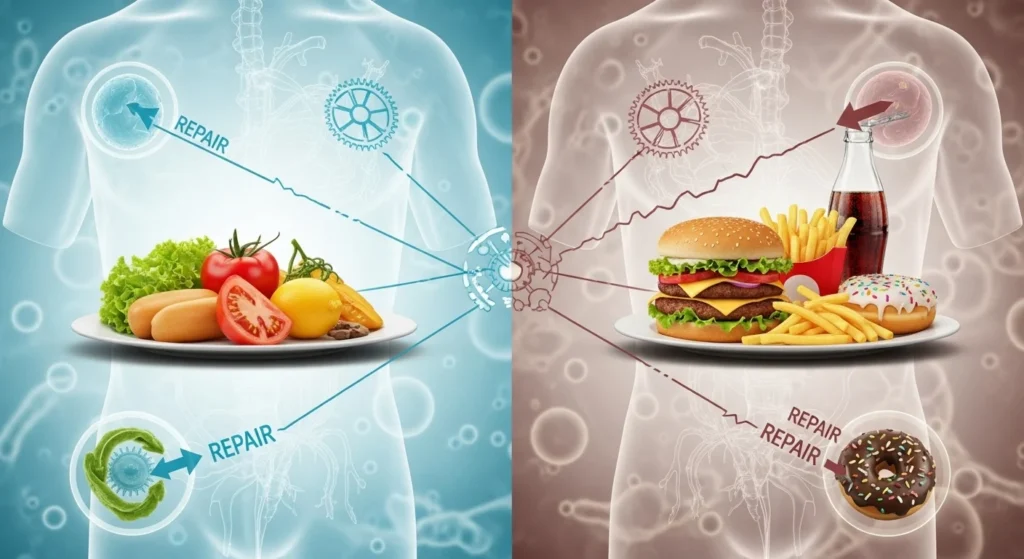
The body is in a constant state of turnover. Bone remodels itself over roughly a decade. Skin cells replace themselves every few weeks. Even DNA repair — the process that fixes small errors before they become bigger problems — depends on nutrients like folate, B12, and zinc to function properly. Every one of these processes draws on whatever raw material is currently available in the bloodstream, which means the quality of that supply, sustained over years, shapes how well those repairs actually get done.
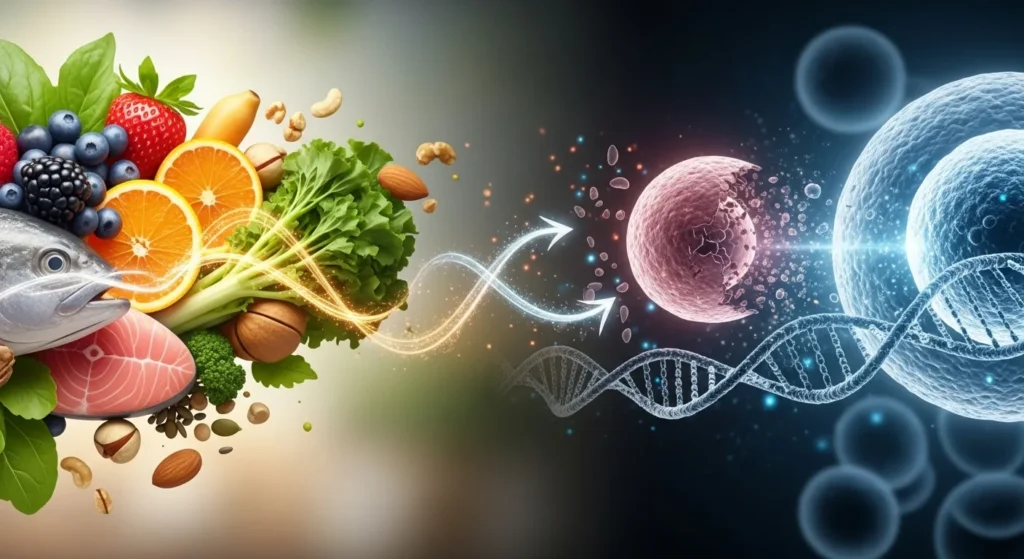
This is where the long view matters more than any single meal. A diet that’s chronically low in these repair-supporting nutrients doesn’t produce an obvious symptom next Tuesday. It produces a slightly less accurate repair process, repeated billions of times, for years, until the accumulated imprecision starts to look like what we casually call “aging.” Telomeres — the protective caps on the ends of chromosomes that shorten with each cell division — appear to shorten faster under chronic nutrient deficiency and oxidative stress, and slower in people with diets rich in antioxidants and omega-3s. Nobody feels their telomeres. But the pace at which they erode is, apparently, listening to what’s on the plate.
The Sugar You Eat Now Is Aging Your Skin Later
There’s a specific, well-documented process called glycation, where excess sugar in the bloodstream binds to proteins like collagen, forming compounds called advanced glycation end products, or AGEs. This isn’t a slow abstract process — it’s happening continuously, and it directly stiffens collagen and elastin, the proteins responsible for skin’s elasticity. High-sugar diets sustained over years produce measurably more of this damage than diets where sugar is occasional rather than constant. The wrinkle that shows up at fifty was, in some literal sense, under construction at thirty.
This tends to land differently than the usual “sugar is bad for you” warning, because it’s not about weight or energy crashes. It’s about a specific mechanical process quietly stiffening tissue years before anyone notices the visible result.
Bone Density Is Decided Earlier Than People Think
Peak bone mass is typically reached by the late twenties, and from that point on, it’s largely a story of how slowly it declines rather than how much more can be built. Calcium and vitamin D intake through the twenties and thirties has an outsized influence on how much bone density there is to draw on decades later, when the decline accelerates, particularly for women after menopause. Someone who spent their twenties skipping dairy and avoiding the sun without compensating elsewhere isn’t just making a choice for that year. They’re setting the baseline their sixty-year-old self will be working from.
The Brain Keeps a Longer Memory Than Expected
Diets high in saturated fat and low in omega-3s, sustained over decades, are associated with more pronounced cognitive decline later in life, while diets resembling the Mediterranean pattern — fish, olive oil, vegetables, nuts — are linked with better-preserved cognitive function into older age. This isn’t a switch that flips at sixty-five. It appears to be a slope that starts forming decades earlier, shaped meal by meal, well before anyone is thinking about memory at all.
The Photo on the Desk
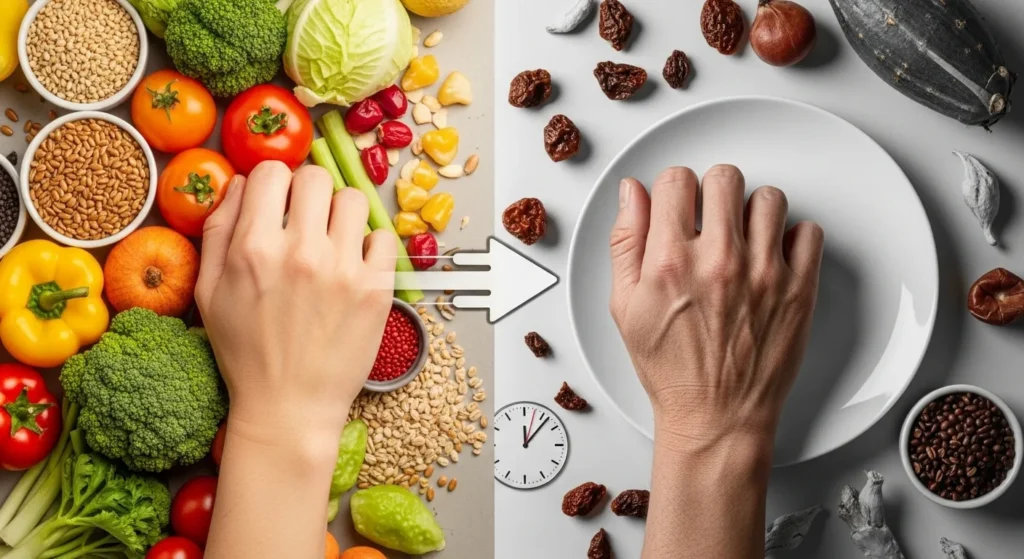
My father-in-law’s point, as best I can tell, isn’t that food is destiny or that one bad decade ruins everything — the body is more forgiving and more responsive than that. His point is smaller and somehow more useful: that the gap between the person eating lunch today and the person who’ll wake up in that body in thirty years is not as wide as it feels. They’re the same project, running continuously, with today’s ingredients becoming tomorrow’s material.
Most people don’t get to see both photos side by side while there’s still time to act on what they show. But the biology behind them is running regardless, quietly, one meal at a time.
Sources:
- National Institute on Aging — Nutrition and Healthy Eating as You Age: https://www.nia.nih.gov/health/healthy-eating-nutrition-and-diet
- Harvard T.H. Chan School of Public Health — Nutrition Source: https://www.hsph.harvard.edu/nutritionsource/
- National Institutes of Health — Office of Dietary Supplements: https://ods.od.nih.gov/
- Mayo Clinic — Healthy Aging: https://www.mayoclinic.org/healthy-lifestyle/healthy-aging

Aarti Solanki, B.Sc. (Food Science), is a food science writer passionate about making nutrition simple and evidence-based. She creates well-researched, easy-to-understand articles on healthy eating, food science, and nutrition, using information from trusted scientific and public health sources.