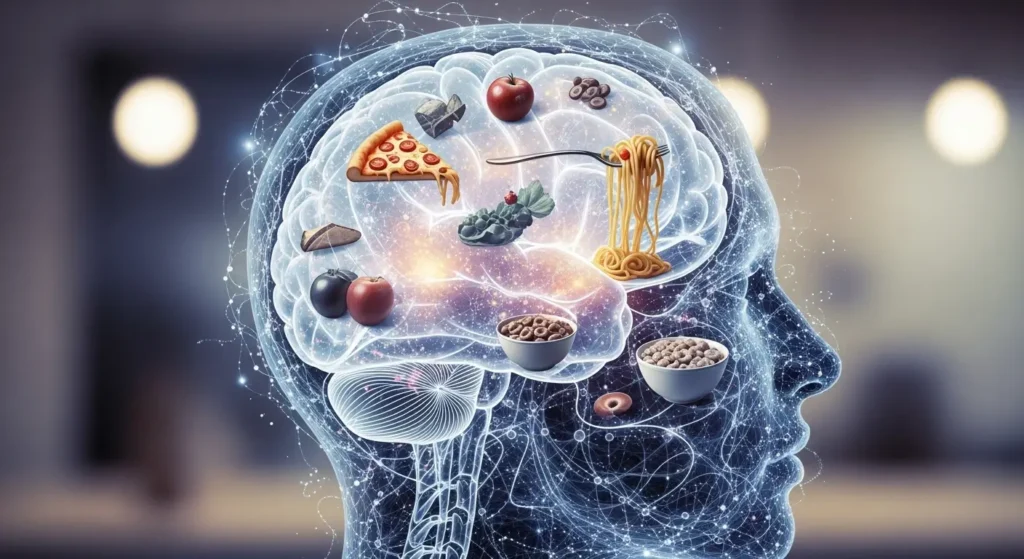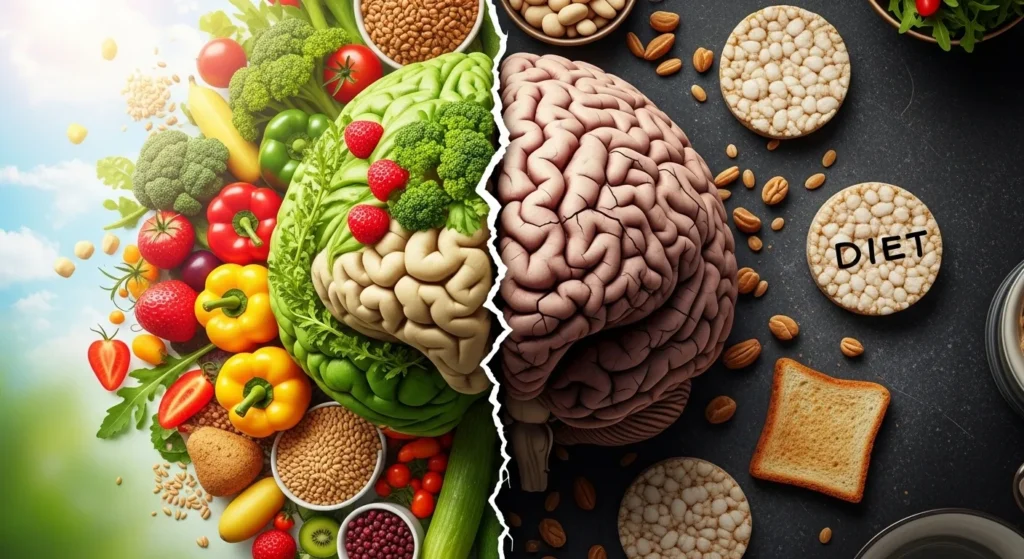
The Part No One Talks About: Dieting Can Change Your Mind Fast
Extreme diets are usually marketed as physical transformations.
Lose weight quickly.
Detox fast.
Reset your body.
But what many people don’t expect is this:
The first backfire often happens in the brain.
Suddenly, you feel:
- mentally slower
- emotionally reactive
- more anxious
- obsessed with food
- unable to focus
And you wonder:
“Why is my mind struggling so much?”
Here’s the truth:
The brain responds poorly to extreme diets because it interprets severe restriction as a threat, not a health upgrade.
Your brain is built for survival, not diet trends.
Let’s explore why harsh eating plans affect mental function so deeply.
The Brain Needs Constant Fuel — Not Dietary Drama
The brain makes up only about 2% of your body weight…
But it uses roughly 20% of your resting energy.
That means the brain has enormous energy demand.
And unlike muscle, the brain cannot store much fuel.
It depends on:
- steady glucose delivery
- consistent nutrient intake
- stable meal rhythms
Extreme diets disrupt that stability quickly.
So even if your body can “push through”…
Your brain often can’t.
Extreme Restriction Activates Survival Mode in the Brain
When intake drops suddenly, the brain doesn’t assume:
“Oh great, fat loss.”
It assumes:
“Food supply is uncertain. Stay alert.”
That triggers protective responses:
- hunger hormones rise
- stress hormones increase
- reward sensitivity heightens
- thinking becomes more survival-driven
This is why extreme dieting often leads to:
- irritability
- anxiety
- cravings
- mental fatigue
It’s not weakness.
It’s neural defense.
Brain Fog Is Often a Fuel Problem
One of the earliest symptoms of extreme dieting is cognitive slowing.
People report:
- difficulty concentrating
- forgetfulness
- sluggish thinking
- reduced motivation
This often happens because:
- glucose availability becomes unstable
- calories drop too low
- meals become inconsistent
- carbohydrate intake is sharply reduced
The brain runs best on steady energy.
Extreme diets create energy uncertainty.
Real-Life Example: “I’m Losing Weight, But I Feel Mentally Worse”
This is incredibly common.
Someone starts an intense diet:
- very low calories
- no carbs
- fasting aggressively
- cutting multiple food groups
The scale drops…
But mentally they feel:
- edgy
- tired
- emotionally fragile
- obsessed with food
That’s because the brain values safety over aesthetics.
Weight loss without stability feels like scarcity.
Scarcity is stressful neurologically.
Extreme Diets Increase Cravings by Design
Restriction strengthens food focus.
Studies on semi-starvation show that food obsession increases dramatically when intake is cut too hard.
The brain becomes hyper-attuned to:
- smells
- food cues
- cravings
- reward anticipation
Why?
Because the brain is trying to keep you alive.
Extreme diets unintentionally train the brain to think about food constantly.
Comparison Table: Moderate Nutrition vs Extreme Diet Effects on the Brain
| Brain Function | Moderate Sustainable Eating | Extreme Diet Restriction |
|---|---|---|
| Focus | Clearer and steadier | Foggy, distracted |
| Mood | More stable | Irritable, anxious |
| Hunger signals | Balanced | Urgent and intense |
| Cravings | Manageable | Obsessive |
| Sleep quality | More regulated | Often disrupted |
Neurotransmitters Depend on Nutrients
The brain doesn’t run only on calories.
It runs on chemistry.
Extreme diets often reduce nutrients needed for neurotransmitters:
- protein → amino acids for dopamine/serotonin
- fats → brain cell membrane health
- B vitamins → neuronal energy pathways
- iron → oxygen and dopamine function
- magnesium → calming neural regulation
When intake becomes too narrow, mood and cognition suffer quickly.
The Brain Reacts Strongly to Carbohydrate Removal
Carbs are controversial in diet culture…
But neurologically, sudden carb removal often causes symptoms:
- brain fog
- low mood
- sluggish thinking
- sleep disruption
That’s because glucose is a primary brain fuel.
The brain can adapt over time, but abrupt changes are stressful.
The issue isn’t “carbs are essential”…
It’s that extreme shifts are destabilizing.
Extreme Dieting Disrupts Sleep — Which Further Damages Cognition
When dieting is aggressive:
- cortisol rises
- hunger hormones increase
- sleep becomes lighter
- wake-ups become more frequent
- cravings
- emotional regulation
- mental clarity
So the brain enters a loop:
restriction → stress → poor sleep → more cravings → less control
Extreme diets create mental instability through multiple pathways.
Hidden Tip: The Brain Prefers Predictability Over Perfection
The brain thrives on rhythm.
Regular eating creates safety signals.
Extreme dieting creates uncertainty signals.
Even if the diet is “healthy” on paper…
If it’s harsh, sudden, or unsustainable…
The brain treats it as threat.
That’s why boring consistency works better than dramatic resets.
Common Mistakes That Trigger Brain Backfire
Mistakes to avoid:
- cutting calories too low
- skipping meals aggressively
- removing carbs suddenly
- eliminating entire food groups
- dieting without enough protein
- relying on caffeine to function
- treating hunger as something to “beat”
Discipline doesn’t override neurobiology.
Stability supports it.
Actionable Steps: Supporting the Brain While Improving Nutrition
Here’s how to pursue health without triggering mental backfire.
1. Choose Gentle Deficits, Not Extreme Cuts
Small changes allow the brain to adapt calmly.
2. Keep Protein Consistent
Protein stabilizes appetite and supports neurotransmitter building.
3. Avoid All-or-Nothing Food Rules
Rigid rules increase psychological stress and rebound eating.
4. Build Balanced Meals for Glucose Stability
Include:
- protein
- fiber
- healthy fats
- slow carbs
5. Focus on Repeatable Habits, Not Rapid Transformation
Ask:
“Can I eat this way on an ordinary week?”
That’s the real test.
Why This Matters Today (Evergreen Truth)
Extreme diets are everywhere:
- social media challenges
- rapid transformations
- detox culture
- “reset” marketing
But the brain hasn’t changed.
It still interprets extreme restriction as danger.
The cost is not just physical…
It’s mental:
- focus loss
- mood instability
- obsession with food
- cognitive fatigue
Sustainable nutrition protects both body and mind.
Key Takeaways
- The brain responds poorly to extreme diets because it senses scarcity and threat
- Restriction increases cravings, stress hormones, and food obsession
- Cognitive fog and mood shifts are common neurological responses
- Nutrient balance supports neurotransmitters and mental resilience
- Gentle consistency works better than extreme dietary swings
FAQ: Extreme Diets and Brain Health
1. Why do extreme diets cause brain fog?
Because the brain experiences unstable energy delivery and reduced nutrient support.
2. Are cravings a sign of weakness?
No. Cravings often reflect survival signaling triggered by restriction.
3. Do low-carb diets harm the brain?
Not necessarily long-term, but sudden drastic carb removal can cause cognitive symptoms during transition.
4. Why do extreme diets feel mentally exhausting?
Because the brain enters alert mode, increasing food focus and reducing cognitive flexibility.
5. What’s the best alternative to extreme dieting?
Small, consistent nutrition upgrades that support stable energy and long-term habits.
Conclusion: The Brain Doesn’t Thrive Under Nutrition Pressure
Extreme diets promise fast results…
But the brain pays attention first.
It wants safety.
It wants steady fuel.
It wants predictability.
So if you’ve ever felt mentally worse while dieting…
It’s not because you’re failing.
It’s because your brain is protecting you.
Real health isn’t built through deprivation.
It’s built through nourishment that your brain and body can trust.
Consistency is calmer.
And calmer is sustainable.