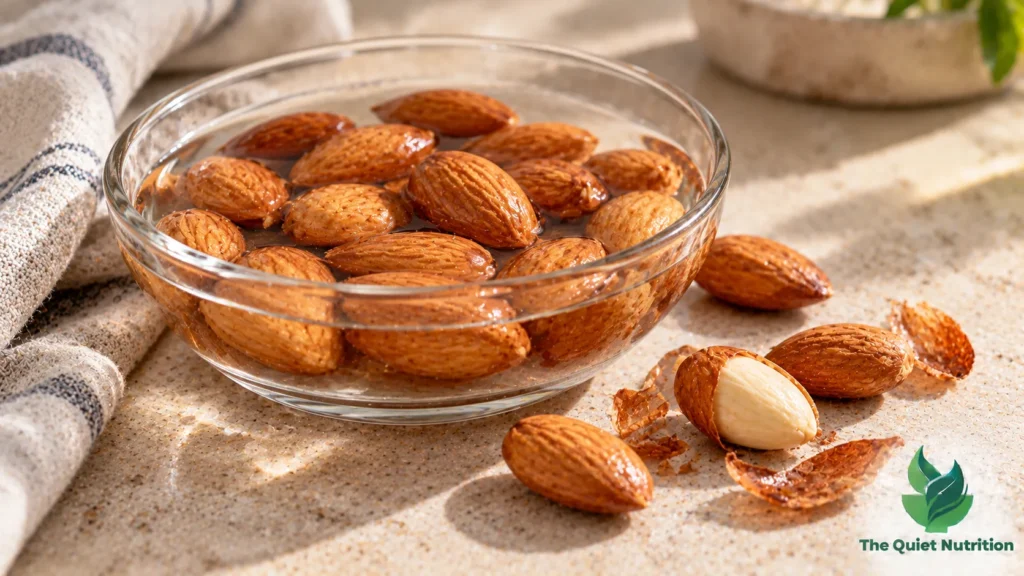
Soaking almonds overnight is a familiar food habit in many households, particularly in India. The practice is often promoted as a way to make almonds easier to digest, improve nutrient absorption, and unlock benefits that raw almonds supposedly cannot provide.
There is some science behind how soaking changes almonds, but the popular claims need a closer look. Almonds are nutritious whether you soak them or eat them plain. Soaking changes their texture and may affect certain compounds, but it has not been convincingly shown to make almonds universally healthier or dramatically increase their nutritional benefits.
This article explores what soaking actually does, which claims have evidence behind them, and how to enjoy almonds in a practical, balanced way.
1. Soaking Changes the Texture of Almonds
The most obvious effect of soaking almonds is physical.
When almonds sit in water, they absorb moisture and become softer. Their skins may loosen, and the nuts develop a less crunchy texture that some people find easier to chew.
This change helps explain why soaked almonds are popular in traditional food practices. They can be more pleasant to eat for people who dislike the firm texture of raw almonds, and they can be easier to blend into certain recipes.
However, softer does not automatically mean more nutritious. Soaking primarily changes the almond’s moisture content and texture; it does not transform an ordinary almond into a fundamentally different food.
If you enjoy the softer texture, soaking can be a reasonable personal preference. If you prefer crunchy almonds, there is no established nutritional reason to force yourself to soak them.
2. They Still Provide Vitamin E and Healthy Fats
Almonds are naturally rich in vitamin E, monounsaturated fats, and other nutrients. These nutritional qualities remain relevant whether you eat them soaked or unsoaked.
Vitamin E acts as an antioxidant and supports normal immune function. Monounsaturated fats contribute energy and form part of a dietary pattern associated with healthier blood cholesterol levels when they replace some saturated fats.
Almonds also provide plant protein, fiber, magnesium, and other minerals. A one-ounce serving of almonds—roughly 23 almonds—contains about 6 grams of protein and 3 grams of fiber, alongside vitamin E and unsaturated fats.
Soaking does not create these nutrients. They are already present in the almond.
It is also worth remembering that soaking can cause some water-soluble substances and minerals to leach into the soaking water. If that water is discarded, some nutrients may be lost. The exact amount depends on the soaking conditions and the nutrient being considered.
The practical lesson is that almonds are nutritious in their ordinary form. Soaking may make them more appealing to you, but it should not be treated as a requirement for obtaining their benefits.
3. The Claim That Soaking Removes Phytates Needs a Closer Look
One of the most common explanations for soaking almonds is that it reduces phytic acid, also known as phytate.
Phytate occurs naturally in many seeds, nuts, grains, and legumes. It can bind minerals such as iron and zinc and reduce their absorption under certain conditions. This is why some nutrition advice recommends soaking, sprouting, or fermenting plant foods.
However, findings from grains and legumes cannot automatically be applied to almonds.
A 2020 study published in Food Chemistry examined whether soaking or “activating” nuts improved their mineral availability. Researchers tested almonds, hazelnuts, peanuts, and walnuts using different soaking conditions. They found only small changes in phytate concentrations, and soaking did not improve the ratios used to assess phytate’s relationship with mineral content. Mineral concentrations sometimes decreased, particularly in chopped nuts.
The researchers concluded that their findings did not support the claim that soaking nuts reliably improves nutrient bioavailability.
This does not mean phytate is inherently harmful. Its effect depends on the overall diet, the amount consumed, and the nutrients available from other foods. For people eating a varied diet, phytate-containing foods can still be valuable sources of nutrition.
The important point is that soaking almonds has not been shown to reliably remove enough phytate to make their minerals substantially more available.
4. Soaked Almonds Are Not Proven to Be Easier to Digest
Some people report that soaked almonds feel gentler on their stomachs. Others notice no difference.
Personal experiences like these can be genuine, but they do not establish a general digestive benefit.
A randomized crossover trial published in the European Journal of Nutrition compared different almond preparations, including soaked and unsoaked whole almonds. The study found that gastrointestinal symptoms were generally minimal, but soaking did not improve gastrointestinal tolerance as popular claims suggest. Flatulence was actually rated higher for soaked whole almonds than for unsoaked whole almonds in the study.
The findings do not mean that soaked almonds will cause digestive discomfort for everyone. They show that soaking is not a reliable, evidence-based solution for digestive symptoms.
If you find soaked almonds easier to chew or more comfortable to eat, there is no need to dismiss that preference. But if you experience persistent bloating, abdominal pain, or other digestive symptoms, soaking almonds should not be assumed to address the underlying cause.
The response may depend on the person, the amount eaten, the rest of the meal, and other digestive factors.
5. They Can Contribute to a Heart-Conscious Diet
The established nutritional value of almonds is more important than whether they have been soaked.
Almonds contain unsaturated fats, fiber, plant protein, and phytochemicals. Research on almonds and other nuts has found benefits for certain cardiovascular risk markers, particularly blood cholesterol, when nuts are included in an appropriate dietary pattern.
Their unsaturated fats are especially relevant when almonds replace snacks or ingredients that contain more saturated fat. A small serving of almonds can therefore be a useful alternative to some less nutritious snack choices.
But this evidence concerns almonds and nut consumption generally—not a special heart-health effect of soaked almonds.
There is no convincing evidence that soaking almonds makes them uniquely effective at lowering cholesterol or preventing heart disease compared with eating them unsoaked.
For heart health, the more important factors are the overall quality of your diet, regular physical activity, and appropriate management of any existing health conditions.
6. The Skin Is Not Something You Must Remove
In many households, soaking almonds is followed by peeling off the brown skin. The practice is familiar, but it is worth asking whether removing the skin is nutritionally necessary.
Almond skin contains fiber and plant compounds, including polyphenols. These compounds have attracted scientific interest because of their potential biological activity.
Removing the skin therefore removes some of the almond’s naturally occurring components. That does not mean peeled almonds become unhealthy; they still contain fat, protein, vitamin E, and minerals.
The important point is that peeling is generally a matter of texture, taste, and tradition rather than a proven nutritional upgrade.
If you enjoy peeled almonds, you can continue eating them that way. If you prefer the convenience of eating almonds whole, there is no established reason to remove the skin solely for health benefits.
A varied diet can include both, and the presence of almond skin is not a reason to avoid an otherwise nutritious food.
7. Soaking Does Not Make Almonds a Weight-Loss Food
Almonds are energy-dense because they contain a substantial amount of fat. That is not inherently a problem: unsaturated fats are an important part of a balanced diet.
A one-ounce serving of almonds supplies approximately 165–170 calories, depending on the product and measurement. Soaking adds water and makes the almonds heavier, but it does not meaningfully eliminate their energy content.
This distinction matters because a serving of soaked almonds may appear larger due to the absorbed water. That does not mean it provides fewer calories from the original almonds.
Almonds can fit into a weight-conscious eating pattern because their protein, fat, and fiber can help make a snack satisfying. Research on nut consumption does not support the assumption that eating nuts automatically causes weight gain.
However, soaking is not a proven weight-loss strategy. The benefit comes from how almonds fit into the overall diet, including whether they replace less nutritious snacks and how much you eat.
A modest portion is a practical starting point, whether the almonds are soaked or crunchy.
How to Soak Almonds Safely
If you prefer the texture of soaked almonds, preparing them is straightforward.
- Place the almonds in a clean bowl or container.
- Cover them with clean drinking water.
- Cover the container and refrigerate while soaking, rather than leaving it at room temperature overnight.
- Drain the water and rinse the almonds before eating.
- Eat them promptly, or store them in a clean, covered container in the refrigerator for a short period.
Discard almonds that develop an unusual smell, visible mould, or a slimy texture. Soaking introduces moisture, which can make improper storage more problematic than storing dry almonds.
You can soak only the portion you intend to eat, avoiding the need to store a large batch of wet almonds for several days.
There is no established need to soak almonds for a particular number of hours to unlock their nutrients. If your goal is simply to soften them, you can adjust the time to achieve the texture you prefer while keeping food safety in mind.
Soaked or Unsoaked: Which Should You Choose?
For most people, the decision comes down to preference and convenience rather than a major difference in nutritional value.
Choose soaked almonds if you enjoy their softer texture, prefer them peeled, or find them more convenient to incorporate into certain dishes.
Choose unsoaked almonds if you enjoy their crunch, want a quick snack, or prefer a preparation method that requires no advance planning.
Either option can supply valuable nutrients. The available evidence does not establish that soaking almonds consistently improves mineral absorption or digestive tolerance, and it does not demonstrate that soaked almonds deliver greater overall health benefits than unsoaked almonds.
If you already enjoy soaked almonds as part of your routine, there is no need to stop simply because the claimed benefits are overstated. Just understand that the habit is primarily a preparation preference rather than a proven nutritional necessity.
The Bottom Line
Soaked almonds are popular because they become softer, can be easier to chew, and fit comfortably into traditional food routines. Almonds themselves are nutritious sources of vitamin E, unsaturated fats, protein, fiber, and minerals.
However, research has not established that soaking reliably reduces phytate enough to improve mineral absorption, or that it consistently makes almonds easier to digest. Their established nutritional value does not depend on soaking.
Enjoy them soaked if you like the texture, or eat them unsoaked if that is more convenient. Choose a sensible portion, store soaked almonds safely, and focus on the quality of your overall diet rather than expecting a simple preparation method to unlock extraordinary health benefits.
Research sources
- Does ‘Activating’ Nuts Affect Nutrient Bioavailability? — Food Chemistry (2020) — tested soaking methods and found no support for improved mineral bioavailability.
- The Effects of ‘Activating’ Almonds on Consumer Acceptance and Gastrointestinal Tolerance — European Journal of Nutrition (2018) — randomized crossover study assessing soaked versus unsoaked almond preparations.
- Harvard T.H. Chan School of Public Health — Almonds — almond nutrient profile, serving size, and evidence on general health effects.
- Harvard Health Publishing — How to Eat Nuts the Healthy Way — nutrient content and practical portion guidance for nuts.

Aarti Solanki, B.Sc. (Food Science), is a food science writer passionate about making nutrition simple and evidence-based. She creates well-researched, easy-to-understand articles on healthy eating, food science, and nutrition, using information from trusted scientific and public health sources.