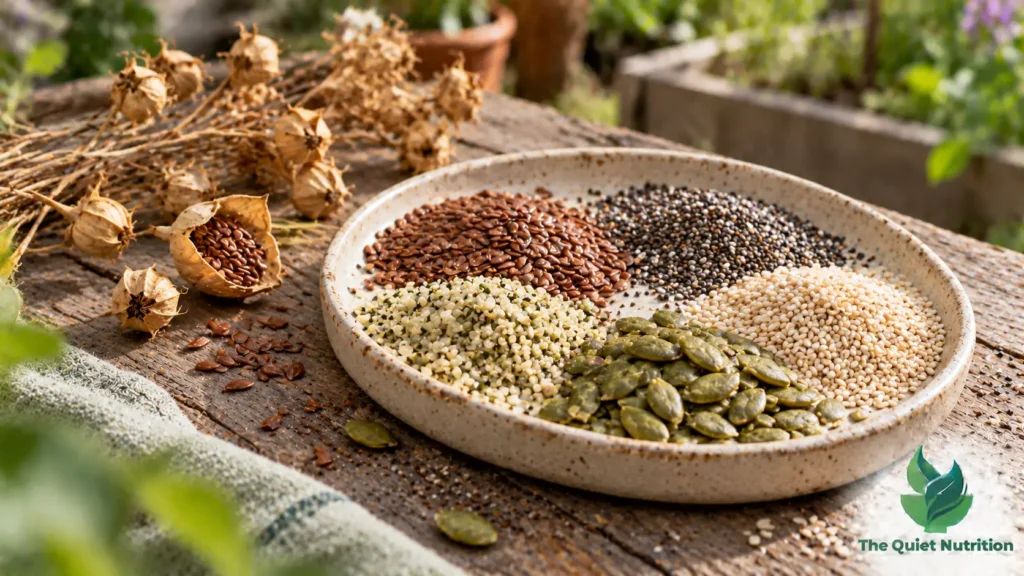
Chia seeds stirred into yogurt, flaxseed mixed into oatmeal, pumpkin seeds scattered over a salad, and sesame seeds added to bread may seem like small dietary details. But these ingredients share something important: they pack a variety of nutrients into a relatively small serving.
Seeds contain different combinations of unsaturated fats, plant protein, fiber, vitamins, minerals, and naturally occurring plant compounds. Some are particularly rich in alpha-linolenic acid (ALA), a plant-based omega-3 fatty acid. Others stand out for their fiber, protein, vitamin E, magnesium, or distinctive compounds such as sesame lignans.
This nutritional density helps explain why seeds are often described as superfoods. Yet the term is not an official scientific classification, and it can exaggerate what a single food can accomplish. Harvard’s nutrition experts point out that there is no magic ingredient that replaces a balanced, varied diet. <Cite refs={[“turn373002view4”]}/>
The more useful question is not whether seeds deserve a fashionable label. It is what makes them nutritious, how their benefits differ, and how to include them in everyday meals.
1. They Pack Several Nutrients Into a Small Serving
One of the main reasons seeds attract nutritional attention is their nutrient density.
Many edible seeds provide unsaturated fats, protein, and minerals in relatively small portions. Some also supply meaningful amounts of dietary fiber, while others are particularly useful sources of specific vitamins or essential fatty acids.
Harvard Health notes that many seeds provide roughly 150 calories per ounce, alongside approximately 5–9 grams of protein, although exact amounts vary by seed type. This means a small serving can deliver several nutrients at once. <Cite refs={[“turn373002view0”]}/>
Consider the differences. Chia seeds are rich in fiber, flaxseeds provide ALA and fiber, pumpkin seeds contribute protein and minerals, and sunflower seeds are notable for vitamin E. Sesame and hemp seeds have their own distinct nutritional profiles.
This combination is more meaningful than any single nutrient claim. Seeds can improve the nutritional variety of a meal without requiring large portions or complicated recipes.
However, nutrient density does not mean unlimited consumption is beneficial. Seeds are concentrated foods, and some provide substantial calories because of their fat content. A modest portion is often enough to add nutritional value.
2. They Provide Unsaturated Fats, Including Plant-Based Omega-3
Seeds contain different types of fat, with many providing substantial amounts of unsaturated fatty acids.
Some, particularly flaxseeds and chia seeds, are valuable sources of alpha-linolenic acid, or ALA. This is an essential omega-3 fatty acid: the body cannot produce enough of it, so it must come from food.
ALA contributes to normal cell function. The body can convert some ALA into the longer-chain omega-3 fatty acids EPA and DHA, but the conversion is limited and varies between individuals.
Sunflower and sesame seeds provide other unsaturated fats, while pumpkin and hemp seeds also contribute a mixture of fatty acids.
Replacing some foods rich in saturated fat with foods containing unsaturated fats can improve the overall quality of dietary fat. Seeds can be one part of that substitution.
However, the presence of omega-3 fats does not establish that eating a particular seed will prevent heart disease or improve brain function. Research on overall dietary patterns is generally more informative than assuming one seed delivers a specific clinical benefit.
The practical advantage is straightforward: seeds offer a plant-based way to diversify the fats in your diet.
3. They Can Make a Meaningful Contribution to Fiber Intake
Fiber is another reason many seeds deserve a place in everyday meals.
Dietary fiber is not fully digested in the small intestine. Depending on the type, it can hold water, contribute bulk to stool, or be fermented by microbes in the large intestine.
Chia and flaxseeds are particularly useful examples. A one-ounce serving of chia seeds provides approximately 11 grams of fiber, while a tablespoon of flaxseed generally supplies around 2–3 grams. Values vary with the product and measurement. <Cite refs={[“turn373002view4″,”turn373002view0”]}/>
Chia seeds absorb water and form a gel because they contain mucilage, a type of soluble fiber. Flaxseeds also contain a mixture of soluble and insoluble fiber.
These properties can help support normal bowel function as part of a fiber-rich diet. Certain fibers are also fermented by gut microbes, producing substances known as short-chain fatty acids that contribute to the intestinal environment.
But seeds are not a guaranteed treatment for constipation, bloating, or other digestive problems. People who are not accustomed to eating much fiber may experience discomfort if they increase their intake too quickly.
Start with small portions, increase gradually, and consume adequate fluids. For chia seeds, mix them into sufficient liquid or moist food rather than swallowing large amounts dry.
Seeds work best alongside other fiber-rich foods such as beans, lentils, vegetables, fruit, and whole grains.
4. They Supply Protein for Everyday Body Functions
Seeds also contribute plant protein, although their protein content differs considerably.
Hemp seeds are notable for their protein concentration. Pumpkin seeds also provide a useful amount, while chia, sesame, sunflower, and flaxseeds contribute varying quantities.
Protein supplies amino acids that the body uses to maintain and repair tissues and produce enzymes and other essential molecules.
For vegetarians and vegans, seeds can add variety to a diet that includes legumes, soy foods, whole grains, and nuts. They are especially convenient when added to foods that would otherwise contain little protein.
Still, seeds should not automatically be treated as equivalent to concentrated protein foods. Some varieties contain more protein per serving than others, and the balance of essential amino acids differs among seeds.
A spoonful of seeds sprinkled over a salad can improve its nutritional profile, but it is unlikely to provide as much protein as a full serving of beans, tofu, yogurt, or another protein-rich food.
The best approach is to use seeds as contributors to a varied diet rather than expecting one type to meet all your protein needs.
5. Different Seeds Provide Different Vitamins and Minerals
A broad mix of seeds can supply several minerals and vitamins, but each variety has its own strengths.
Pumpkin seeds provide magnesium, zinc, phosphorus, and protein. Magnesium supports normal muscle and nerve function, while zinc contributes to immune function and tissue repair.
Sunflower seeds are particularly notable for vitamin E, an antioxidant nutrient that helps protect cell membranes and supports normal immune function.
Sesame seeds contribute copper, manganese, and other minerals. Their calcium content can be substantial in some forms, but the amount varies, and naturally occurring compounds can affect calcium absorption.
Chia seeds provide calcium, phosphorus, and other minerals alongside their fiber and ALA.
Flaxseeds contribute ALA and fiber, together with other nutrients and plant compounds.
Hemp seeds supply protein, magnesium, phosphorus, and unsaturated fats.
These distinctions matter because there is no single seed that excels at everything. A mixture can broaden your nutrient intake, while selecting a particular seed can help you focus on a specific nutritional contribution.
Nevertheless, nutritional content is not the same as a guaranteed health outcome. Eating pumpkin seeds, for example, can contribute magnesium intake, but it does not automatically correct a deficiency or treat muscle cramps.
6. They Contain Plant Compounds Beyond Basic Nutrients
Seeds contain naturally occurring compounds beyond the usual vitamins, minerals, fats, and proteins.
These include polyphenols and other phytochemicals that researchers study for their chemical and biological activity. Flaxseeds contain lignans, and sesame seeds are known for lignans such as sesamin and sesamolin.
Such compounds have attracted interest because laboratory and preliminary studies suggest several possible biological effects. Researchers are investigating how they interact with processes related to oxidative stress, inflammation, and metabolism.
But this evidence needs careful interpretation. Demonstrating that a compound has antioxidant activity in a laboratory does not prove that eating the whole food prevents cancer, slows ageing, or treats a chronic condition.
The amount absorbed from food, the dose used in research, and the way a compound behaves in the human body all matter. Findings involving concentrated extracts or isolated compounds also cannot automatically be applied to ordinary servings of seeds.
This is one reason it is more accurate to say that seeds provide a variety of naturally occurring plant compounds than to describe them as disease-fighting foods.
Their nutritional appeal does not depend on proving a dramatic effect for every compound they contain.
7. Research Supports Their Place in a Healthy Dietary Pattern
There is encouraging evidence linking the consumption of nuts and seeds with some important health outcomes. However, the strength of the evidence depends on the food category and the outcome being investigated.
A 2022 umbrella review published in Advances in Nutrition examined existing systematic reviews and meta-analyses concerning nuts and health outcomes. It found that higher nut consumption was associated with a lower risk of cardiovascular disease, with moderate-quality evidence for that relationship. The review also examined seeds, but much of the strongest outcome evidence concerned nuts rather than individual seed varieties. <Cite refs={[“turn651109search0″,”turn651109search1”]}/>
That distinction is important. Research showing an association between consuming nuts and better cardiovascular outcomes is not proof that every seed produces the same effects. Nor does it show that taking one seed in isolation will prevent disease.
Research on chia seeds illustrates the limitation. A systematic review of 12 clinical trials found that the overall evidence for specific health outcomes was limited, with the available studies often using indirect measures such as blood pressure, blood lipids, and blood glucose rather than long-term disease outcomes. The authors judged the evidence low or very low quality. <Cite refs={[“turn875595search5”]}/>
The most reasonable conclusion is that seeds can contribute to a nutritious plant-rich eating pattern. They offer several valuable nutrients, but the effects of individual seeds on disease prevention are not equally well established.
8. They Make Nutritious Meals Easier to Build
Perhaps the most practical reason seeds deserve attention is how easily they fit into familiar foods.
A small spoonful can add texture, flavour, and nutrients to a meal without requiring a separate recipe. That makes seeds useful for people who want to improve their diet through realistic, repeatable habits.
Try these simple approaches:
- At breakfast: Add chia or ground flaxseed to oatmeal, porridge, or yogurt.
- In salads: Sprinkle pumpkin, sunflower, or sesame seeds over leafy greens and vegetables.
- In smoothies: Blend a modest amount of seeds into a drink with fruit and yogurt or a suitable fortified alternative.
- With grains: Add seeds to brown rice, quinoa, or other grain bowls.
- In homemade bread: Mix sesame or sunflower seeds into the dough or sprinkle them on top.
- In savoury dishes: Use pumpkin or sesame seeds to add texture to soups and cooked vegetables.
- In snacks: Combine a measured portion of seeds with fruit or plain yogurt.
You do not need to mix every seed together. A simple routine using one or two varieties may be easier to maintain than purchasing many specialist ingredients.
How Much Seed Should You Eat?
There is no universal daily seed requirement, and the amount that makes sense depends on the type of seed and the rest of your diet.
A modest serving is a sensible starting point. For many seeds, this may be one or two tablespoons added to a meal, although a standard one-ounce portion is also used in nutritional references. Chia, flax, pumpkin, sunflower, sesame, and hemp seeds differ in weight and nutrient composition, so their servings are not interchangeable gram for gram.
Remember that seeds can be energy-dense. Adding large amounts to multiple meals may increase total calorie intake, even when the ingredients are nutritious.
Choose plain or lightly seasoned products where practical, particularly if you need to manage sodium intake. Store seeds in sealed containers away from heat, light, and moisture, and follow the storage instructions on the package.
For whole flaxseeds, grinding them can make their nutrients more accessible than eating the seeds intact. Chia seeds can be mixed into moist foods or hydrated before eating.
Variety is helpful, but you do not need every type of seed to have a healthy diet.
Are There Any Downsides?
Seeds are nutritious foods for most people, but a few considerations are worth keeping in mind.
Digestive discomfort: Increasing fiber rapidly can cause gas or bloating. Start with smaller servings and increase gradually.
Allergies: Sesame is a recognised food allergen, and allergies to other seeds can occur. Follow medical advice if you have a known or suspected allergy.
Energy density: Seeds contain calories, largely from fat. Large unmeasured portions can add up, so consider how much you are using.
Preparation: Dry chia seeds expand after absorbing liquid. People with swallowing difficulties should take particular care and seek appropriate advice.
Mineral availability: Some plant compounds can reduce the absorption of certain minerals. This does not make seeds unhealthy, but it is one reason their nutrient content should not be mistaken for the exact amount the body absorbs.
For people with a balanced diet, these considerations do not outweigh the practical benefits of including seeds in reasonable amounts.
The Bottom Line
Seeds are often grouped under the word superfood because they deliver several useful nutrients in small, versatile servings. Depending on the variety, they can contribute unsaturated fats, plant protein, fiber, minerals, and distinctive plant compounds.
Their strengths are complementary rather than identical. Chia and flaxseed stand out for fiber and ALA, pumpkin seeds for protein and minerals, sunflower seeds for vitamin E, and hemp seeds for protein and unsaturated fats.
But no seed is a nutritional miracle, and the term superfood is marketing language rather than a formal scientific category. Evidence for individual seeds preventing or treating disease is often less conclusive than broad claims suggest.
The practical lesson is to use seeds as part of a diverse diet. Add a small amount to foods you already enjoy, vary the types when convenient, and focus on the overall quality of your meals.
Seeds do not need extraordinary promises to deserve their place at the table.
Research sources
- Harvard T.H. Chan School of Public Health — Chia Seeds — explains why “superfood” is not a formal scientific classification, and reviews chia’s nutrient profile and the limits of specific health claims.
- Harvard Health Publishing — Quick-Start Guide to Nuts and Seeds — compares nutrients in commonly eaten seeds, including protein, fiber, and unsaturated fats.
- Consumption of Nuts and Seeds and Health Outcomes: An Umbrella Review, Advances in Nutrition (2022) — reviews evidence connecting nuts and seeds with cardiovascular disease, mortality, metabolic outcomes, and other health measures; many stronger findings relate to nuts collectively.
- Specialty Seeds: Nutrients, Bioactives, Bioavailability, and Health Benefits — Comprehensive Review — reviews nutrient composition, bioactive compounds, mineral availability, and the research landscape for chia, flax, hemp, pumpkin, and sesame seeds.
- Clinical Evidence on Dietary Supplementation With Chia Seed: A Systematic Review and Meta-analysis — illustrates the limitations of clinical evidence for specific health outcomes attributed to an individual seed.

Aarti Solanki, B.Sc. (Food Science), is a food science writer passionate about making nutrition simple and evidence-based. She creates well-researched, easy-to-understand articles on healthy eating, food science, and nutrition, using information from trusted scientific and public health sources.