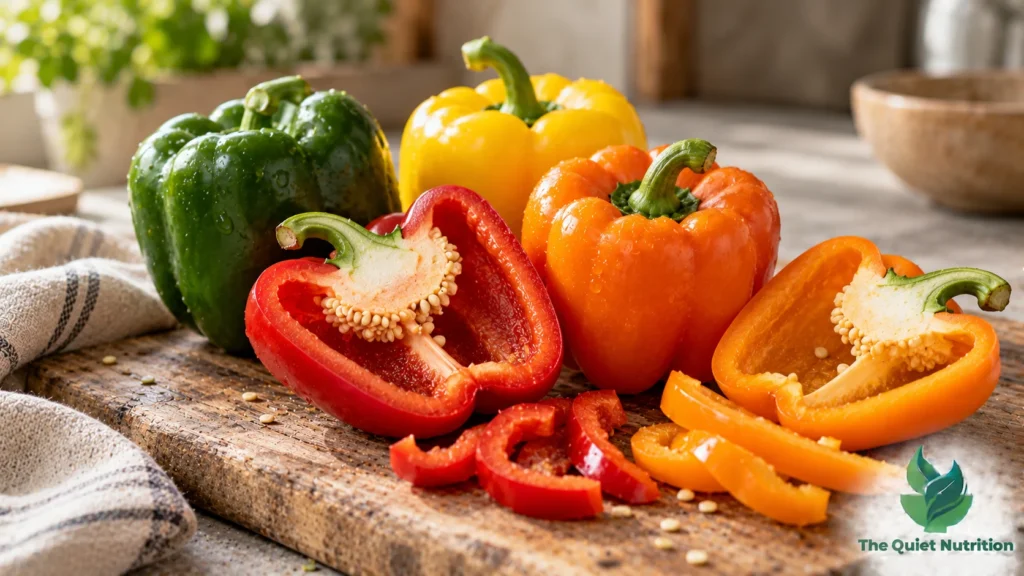
A red bell pepper can provide more vitamin C in half a cup than a medium orange. A green one contains less vitamin C by the same serving comparison, yet green peppers can have a different mix of plant compounds of their own. The difference is not simply that one colour is healthier than another. Bell peppers change as they mature, and their pigments, flavour and nutritional composition can change with them.
That makes the familiar row of green, yellow, orange and red peppers at the supermarket more interesting than it first appears. They all offer useful nutrients, but their colours provide clues about what is happening inside the fruit.
Bell peppers are particularly notable for vitamin C, the compounds that give them their distinctive colours, and their versatility as a raw or cooked vegetable. Understanding those features makes it easier to choose between varieties without turning a simple grocery decision into a search for the single healthiest pepper.
The vitamin C content is easy to underestimate
Vitamin C is usually associated with oranges, grapefruit and other citrus fruits. Bell peppers deserve a place in that conversation, too.
The US National Institutes of Health Office of Dietary Supplements lists approximately 95 milligrams of vitamin C in half a cup of raw red sweet pepper. The corresponding amount for raw green sweet pepper is about 60 milligrams. For comparison, one medium orange supplies around 70 milligrams. These are standard serving estimates rather than fixed values for every pepper or orange, but they illustrate how substantial a contribution peppers can make.
The numbers matter because vitamin C does several jobs in the body. It is required to make collagen, a protein that helps maintain connective tissue and supports wound healing. It also contributes to normal immune function and improves the absorption of non-haem iron, the form found in foods such as beans, lentils, tofu and leafy greens.
That last function is particularly useful when planning meals built around plant foods. A handful of sliced red pepper alongside a lentil salad, for example, adds freshness and crunch while supplying vitamin C that can help the body absorb iron from the meal.
There is no need to treat the pepper as a supplement or calculate every milligram. The practical point is simpler: adding bell peppers to ordinary meals can contribute a meaningful amount of an essential vitamin without requiring a special product or complicated preparation.
Why red and green peppers are not nutritionally identical
A green pepper and a red pepper can look like different vegetables, but in many common varieties, green is the colour of the fruit before full ripening. As the pepper matures, its colour and chemical composition may change.
The process is not identical in every variety. Some mature to red, others to yellow or orange, and different cultivars can have distinct pigment profiles. A yellow pepper is not necessarily an intermediate stage on the way to becoming a red one.
Scientific research has examined how the composition of sweet peppers changes during ripening. In a study published in the Journal of Agricultural and Food Chemistry in 2004, researchers analysed one sweet pepper cultivar at four maturity stages. They found that the measured polyphenol content was highest in the immature green fruit, while vitamin C and provitamin A were highest in the red-ripe samples.
The qualification matters: this was an analysis of one cultivar, not proof that every green pepper contains more polyphenols than every red pepper. Growing conditions, variety, maturity and storage can all influence the final composition.
Still, the study illustrates a useful principle. Ripening is not simply a cosmetic change. It can alter several groups of compounds at once, and those changes do not necessarily move in the same direction.
This is why ranking peppers from healthiest to least healthy based on colour alone is misleading. A red variety may offer more vitamin C or certain carotenoids, while a less mature green variety may retain a different profile of phenolic compounds. Neither observation establishes that one is universally better for human health.
The colour comes from more than appearance
The red, orange and yellow shades of many peppers come largely from natural plant pigments called carotenoids. These compounds help determine the colour of numerous fruits and vegetables.
Some carotenoids, including beta-carotene, can be converted by the body into vitamin A. Vitamin A has important roles in normal vision, immune function and the maintenance of tissues. Other carotenoids cannot be converted into vitamin A, although they may have other biological functions.
Red sweet peppers provide some provitamin A activity, but their nutritional contribution should be kept in proportion. The NIH’s selected-food table lists half a cup of raw red sweet pepper at approximately 117 micrograms of retinol activity equivalents, or about 13% of the Daily Value for vitamin A. That is a useful contribution, not an indication that peppers alone meet the body’s vitamin A requirements.
Peppers also contain other naturally occurring plant compounds, including phenolic compounds and flavonoids. Their amounts and types vary between cultivars and maturity stages. These compounds attract scientific interest partly because of their chemical and antioxidant properties, but laboratory findings do not automatically translate into a measurable improvement in human health.
That distinction is particularly important in nutrition reporting. Demonstrating that a compound can interact with reactive molecules in a laboratory is not the same as demonstrating that eating a particular vegetable prevents cancer, protects against heart disease or treats an existing condition.
Bell peppers do not need extraordinary medical claims to justify their place on the plate. Their established nutritional value is already useful.
Green peppers have a place of their own
Red peppers often receive more attention because of their higher vitamin C content in standard food comparisons and their conspicuous colour. That does not make green peppers a poor choice.
Their flavour is less sweet and often more vegetal, which is one reason they work so well in savoury dishes. Green peppers are a natural fit for omelettes, fajitas, stir-fries, stuffed peppers and tomato-based sauces. They bring texture and flavour to meals that might otherwise rely heavily on meat, cheese or starch.
The research on maturity also suggests that nutritional comparisons are more complicated than a simple colour hierarchy. The study of sweet pepper ripening described earlier found higher measured polyphenol levels in its immature green samples, even though the red-ripe samples had more vitamin C and provitamin A.
That is an interesting difference in composition, but it should not be turned into a claim that green peppers are better for preventing disease. The study did not test whether people who ate one colour experienced better health outcomes.
A more useful approach is to choose peppers according to the meal, taste and variety you enjoy. Green peppers make sense when you want a firmer, less sweet flavour. Red, orange and yellow varieties can add sweetness, colour and variety to salads or roasted vegetable dishes.
There is no need to avoid one colour to obtain the supposed benefits of another.
Does cooking take away their nutritional value?
Cooking changes the composition of vegetables, but the effects depend on the nutrient and the method.
Vitamin C is water-soluble and sensitive to heat. Its content can decline with prolonged storage and cooking, which is one reason raw peppers are an easy way to retain more of the vitamin. The NIH notes that steaming and microwaving may reduce cooking losses compared with some other approaches.
That does not mean cooked bell peppers are nutritionally disappointing. Roasting, sautéing or adding peppers to a stew can make them easier to include in regular meals and can change their flavour and texture in ways that people enjoy.
Heat can also make certain carotenoids more accessible from some foods by changing the plant’s cellular structure. Consequently, cooking does not cause every aspect of a vegetable’s nutritional value to move in the same direction. The outcome depends on the compound, the food and how it is prepared.
For everyday cooking, there is little reason to obsess over the theoretically perfect method. Slice peppers into a salad when you want a crisp texture and a substantial contribution of vitamin C. Roast them when sweetness and a softer texture suit the meal. Add them to a quick stir-fry when convenience matters.
A meal you make and enjoy regularly is more useful than an elaborate preparation method you rarely use.
The most useful way to eat bell peppers
Bell peppers fit into meals particularly well because their flavour is adaptable and their preparation requires little effort. They can be washed, sliced and eaten raw, or cooked alongside ingredients that already form part of a balanced meal.
For a quick lunch, pair sliced peppers with hummus or add them to a sandwich. For a plant-based dinner, combine them with beans, lentils or tofu; the vitamin C can help improve the absorption of non-haem iron from plant foods.
They also work well in omelettes, grain bowls, soups and roasted vegetable trays. Using more than one colour can make a dish visually appealing and introduce variety in flavour and plant compounds, although the exact nutritional difference will depend on the varieties used.
Storage and preparation are worth keeping practical, too. Buy peppers you are likely to use, store them appropriately and avoid leaving cut pieces exposed for unnecessarily long periods. Because vitamin C can decline during prolonged storage, freshness is one more reason to use the produce while it is still in good condition.
Above all, bell peppers work best as part of a varied diet. They do not supply every nutrient in meaningful amounts, and they cannot compensate for a diet that lacks other vegetables, fruits, legumes, whole grains or suitable protein sources. Their strength lies in what they contribute to meals that already have room for a range of foods.
A better way to think about bell peppers
The most interesting thing about bell peppers is not that one colour wins a nutritional competition. It is that a familiar vegetable can contain a different mix of nutrients and plant compounds depending on its variety and maturity.
Red peppers stand out as a particularly rich source of vitamin C in standard serving comparisons. Their carotenoid pigments add another dimension to their nutritional profile. Green peppers remain valuable, with a different flavour and a composition that can also include notable plant compounds. Cooking changes some nutrients while making peppers useful in a wider range of meals.
The practical choice is therefore refreshingly uncomplicated: eat the colours you enjoy, use them in both raw and cooked dishes, and let them contribute to the broader variety of foods in your diet. A bell pepper does not have to be a miracle food to be an excellent everyday ingredient.
Source:
National Institutes of Health, Office of Dietary Supplements. Vitamin C: Fact Sheet for Health Professionals. Provides standard serving estimates for vitamin C in red and green sweet peppers, information on vitamin C’s biological functions, its role in non-haem iron absorption, and the effects of storage and cooking. https://ods.od.nih.gov/factsheets/VitaminC-HealthProfessional
Marín A, Ferreres F, Tomás-Barberán FA, Gil MI. Characterization and quantitation of antioxidant constituents of sweet pepper (Capsicum annuum L.). Journal of Agricultural and Food Chemistry. 2004;52(12):3861–3869. DOI: 10.1021/jf0497915. Analyses phenolic compounds, vitamin C and carotenoids across four maturity stages in one sweet pepper cultivar. Its findings support the discussion of ripening while also requiring caution about generalising to all varieties. https://pubmed.ncbi.nlm.nih.gov/15186108
National Institutes of Health, Office of Dietary Supplements. Vitamin A and Carotenoids: Fact Sheet for Health Professionals. Explains provitamin A carotenoids, vitamin A functions and reference values for selected foods, including red sweet pepper. Also discusses the effects of cooking on carotenoid bioavailability. https://ods.od.nih.gov/factsheets/VitaminA-HealthProfessional

Aarti Solanki, B.Sc. (Food Science), is a food science writer passionate about making nutrition simple and evidence-based. She creates well-researched, easy-to-understand articles on healthy eating, food science, and nutrition, using information from trusted scientific and public health sources.