Cauliflower has become a familiar substitute for rice, mashed potatoes and even pizza crust. Its mild flavour and adaptable texture make those swaps possible, but focusing on what cauliflower can replace overlooks what it brings to a meal in its own right.
A serving supplies vitamin C, fibre and folate, along with naturally occurring compounds found throughout the cruciferous vegetable family. Those compounds have attracted scientific interest, although their potential health effects are more complicated than many headlines suggest.
Cauliflower is not an unusually rich source of every nutrient, nor does eating it guarantee better health. Its appeal lies in a more practical combination: a relatively low calorie content, useful amounts of certain micronutrients, a little fibre and the flexibility to fit into many different kinds of meals.
Cauliflower provides more than bulk for relatively few calories
Raw cauliflower contains approximately 25 calories per 100 grams, according to USDA food-composition data. The same amount provides around 2 grams of fibre and 48 milligrams of vitamin C, although the precise figures vary with the sample and preparation method.
That combination explains part of cauliflower’s appeal. It adds volume and texture to a meal without contributing as much energy as many refined-grain or fat-rich alternatives.
However, low calorie content should not be confused with exceptional nutrient density across every category. Cauliflower contains relatively modest amounts of protein, for example, and its fibre contribution is useful without being particularly high compared with beans, lentils or some whole grains.
Its best role is as one part of a varied meal rather than a food expected to provide everything.
Consider a lunch of roasted cauliflower, chickpeas, whole grains and a yoghurt-based dressing. The cauliflower contributes texture, vitamin C and some fibre; the chickpeas provide additional fibre and protein; and the grains contribute energy and other nutrients. Each ingredient has a different job.
This is a more useful way to assess cauliflower than asking whether it can replace an entire category of food.
Vitamin C is one of its more substantial nutritional contributions
Vitamin C often brings citrus fruit to mind, but vegetables can also provide meaningful amounts. Cauliflower is one of them.
At approximately 48 milligrams per 100 grams in raw form, it can make a useful contribution toward daily vitamin C requirements. [1,2]
The vitamin has several established functions. The body uses it to produce collagen, a structural protein important to skin, blood vessels, bones and connective tissue. Vitamin C also supports normal immune function and helps the body absorb non-haem iron, the type found in plant foods such as lentils, beans and leafy vegetables.
That final point offers a straightforward way to build a more useful meal. Pairing cauliflower with lentils or beans brings together plant sources of iron and a vegetable that contributes vitamin C. The combination can help the body absorb some of the iron in that meal.
Vitamin C is also sensitive to heat, and prolonged cooking can reduce the amount that remains in vegetables. The size of the loss depends on the cooking conditions, including duration, temperature and whether nutrients leach into water. Steaming or microwaving can reduce some cooking losses compared with methods that involve more prolonged water exposure.
This does not mean cauliflower should be eaten exclusively raw. Cooked vegetables still have a place in a nutritious eating pattern, and preparing them in a way that makes them appealing is often more important than trying to preserve every milligram.
The fibre is useful, even if cauliflower is not a high-fibre champion
Fibre is one reason vegetables deserve a regular place in meals. It contributes to normal bowel function, and dietary patterns containing adequate fibre are associated with important benefits for digestive and cardiometabolic health.
Cauliflower supplies around 2 grams of fibre per 100 grams in its raw form. That is a worthwhile contribution, but it is not enough to make cauliflower a substitute for more concentrated sources such as legumes or many whole grains.
The distinction becomes particularly relevant when cauliflower is used as a replacement for another food.
Cauliflower rice, for instance, may provide a lower-calorie alternative to conventional rice when someone wants a larger portion of vegetables. But it does not offer the same amount of energy or the same nutritional composition as a serving of rice. Replacing whole grains with cauliflower in every meal could also mean missing nutrients that whole grains contribute.
Neither food needs to be declared the winner. Rice can provide energy as part of a balanced meal, while cauliflower adds vegetables, texture and variety. The best choice depends on what the rest of the meal contains and what the person needs from it.
For someone who enjoys cauliflower rice, using it occasionally or combining it with regular rice is a reasonable way to vary a meal without treating carbohydrates as something that must always be eliminated.
Its cruciferous compounds are interesting, but the evidence needs context
Cauliflower belongs to the Brassica family, alongside broccoli, cabbage, kale and Brussels sprouts. These vegetables contain naturally occurring sulfur-containing substances called glucosinolates. When the plant’s tissues are damaged through chopping, chewing or processing, these compounds can be broken down into several products, including isothiocyanates and indole-related compounds.
Researchers study these substances because laboratory experiments suggest that some can influence cellular processes involved in how the body responds to potentially harmful compounds and oxidative stress.
This is biologically interesting, but the distinction between a mechanism and a demonstrated health benefit matters.
A compound that influences a cellular pathway in a laboratory does not necessarily produce the same effect when a person eats a serving of cauliflower. The amount consumed, the compound’s absorption, its metabolism and interactions with other components of a meal can all affect what happens in the body.
Research involving people has explored whether cruciferous vegetable consumption is associated with lower risks of various chronic diseases. An umbrella review published in 2022 examined 41 meta-analyses covering 303 observational studies and more than 13 million participants. It found suggestive evidence for some beneficial associations, including associations involving certain cancers and all-cause mortality, while many other findings were supported by weaker evidence.
These studies examined cruciferous vegetables as a broader food group, not cauliflower as an isolated intervention. Observational findings also cannot establish that the vegetables themselves caused the differences in health outcomes.
Consequently, it would be inaccurate to claim that cauliflower prevents cancer or that eating it activates a guaranteed protective mechanism. The evidence supports an interest in these compounds, not a promise of a particular medical outcome.
The practical takeaway is to include cauliflower as one of several vegetables in a varied diet, rather than relying on it as a disease-prevention strategy.
How you cook cauliflower changes more than its texture
Cauliflower can be eaten raw, steamed, roasted, sautéed or boiled. Each method changes its flavour and texture, but cooking can also affect some of its plant compounds.
A study published in 2019 compared uncooked, steamed and boiled cauliflower. Researchers measured glucosinolates, polyphenols and flavonoids, among other characteristics. Boiled samples had lower measured concentrations of these compounds than the uncooked and steamed samples.
The finding is useful, but its limitations deserve attention. The researchers measured compounds in prepared cauliflower and laboratory indicators of antioxidant activity; they did not demonstrate that people who eat steamed cauliflower experience better health outcomes than people who eat boiled cauliflower.
Other research on Brassica vegetables has also found that boiling can cause glucosinolates to leach into cooking water, whereas steaming, microwaving and stir-frying may retain more of these compounds under certain conditions. Results vary with the vegetable, cooking duration and preparation method.
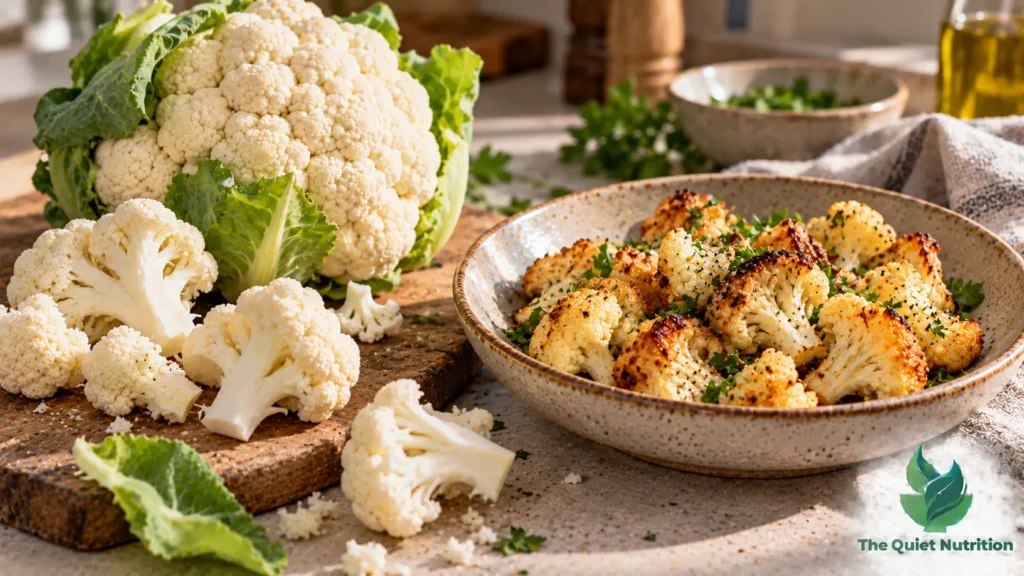
For everyday cooking, steaming is a sensible option when you want tender cauliflower without prolonged contact with water. Roasting is another practical choice because it develops browned edges and a more pronounced, slightly sweet flavour.
Boiling remains perfectly reasonable, particularly when the cauliflower will be used in soup or another dish where the cooking liquid is consumed. Some nutrients and compounds that leave the vegetable may remain in the liquid.
There is no need to reject a cooking method simply because it reduces one measurable component. A nutritious meal depends on more than a single compound, and food preparation also affects whether people enjoy eating the vegetables they buy.
Cauliflower works best when it complements other foods
One of cauliflower’s practical advantages is that it can be incorporated into meals without requiring a major change in cooking habits.
Roasted florets work alongside fish, chicken, tofu or lentils. Steamed cauliflower can be mixed into grain bowls or served with a protein-rich main dish. Finely chopped cauliflower can add texture to vegetable soups, while raw florets can be served with hummus or another dip.
These preparations have different nutritional implications depending on the accompanying ingredients. Cauliflower roasted with a modest amount of olive oil is not nutritionally identical to cauliflower covered in a rich cheese sauce, although both can fit into a person’s overall eating pattern.
The same principle applies to cauliflower-based substitutes. Replacing a portion of a calorie-dense ingredient with cauliflower can change the energy content of a meal, but the result is not automatically more nutritious if the substitution removes important nutrients or leaves the dish less satisfying.
A better question is what the entire plate provides. Does it include an appropriate source of protein? Are there adequate sources of fibre and energy? Is there enough variety across the day? Cauliflower can help answer some of those needs, but it cannot answer all of them on its own.
People who experience bloating after eating cruciferous vegetables may also find that smaller portions or thoroughly cooked cauliflower are more comfortable than large servings eaten raw. Individual tolerance varies, so there is no need to force large quantities simply because a food has a healthy reputation.
What cauliflower’s nutrition means in practice
Cauliflower earns its place on the plate through a combination of qualities rather than one extraordinary benefit. It supplies vitamin C, contributes fibre and folate, contains glucosinolates and related plant compounds, and adds substantial volume for relatively few calories.
Its plant compounds are an active area of scientific investigation, but evidence about cruciferous vegetables as a group should not be mistaken for proof that cauliflower prevents specific diseases. Similarly, preserving more of a compound during cooking does not by itself establish a meaningful health advantage.
The simplest approach is also the most useful: choose cauliflower because you enjoy it, prepare it in ways that make you want to eat it, and combine it with foods that provide the nutrients it lacks. Use it as a vegetable, not as a compulsory replacement for grains or other carbohydrate sources.
Cauliflower does not need to be a low-carb substitute to justify eating it. Its nutritional value is already there.
Sources:
[1] U.S. Department of Agriculture, FoodData Central. Food composition database for raw cauliflower. Reference for calorie, fibre, vitamin C and other nutrient estimates. Nutrient values can vary by sample and preparation. https://fdc.nal.usda.gov/food-search/?query=cauliflower
[2] National Institutes of Health, Office of Dietary Supplements. Vitamin C: Fact Sheet for Health Professionals. Explains vitamin C’s functions, food sources, iron absorption and sensitivity to storage and cooking. https://ods.od.nih.gov/factsheets/VitaminC-HealthProfessional
[3] National Institutes of Health. Health Benefits of Dietary Fibers Vary. Summarizes evidence showing that fibre’s effects depend on fibre type, amount and individual factors. https://www.nih.gov/news-events/nih-research-matters/health-benefits-dietary-fibers-vary
[4] National Cancer Institute. Cruciferous Vegetables and Cancer Prevention. Explains the glucosinolates found in cruciferous vegetables and how they can break down into biologically active compounds. https://www.cancer.gov/about-cancer/causes-prevention/risk/diet/cruciferous-vegetables-fact-sheet
[5] Li YZ, et al. Cruciferous vegetable consumption and multiple health outcomes: an umbrella review of 41 systematic reviews and meta-analyses of 303 observational studies. Food & Function. 2022;13:4247–4259. DOI: 10.1039/D1FO03094A. The authors found suggestive evidence for selected associations, alongside substantial uncertainty for many other outcomes. https://pubmed.ncbi.nlm.nih.gov/35352732
[6] Effect of Cooking Method on Antioxidant Compound Contents in Cauliflower. Preventive Nutrition and Food Science. 2019. DOI: 10.3746/pnf.2019.24.2.210. Compared measured glucosinolates, polyphenols, flavonoids and antioxidant activity in uncooked, steamed and boiled cauliflower. https://pubmed.ncbi.nlm.nih.gov/31328127
[7] Nugrahedi PY, Verkerk R, Widianarko B, Dekker M. A mechanistic perspective on process-induced changes in glucosinolate content in Brassica vegetables: a review. Comprehensive Reviews in Food Science and Food Safety. Summarizes how processing and cooking affect glucosinolate retention in cruciferous vegetables. https://pubmed.ncbi.nlm.nih.gov/24915330

Aarti Solanki, B.Sc. (Food Science), is a food science writer passionate about making nutrition simple and evidence-based. She creates well-researched, easy-to-understand articles on healthy eating, food science, and nutrition, using information from trusted scientific and public health sources.