
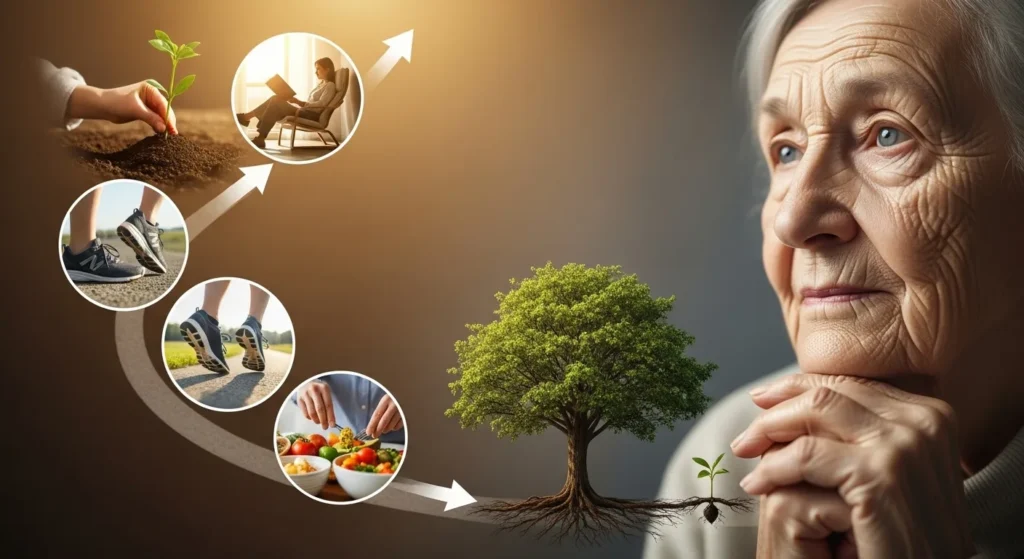
My grandmother used to say that getting old wasn’t the problem — getting old badly was. She lived to ninety-one, sharp until nearly the end, and when people asked her secret she’d shrug and say she just never stopped eating like it mattered. At the time I thought this was the kind of thing grandmothers say. Looking into the actual biology of aging now, I think she’d stumbled onto something researchers are only recently able to explain with real precision.
The common story about aging treats it like a slow-motion breakdown — parts wearing out, systems failing, decline as an inevitable verdict handed down by time itself. That framing feels intuitive, but it’s not quite accurate. What the research increasingly shows is something more specific and, honestly, more useful: aging looks less like failure and more like a gradual loss of efficiency, particularly at the cellular level. And efficiency, unlike failure, can be influenced.
The Mitochondria Are the Real Story
Almost every cell in the body relies on mitochondria to convert food into usable energy. In youth, this process runs efficiently. Over time, mitochondrial function tends to decline — not because mitochondria “fail,” but because their efficiency at converting fuel into energy, and at managing the cellular waste that process produces, gradually erodes. This is sometimes called the mitochondrial theory of aging, and it reframes a lot of what we experience as “getting old”: the afternoon fatigue that wasn’t there a decade ago, the slower recovery from a hard workout, the sense that everything just takes a little more effort than it used to.
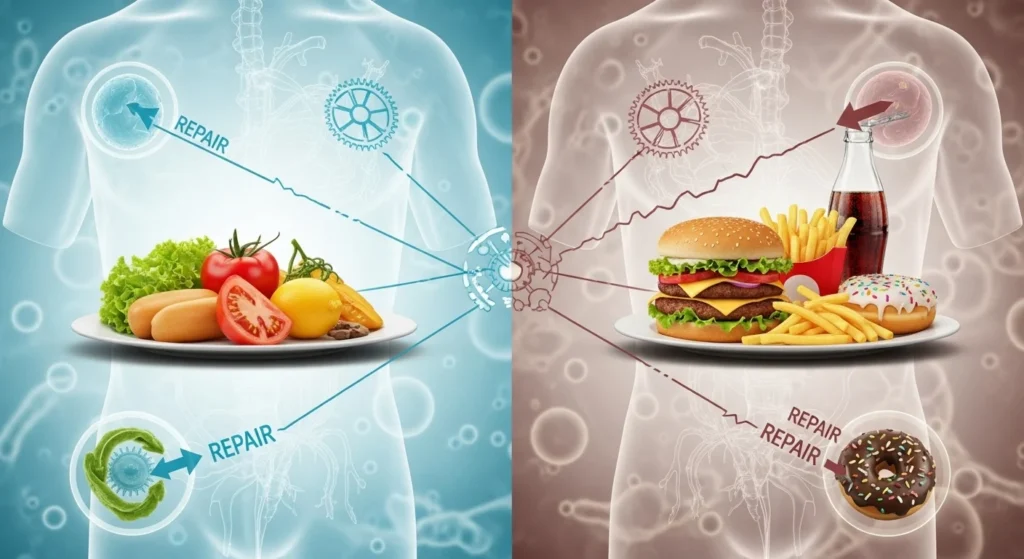
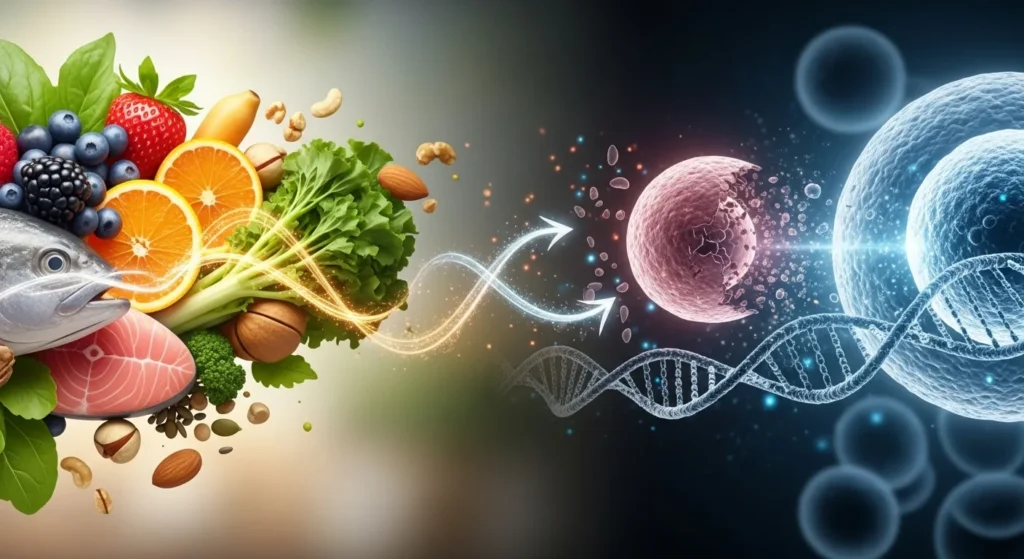
This matters because mitochondrial efficiency isn’t fixed. It responds to nutrition, and fairly directly. Diets rich in antioxidants help manage the oxidative stress that accumulates as a byproduct of energy production. Adequate protein supports the ongoing repair of mitochondrial proteins. Certain micronutrients — CoQ10, B vitamins, magnesium — are directly involved in the biochemical pathways mitochondria depend on. None of this reverses time. But it does appear to slow how quickly efficiency erodes.
Inflammation as an Efficiency Tax
There’s a term researchers use for the low-grade, chronic inflammation that tends to rise with age: inflammaging. It’s not the acute inflammation of an injury. It’s a quieter, background hum that increases over decades, and it appears to accelerate almost every hallmark of aging — from joint stiffness to cognitive decline to slower wound healing.
What’s notable is how much of that inflammatory load is influenced by diet. Diets high in refined sugar and ultra-processed food tend to feed this background inflammation. Diets built around fiber, omega-3 fatty acids, and polyphenol-rich plants — berries, leafy greens, olive oil — tend to blunt it. This is essentially an efficiency tax: the body has to spend resources managing inflammation that could otherwise go toward repair and maintenance. Lower the tax, and more of the body’s energy budget goes where it’s actually needed.
Muscle Loss Isn’t Inevitable — It’s Under-fueled
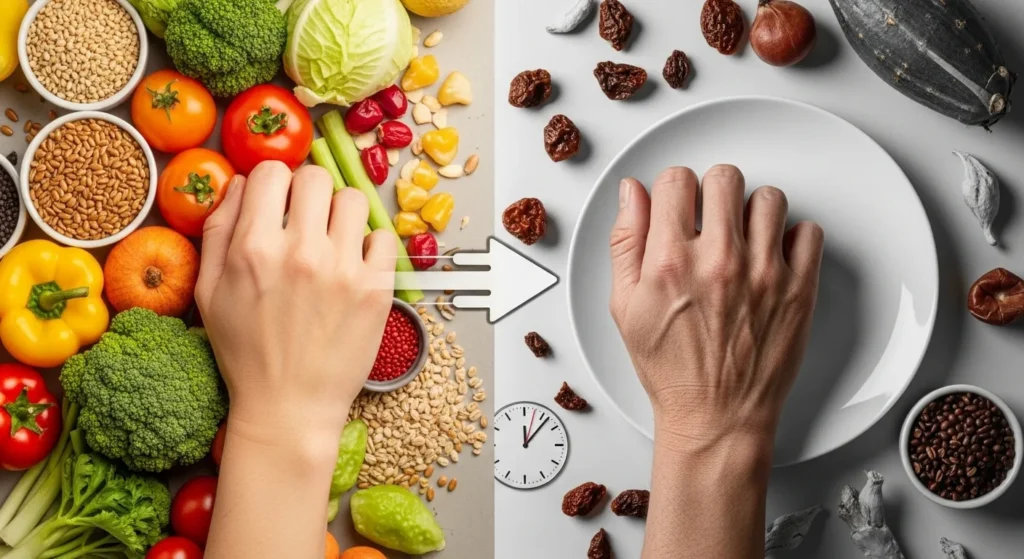
One of the more correctable pieces of the aging story is sarcopenia, the gradual loss of muscle mass that tends to accelerate after age fifty. For a long time this was treated as simply what bodies do. More recent research suggests a meaningful chunk of it is driven by inadequate protein intake combined with declining physical activity — a fixable combination, not a fixed sentence. Older bodies appear to need more protein per meal than younger ones to trigger the same muscle-building response, something called anabolic resistance. Most older adults eat far less protein than that threshold requires, often without realizing it.
My grandmother, it turns out, ate eggs nearly every morning of her adult life and kept a garden she worked in until she physically couldn’t anymore — protein and movement, unknowingly stacked in her favor for seven decades.
What This Actually Changes
None of this promises immortality or even dramatic reversal. But reframing aging as an efficiency problem rather than an inevitable failure changes what’s worth doing about it. It means the goal isn’t fighting an unwinnable war against time. It’s supporting the systems — mitochondrial function, inflammatory balance, muscle maintenance — that determine how gracefully that time gets spent. Nutrient-dense food, adequate protein, and diets that manage rather than fuel inflammation don’t stop the clock. They appear to keep the machinery running closer to its original specifications for longer.
That distinction, between failure and inefficiency, is small on paper and enormous in practice. Failure suggests nothing can be done. Efficiency loss suggests there’s still a dial to turn, and the food on your plate is one of the more reliable hands available to turn it.
Sources:
- National Institute on Aging — Nutrition and Healthy Eating as You Age: https://www.nia.nih.gov/health/healthy-eating-nutrition-and-diet
- Harvard T.H. Chan School of Public Health — Nutrition Source: https://www.hsph.harvard.edu/nutritionsource/
- National Institutes of Health — Office of Dietary Supplements: https://ods.od.nih.gov/
- Mayo Clinic — Healthy Aging: https://www.mayoclinic.org/healthy-lifestyle/healthy-aging

Aarti Solanki, B.Sc. (Food Science), is a food science writer passionate about making nutrition simple and evidence-based. She creates well-researched, easy-to-understand articles on healthy eating, food science, and nutrition, using information from trusted scientific and public health sources.




Pingback: What You Eat Today Quietly Shapes How You’ll Age Tomorrow
Pingback: How Nutritional Stress Speeds Up Aging Long Before You Notice