
My neighbor Tom fixes things for a living — boilers, mostly, the kind that quietly keep a building alive until the day they don’t. He once told me that most systems don’t fail all at once. They fail in tiny increments nobody notices until the whole thing seizes up on a Tuesday morning. I think about that conversation more than I probably should, mostly because it’s the best explanation I’ve ever heard for what food actually does inside the human body.
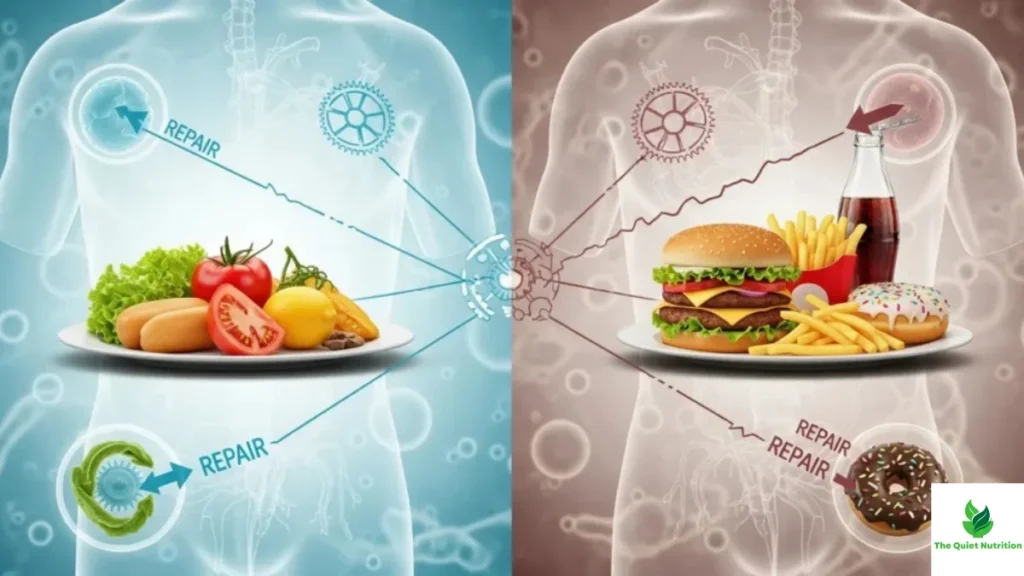
We tend to think of eating as fuel — calories in, energy out, simple math. But that framing misses almost everything interesting. Food isn’t just fuel. It’s maintenance. Every meal is a small set of instructions telling the body what to repair, what to build, what to defend against. Skip that maintenance long enough, in small enough increments, and nothing dramatic happens right away. Then one day, it does.
The Body Is Always Mid-Repair
At any given moment, your body is quietly rebuilding itself. Skin cells turn over roughly every few weeks. The lining of the gut regenerates every few days. Red blood cells last around four months before being replaced entirely. None of this is optional, and none of it happens without raw material — protein for tissue repair, iron for oxygen transport, vitamin C for collagen synthesis, zinc for immune function.
This is where everyday food choices start to matter more than people expect. A diet that’s technically enough calories but thin on protein or micronutrients doesn’t cause an obvious problem next week. It causes a slow erosion — hair that thins a little faster, cuts that heal a little slower, a cold that lingers two extra days. Tom’s boiler analogy holds up uncomfortably well here. The failure isn’t in the big meal you skip once. It’s in the pattern that repeats three hundred times a year.
Inflammation: The Quiet Variable
If there’s one concept that connects nearly every chronic condition doctors worry about — heart disease, type 2 diabetes, even some cognitive decline — it’s chronic low-grade inflammation. Unlike the acute inflammation that shows up as swelling around a sprained ankle, this version is invisible day to day. It doesn’t announce itself. It just accumulates, driven substantially by dietary patterns: too much refined sugar, too many ultra-processed foods, not enough fiber or omega-3 fatty acids to counterbalance it.
The unsettling part is how ordinary the contributing choices look. A can of soda most afternoons. Fast food twice a week because the schedule doesn’t allow for much else. None of it feels reckless in the moment. It’s the accumulation, not any single choice, that tips the body from managing inflammation to being slowly overwhelmed by it.
Fiber Does More Than People Give It Credit For
If there’s an unsung hero in daily nutrition, it’s fiber, and specifically the diversity of fiber sources rather than just the total amount. The gut microbiome — the trillions of bacteria living in the digestive tract — depends on a varied diet of plant fibers to stay balanced. A narrow diet, even a “healthy” one built around the same five vegetables on rotation, can leave microbial diversity thinner than it should be, with downstream effects on everything from immune regulation to mood, since a meaningful share of serotonin production happens in the gut.
This is part of why the old advice to “eat the rainbow” isn’t just a catchy phrase. Different plant pigments correspond to different phytonutrients, and each seems to feed different bacterial populations. Variety, not just volume, is doing real work here.
Small Choices, Compounded
Tom eventually got serious about his own health after a doctor flagged his blood pressure at a routine check — nothing dramatic, just a number trending the wrong direction for a few years running. His fix wasn’t an overhaul. He added more vegetables to dinners that used to be mostly meat and starch. He swapped his afternoon soda for water most days, not all days. He started eating fish instead of processed lunch meat a couple of times a week.
None of it looked impressive from the outside. But eighteen months later, his numbers had shifted meaningfully, and he’d stopped getting sick every time the seasons changed. Nothing about his life had transformed. The compounding had just been running in a different direction.
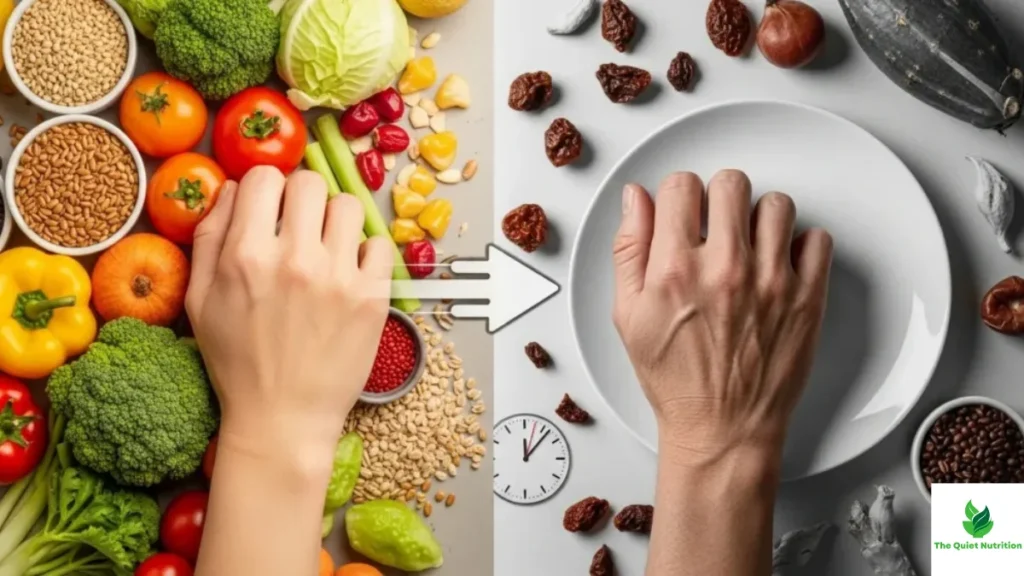
That’s the part conventional health advice often struggles to communicate. The body doesn’t measure your diet by its best day or its worst day. It measures the average, repeated relentlessly, week after week, until the pattern becomes physical reality. Falling apart, when it happens, is rarely one bad decision. It’s usually thousands of small ones, quietly unaddressed. The reverse is just as true — and considerably more hopeful.
Sources:
- Harvard T.H. Chan School of Public Health — Nutrition Source: https://www.hsph.harvard.edu/nutritionsource/
- National Institutes of Health — Office of Dietary Supplements: https://ods.od.nih.gov/
- Mayo Clinic — Nutrition and Healthy Eating: https://www.mayoclinic.org/healthy-lifestyle/nutrition-and-healthy-eating
- World Health Organization — Healthy Diet Fact Sheet: https://www.who.int/news-room/fact-sheets/detail/healthy-diet

Aarti Solanki, B.Sc. (Food Science), is a food science writer passionate about making nutrition simple and evidence-based. She creates well-researched, easy-to-understand articles on healthy eating, food science, and nutrition, using information from trusted scientific and public health sources.






Pingback: What You Eat Today Quietly Shapes How You’ll Age Tomorrow