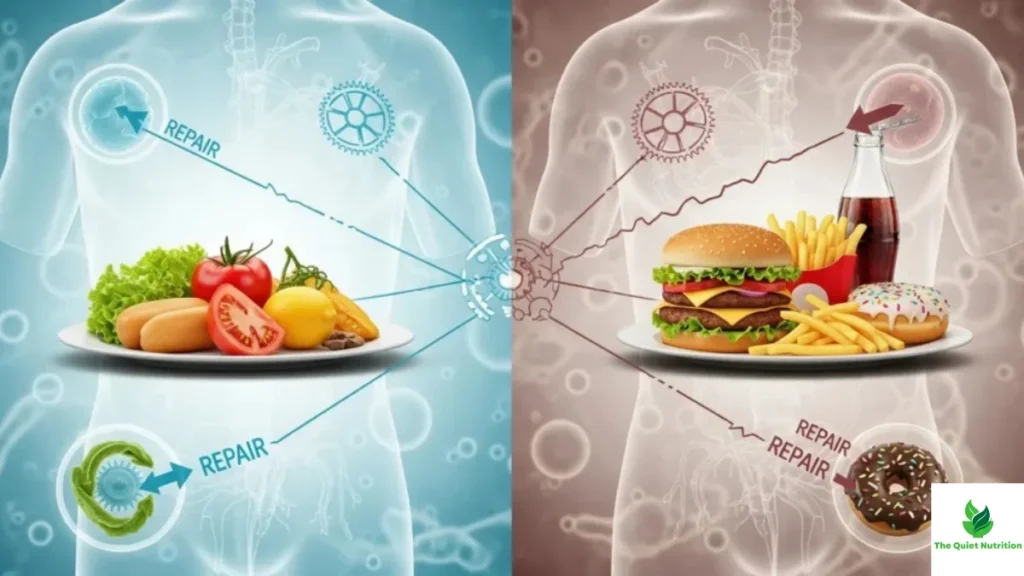
Two people can be born in the same month of the same year, and by sixty, one of them is climbing mountains while the other struggles to climb a flight of stairs. Same number of trips around the sun. Wildly different bodies. If aging were purely a countdown, that gap shouldn’t exist. It does, and the reason has less to do with the calendar than with something far less visible: how efficiently a body has spent, stored, and repaired its energy over the decades.
Time is just the unit we use to measure aging. It isn’t the mechanism. The actual process happening inside cells is closer to bookkeeping than to a ticking clock — a constant negotiation between energy coming in, energy going out, and how much is left over for maintenance and repair.
The cell as a power plant with a maintenance budget
Every cell runs on energy produced mostly inside mitochondria, tiny structures often described as the cell’s power plants. That process isn’t perfectly clean. It throws off reactive byproducts called free radicals, which can damage proteins, membranes, and DNA if they aren’t neutralized quickly enough. This is roughly the idea behind the free radical theory of aging, first proposed decades ago: the wear and tear of metabolism itself, not the passage of time, gradually erodes cellular function.
For a while, scientists assumed this meant a simple rule — burn energy faster, age faster. Animals with high metabolic rates should die young; slow metabolisms should mean long lives. It’s a tidy theory, and it’s also wrong more often than it’s right. Some small, fast-metabolizing animals live remarkably long lives, while some large, slow ones don’t. Elephants have far more cells than mice and dramatically lower cancer rates than that cell count would predict, a puzzle researchers call Peto’s paradox. Total energy expenditure alone doesn’t explain who ages well and who doesn’t. What matters more is what the body does with that energy — how much goes toward growth and reproduction, and how much gets diverted to repair and cleanup.
The switch between growing and repairing
Cells are constantly listening for signals about how much fuel is available, and they respond very differently depending on the answer. When nutrients are abundant, pathways like mTOR and the insulin/IGF-1 signaling network push cells toward growth, division, and protein synthesis. That’s useful when you’re young and building tissue. But left switched on permanently, that same growth-oriented state comes at a cost: it suppresses autophagy, the cellular process that clears out damaged proteins and worn-out organelles, essentially cellular housekeeping.
When energy is scarcer, a different set of pathways takes over. AMPK activates, sirtuins linked to NAD+ levels become more active, and autophagy ramps up. The cell shifts from expansion mode into maintenance mode. This is a big part of why calorie restriction has been shown, repeatedly, across yeast, worms, flies, and mice, to extend lifespan and delay age-related disease. It isn’t starvation working some kind of magic — it’s a shift in which internal repair systems get prioritized when the body isn’t flush with fuel.
Human studies point the same direction. Research into sustained energy restriction in people, including trials run under the National Institute on Aging, has linked it to markers of slower metabolic aging, though the long-term picture in humans is still being filled in and extreme restriction carries its own risks.
Why modern life keeps that switch stuck in one position
Most people today aren’t at risk of too little energy. The more common problem is a body that’s rarely, if ever, given a reason to shift into repair mode. Constant eating, minimal movement, and chronic caloric surplus keep growth pathways switched on almost continuously. Over years, that contributes to insulin resistance, low-grade chronic inflammation — researchers increasingly refer to this as “inflammaging” — and a gradual decline in the mitochondria’s own efficiency and turnover. The energy books never balance, and the debt accumulates as cellular damage.
This is also part of why exercise shows up as one of the most consistent interventions in aging research, alongside diet. Physical activity doesn’t just burn calories; it forces mitochondria to renew themselves, improves how cells sense and use insulin, and triggers some of the same repair pathways activated by periods of lower energy intake. Intermittent fasting and time-restricted eating work on a similar principle, giving the body regular windows where the growth switch can flip off and the maintenance crew can get to work.
None of this erases the role of genetics, environment, or plain chance. But it reframes the question people usually ask about aging. It’s less “how much time has passed” and more “how has this body balanced its energy ledger, year after year.” Two people can share a birth year and still be aging at very different speeds, because the clock that matters most isn’t counting years. It’s counting how well the lights stay on, how much gets repaired before it breaks down further, and how the body decides, moment to moment, whether to grow or to fix what’s already there.
Source: National Institute on Aging – Biology of Aging

Aarti Solanki, B.Sc. (Food Science), is a food science writer passionate about making nutrition simple and evidence-based. She creates well-researched, easy-to-understand articles on healthy eating, food science, and nutrition, using information from trusted scientific and public health sources.