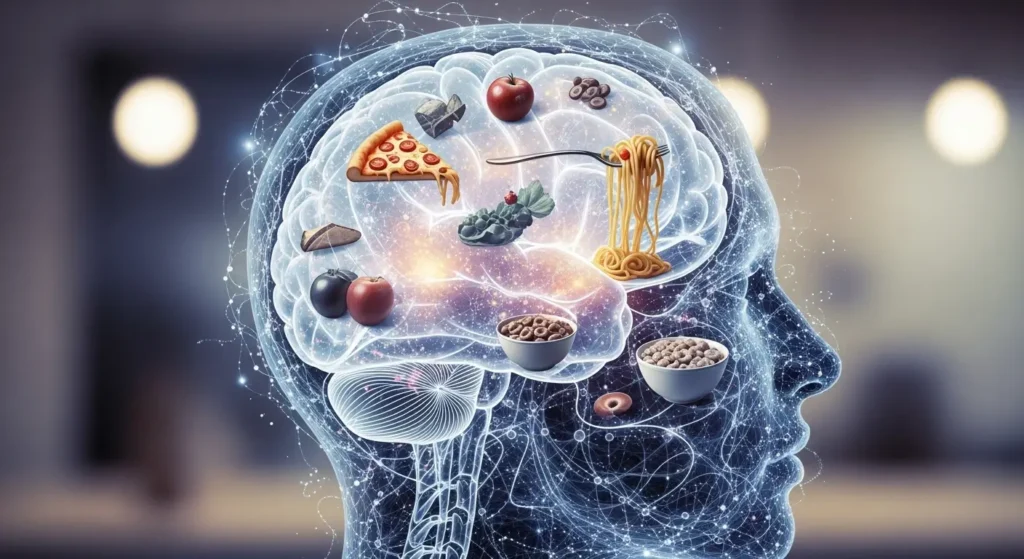
My aunt has dementia now, advanced enough that she doesn’t recognize most of us on a given afternoon. But she still asks for tea at exactly 4 o’clock, the way she has for fifty years, and she still reaches for sugar before anyone hands it to her, even though she couldn’t tell you her own address. Watching that happen, over and over, taught me something about memory that no article had managed to explain quite as clearly: the brain holds onto eating patterns in places that seem to survive almost everything else.
It’s a strange kind of resilience, and it points to something worth taking seriously even for people nowhere near that stage of life. The relationship between the brain and eating isn’t stored in one tidy folder labeled “food memories.” It’s distributed across systems — habit, reward, emotion, procedure — some of which are shaped by decades of repetition and prove remarkably durable, for better and for worse.
Habit Lives Outside Conscious Memory
Neuroscience draws a sharp line between declarative memory — the kind used to recall facts, names, events — and procedural memory, which governs learned patterns and routines. Riding a bike sits in procedural memory. So, it turns out, does a great deal of eating behavior. The 4 o’clock tea, the reach for something salty during stress, the specific way someone plates dinner — these get encoded as procedure through repetition, and procedural memory is housed largely in the basal ganglia, a region that tends to remain functional even when the hippocampus, responsible for forming new declarative memories, is significantly damaged.
This is part of why my aunt can still perform an eating ritual she can no longer consciously describe. The knowledge of “how I eat” was never filed the same way as “what I did yesterday.” It was built through thousands of repetitions into something closer to muscle memory than intellectual recall, and that kind of memory degrades far more slowly.
The Reward System Never Forgets Either
Food is also deeply entangled with the brain’s dopamine-driven reward circuitry, and that circuitry is famously resistant to erosion. Highly palatable foods — high in sugar, fat, or salt — create strong dopamine responses that get reinforced with repeated exposure, carving associative pathways between specific foods and pleasure that can persist for decades, often outlasting explicit memory of when or why those associations formed.
This explains something a lot of people notice without quite naming it: a comfort food from childhood can trigger an intense emotional pull well into adulthood, even when the specific memories tied to it have faded. The brain isn’t recalling the birthday party. It’s running the reward pathway that birthday cake built thirty years ago, still intact, still firing, independent of whether the original context survived.
Emotional Eating Patterns Get Encoded Early
The amygdala, central to emotional processing, forms strong associative links between food and emotional states — comfort, stress relief, celebration — often in childhood, well before someone has the conceptual language to describe what’s happening. These associations tend to be encoded with unusual strength precisely because emotional arousal enhances memory consolidation. A pattern of reaching for sweets during stress, learned at age eight, can remain fully intact and operative at fifty, resurfacing under pressure regardless of how much someone consciously understands about nutrition or knows they’d rather respond differently.
This is often mistaken for a willpower failure in adulthood, when it’s really closer to an old, deeply reinforced neural pathway running exactly as designed, just no longer serving its original purpose.
Why This Matters Beyond Dementia
Most people will never experience the extreme version my aunt is living through, where declarative memory fails while eating patterns persist almost eerily intact. But the underlying principle applies broadly, at a much smaller scale, to everyone: the eating patterns built over years of repetition are stored more durably, and operate more automatically, than most people assume. That’s precisely why changing them tends to feel disproportionately hard compared to other kinds of behavior change — a new habit has to compete against a procedural and reward-based memory system that was never designed to be easily overwritten by a New Year’s resolution.
It also means the patterns built now, today, in ordinary unremarkable meals, are being encoded more permanently than they feel like they are in the moment. The brain is quietly filing away not just what gets eaten, but how, when, and under what emotional conditions — building a template that may still be running decades from now, long after the specific days that built it have been forgotten entirely.
Sources:
- National Institute on Aging — Cognitive Health and Older Adults: https://www.nia.nih.gov/health/brain-health/cognitive-health-and-older-adults
- Harvard T.H. Chan School of Public Health — Nutrition Source: https://www.hsph.harvard.edu/nutritionsource/
- National Institute of Mental Health — The Brain’s Reward System: https://www.nimh.nih.gov/health
- Alzheimer’s Association — Understanding Memory Loss: https://www.alz.org/alzheimers-dementia/what-is-alzheimers
- Mayo Clinic — Emotional Eating and Stress: https://www.mayoclinic.org/healthy-lifestyle/stress-management

Aarti Solanki, B.Sc. (Food Science), is a food science writer passionate about making nutrition simple and evidence-based. She creates well-researched, easy-to-understand articles on healthy eating, food science, and nutrition, using information from trusted scientific and public health sources.





Pingback: Why What You Eat Can Quiet an Overactive Mind