Chia seeds are small enough to disappear into a spoonful of yogurt, yet they can transform a thin liquid into a thick pudding within minutes. That change is more than a kitchen trick. It reflects the way chia seeds absorb water and how their fiber contributes to the texture and function of foods.
A two-tablespoon serving, roughly 28 grams, supplies about 10 grams of dietary fiber alongside plant-based omega-3 fat, protein and minerals. For a food that barely changes the flavour of a meal, that is a substantial nutritional contribution.
But chia seeds’ reputation deserves a closer look. Their fiber can support normal digestion, and adding them to meals can help increase overall fiber intake. The evidence does not establish that chia seeds alone reliably cause weight loss, prevent constipation in everyone or control blood sugar.
The most useful way to understand chia seeds is to look at what their fiber actually does, why soaking matters, and how to include them without creating digestive discomfort.
Why such tiny seeds contain so much fiber
Chia seeds come from Salvia hispanica, a flowering plant in the mint family. Despite their small size, they contain a concentrated mixture of fiber, fat, protein and other nutrients.
A typical 28-gram serving of dried chia seeds provides approximately:
- 138 calories
- About 9.8 grams of dietary fiber
- About 4.7 grams of protein
- About 8.7 grams of fat, much of it unsaturated
- Roughly 5 grams of alpha-linolenic acid (ALA), a plant-based omega-3 fatty acid
Exact values vary slightly with the product and food database.
The fiber figure is what makes chia seeds particularly interesting. A serving can provide a substantial portion of the daily fiber intake recommended for adults, although individual requirements vary.
The catch is that 28 grams is a measured serving, not a tiny pinch. Sprinkling a teaspoon over breakfast contributes fiber, but it will provide considerably less than a full serving.
Chia seeds also contain both soluble and insoluble fiber. These categories describe different properties of fiber, and both contribute to the way plant foods behave in the digestive system.
1. Chia seeds form a gel because of their outer coating
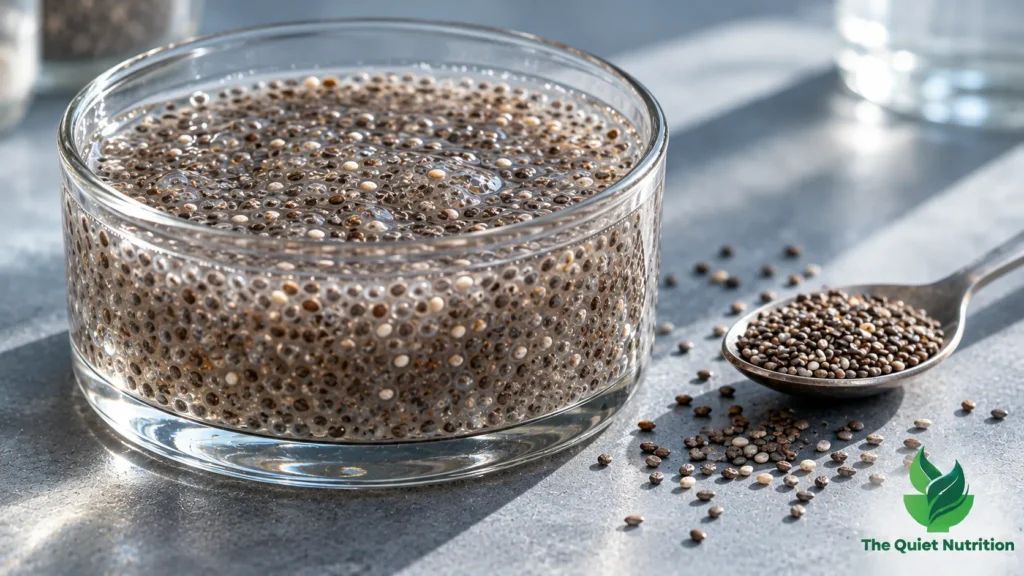
One of the most distinctive features of chia seeds becomes visible when they are mixed with liquid.
Within minutes, a clear, slippery layer develops around each seed. Given more time, the mixture can become noticeably thicker.
This happens because substances in the seed’s outer layer absorb water and form a gel-like material. Some of these substances are mucilage, a type of water-absorbing plant polysaccharide.
The result is easy to observe in a glass of soaked chia seeds or a jar of chia pudding. The seeds remain visible, but the surrounding liquid takes on a thicker consistency.
This property also explains why chia seeds can change the texture of oatmeal, smoothies and other moist foods without requiring flour or a commercial thickener.
The gel is relevant to digestion, too, because chia’s water-holding properties help explain how its fiber behaves. However, the visible gel should not be mistaken for proof that chia seeds have a special detoxifying effect or that they automatically improve every digestive symptom.
The food’s physical behaviour is well established. The size of its effects on specific health outcomes is a separate question.
2. Their fiber can help support regular bowel movements
Fiber contributes to normal bowel function in several ways. Depending on its characteristics, it can hold water, add bulk to stool and influence how material moves through the digestive tract.
Chia seeds contain a substantial amount of fiber, so they can help increase total intake when added to a diet that is otherwise low in fiber.
This matters because many people do not consistently eat enough whole grains, vegetables, legumes, fruit, nuts and seeds to meet their daily needs.
Adding chia seeds to breakfast is one straightforward way to improve that pattern. A serving stirred into oatmeal or soaked overnight in milk or a fortified plant-based drink can contribute meaningful fiber without requiring a major change to the meal.
However, there is an important distinction between evidence for dietary fiber generally and evidence for chia seeds specifically.
A 2022 systematic review and meta-analysis examined 16 randomized controlled trials involving 1,251 adults with chronic constipation. Across the studies, fiber supplementation improved the likelihood of treatment response and increased stool frequency, although results differed by fiber type and dose. Psyllium and pectin showed significant effects in the analysis.
That review supports the value of certain fiber interventions, but it was not a trial of chia seeds. It would therefore be inaccurate to use its results as proof that chia seeds treat chronic constipation.
For most people, the practical goal is to increase fiber gradually through a variety of foods and drink adequate fluids. Chia seeds can contribute to that effort without being the only source of fiber.
3. Chia’s fiber may help a meal feel more satisfying
Chia seeds are often promoted as an appetite-control food because they absorb water and form a gel.
The reasoning is understandable: foods containing fiber can influence fullness, and the physical properties of a meal can affect how quickly it is eaten and how satisfying it feels.
When chia seeds are mixed into yogurt or milk, they thicken the food and change its texture. Their fiber, fat and protein also contribute to the nutritional composition of the meal.
But that does not mean chia seeds reliably suppress appetite or produce weight loss.
Research on chia seeds and body weight has been limited, and clinical findings have not consistently demonstrated meaningful weight-loss effects. Memorial Sloan Kettering Cancer Center’s review of the evidence notes that a clinical trial did not find an effect on weight loss and that more research is needed.
This is a useful reminder that a plausible mechanism does not guarantee a practical result.
If chia pudding helps you prepare a satisfying breakfast that replaces a less balanced option, it may be useful in your routine. If you simply add a large portion of chia seeds to your usual meals without adjusting anything else, you will also add calories.
The sensible approach is to use chia seeds as an ingredient that improves a meal, not as a guaranteed appetite suppressant.
4. Their fiber can change the way you prepare breakfast
Chia seeds are particularly convenient because they can be added to foods that already form part of an ordinary breakfast.
When mixed with enough liquid and left to stand, they create a thick texture that works well in overnight oats, yogurt bowls and pudding-style breakfasts.
That convenience can make it easier to establish a consistent habit of eating more fiber.
Try mixing one tablespoon of chia seeds into a serving of plain yogurt, adding a little milk and leaving the mixture in the refrigerator until the seeds have absorbed some liquid. Add fruit before eating.
You can also stir chia seeds into oatmeal or blend them into a smoothie. In each case, they contribute fiber and other nutrients without requiring elaborate preparation.
The important point is that the nutritional value depends on the complete meal. Chia seeds mixed with plain yogurt and berries create a different nutritional combination from chia seeds mixed with large amounts of syrup or sweetened condensed milk.
Neither preparation method changes the seeds into a miracle food. What matters is how the ingredients fit into your overall diet.
5. Chia seeds provide plant-based omega-3 fat
Fiber is the main focus of this article, but chia seeds also contain alpha-linolenic acid, or ALA.
ALA is an essential omega-3 fatty acid, meaning the body cannot make it in sufficient amounts and must obtain it from food.
Chia seeds are one of several plant sources of ALA, alongside flaxseeds, walnuts and some vegetable oils.
The body can convert ALA into the longer-chain omega-3 fatty acids EPA and DHA, but this conversion is limited and varies between individuals. Chia seeds therefore should not be treated as nutritionally identical to oily fish, which directly supplies EPA and DHA.
Their value lies in providing ALA alongside fiber and other nutrients in a convenient plant food.
Eating chia seeds does not automatically reduce cardiovascular risk. Although ALA is an essential nutrient and plant-rich dietary patterns are associated with health benefits, the independent effects of chia seeds on heart attacks and other major clinical outcomes remain uncertain.
They are best viewed as one useful component of a varied diet.
6. Their fiber does not make chia seeds a proven blood sugar treatment
Chia seeds are sometimes described as a way to prevent blood sugar spikes because their fiber absorbs water and can alter the texture of a meal.
Fiber can influence digestion and the absorption of nutrients, but the response depends on the type of fiber, the amount eaten, the rest of the meal and individual physiology.
It is therefore too strong to claim that adding chia seeds to any meal will prevent a rise in blood glucose.
Human studies investigating chia seeds and markers of metabolic health have produced mixed results. Research has not established that chia seeds alone reliably improve blood sugar control or prevent type 2 diabetes.
They can still be part of a balanced eating pattern. For example, adding chia seeds to plain yogurt or oatmeal may increase the meal’s fiber content. But the carbohydrates in the rest of the meal still matter, particularly for someone managing diabetes.
If you monitor blood glucose, consider the full meal rather than assuming that chia seeds cancel out the effect of other ingredients.
How much chia seed should you eat?
A practical starting point for many adults is one tablespoon of dry chia seeds, approximately 12 grams. This supplies roughly 4–5 grams of fiber, depending on the product.
If you tolerate that amount comfortably, you may choose to use two tablespoons in a meal. A two-tablespoon portion provides around 10 grams of fiber, which is a substantial contribution to the day’s intake.
There is no universally established chia seed dose that guarantees a particular health outcome. You do not need to eat them every day, and a larger serving is not automatically better.
A few easy options include:
- Stir one tablespoon into oatmeal.
- Mix chia seeds into yogurt and allow them to hydrate.
- Prepare overnight chia pudding with milk and fruit.
- Add a modest amount to a smoothie with enough liquid.
- Mix soaked chia seeds into a moist cereal or grain dish.
If your usual diet is low in fiber, increase the amount gradually. A sudden jump in fiber intake can cause bloating, gas or abdominal discomfort.
Drink enough fluid to support normal digestion, unless you have been advised to restrict fluids for a medical reason.
Why you should not eat chia seeds dry by the spoonful
Chia seeds can absorb substantial amounts of liquid and expand as they hydrate. That makes their preparation worth taking seriously.
Do not swallow a spoonful of dry chia seeds and then try to wash them down with water. The seeds may expand in the esophagus, creating a risk of blockage, particularly for someone who has difficulty swallowing.
A published case report described an esophageal obstruction after a person swallowed dry chia seeds followed by water. Although such incidents appear uncommon, the potential consequence is serious enough to warrant a simple precaution.
Instead, mix chia seeds into a sufficiently moist food or allow them to absorb liquid before eating. For pudding, give them time to hydrate thoroughly and stir the mixture to break up clumps.
People with swallowing difficulties should seek individual medical guidance before using chia seeds.
There is no need to avoid chia seeds altogether. Proper preparation is a straightforward way to enjoy their texture and nutritional value while reducing an avoidable risk.
What happens if you eat too many chia seeds?
The main concern for most people is digestive discomfort rather than a unique toxic effect.
Because chia seeds contain so much fiber, suddenly consuming a large quantity can cause bloating, gas or abdominal discomfort, particularly if your usual diet is low in fiber.
Their calorie content can also add up. Two tablespoons provide roughly 138 calories, so adding several servings every day without considering the rest of your diet may increase your overall energy intake.
More is not necessarily better, either. There is no convincing evidence that eating unusually large quantities of chia seeds produces proportionally greater health benefits.
Start with a modest serving, allow the seeds to hydrate and pay attention to how your digestive system responds. If you have persistent abdominal symptoms, difficulty swallowing or a medical condition that affects digestion, seek appropriate professional advice.
Chia seeds are useful because of what their fiber can do
Chia seeds stand out because a small, measured serving supplies a substantial amount of dietary fiber. Their ability to absorb water and form a gel makes them useful in moist foods, while their fiber can help increase overall intake and support normal bowel function.
They also contribute plant-based omega-3 fat, protein and minerals. However, research has not established that chia seeds alone reliably produce weight loss, prevent chronic disease or control blood sugar.
The most practical approach is to begin with a tablespoon, mix the seeds into a moist meal, increase the amount gradually if you tolerate it, and obtain the rest of your fiber from a variety of foods.
Chia seeds do not need extraordinary health claims to be worth eating. Their real strength is that they make it relatively easy to add meaningful fiber to an ordinary breakfast.
Scientific sources
1. Harvard T.H. Chan School of Public Health — Chia Seeds. Covers nutritional composition, fiber, hydration and practical preparation considerations. Read Harvard’s overview.
2. MedlinePlus — Healthy Food Trends: Chia Seeds. Explains chia’s fiber content, water-absorbing properties and potential digestive benefits. Read the article.
3. van der Schoot et al. (2022) — “The Effect of Fiber Supplementation on Chronic Constipation in Adults: An Updated Systematic Review and Meta-Analysis of Randomized Controlled Trials.” A review of 16 randomized trials involving 1,251 adults; supports fiber supplementation generally, but does not establish chia-specific effects. Read the full review.
4. Memorial Sloan Kettering Cancer Center — Chia. Reviews the available evidence on weight loss and heart-health claims and explains the safety concern around swallowing dry seeds. Read the evidence review.
5. USDA FoodData Central. Nutrient composition data for dried chia seeds, including calories, fiber, protein and fatty acids. Search the official database.
6. National Institute of Diabetes and Digestive and Kidney Diseases — Eating, Diet, and Nutrition for Constipation. Practical guidance on increasing dietary fiber gradually and consuming sufficient fluids. Read the guidance.

Aarti Solanki, B.Sc. (Food Science), is a food science writer passionate about making nutrition simple and evidence-based. She creates well-researched, easy-to-understand articles on healthy eating, food science, and nutrition, using information from trusted scientific and public health sources.