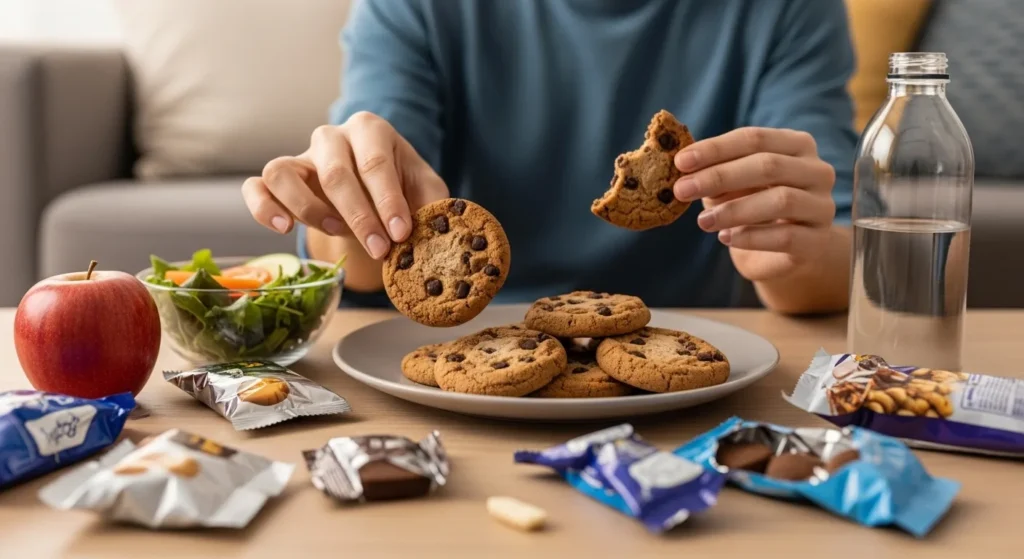
The Most Dangerous Ingredient Might Be the Claim on the Front
You’ve probably done this without realizing it.
You open a bag of snacks that says:
“Baked, Not Fried.”
Or a granola that promises:
“Low Sugar.”
Or a yogurt labeled:
“High Protein.”
And something subtle happens in your brain:
You relax.
You serve more.
You snack longer.
Not because you’re careless…
but because the label made the portion feel safer.
This is one of the most overlooked realities of modern nutrition:
Label claims don’t just change what you buy.
They change how much you eat.
And the effect is far stronger than most people imagine.
Let’s unpack why.
Portion Perception Is Psychological, Not Mathematical
Most people think portion size is a physical choice.
But research in eating behavior shows portion perception is deeply mental.
Your brain doesn’t measure grams.
It measures meaning.
So when a food is framed as “healthy,” your brain often assumes:
- It’s less indulgent
- It’s less risky
- It requires less restraint
- It won’t “count as much”
That mental shift leads to bigger portions without conscious intent.
This is why portion control isn’t only about willpower.
It’s about perception.
And perception is easily shaped by packaging.
The “Health Halo” Effect: The Portion Distortion Engine
One of the most studied phenomena in nutrition psychology is the health halo effect.
This happens when one positive claim makes the entire product feel healthier than it is.
For example:
- “Organic” feels lower-calorie
- “Gluten-free” feels lighter
- “Low fat” feels unlimited
- “High protein” feels guilt-free
Even when the nutrition facts are similar…
the portion changes.
People consistently serve themselves more of foods they believe are “better.”
Not because they’re hungry.
Because the label gives permission.
Real-Life Example: The Snack That Doubles Quietly
Imagine two identical snack bowls.
One is labeled:
Regular Chips
The other says:
Baked Veggie Chips — Low Fat
Most people will eat more from the second bowl.
Even if calories are nearly the same.
That’s the label claim effect:
The food seems lighter…
so the portion grows.
The brain thinks:
“This is a smart choice, so I can have extra.”
That’s how overeating becomes invisible.
Why “Low Fat” Claims Often Increase Portions
The “low fat” era created one of the biggest portion perception distortions in history.
When fat became feared, products replaced fat with:
- sugar
- starch
- additives
But consumers saw “low fat” and assumed:
- fewer calories
- healthier eating
- less need to stop
The result?
Bigger servings.
More snacking.
Less satisfaction.
Fat provides fullness.
Removing it often makes people eat more to compensate.
So the portion grows…
even when the label looks virtuous.
High Protein Claims Can Trigger the Same Trap
Protein is now the most powerful health claim in supermarkets.
Protein bars. Protein cookies. Protein cereal.
And protein does help fullness…
but the claim can distort perception.
People assume:
- It’s fitness food
- It’s for weight control
- It’s automatically balanced
So they underestimate portion impact.
A “protein cookie” can still be:
- ultra-processed
- high calorie
- high saturated fat
- low in fiber
The label creates a halo…
and the portion grows again.
Serving Size vs Serving Perception: The Quiet Disconnect
Nutrition labels show serving size.
But humans don’t eat servings.
They eat packages, bowls, routines.
A label may say:
Serving size: 8 crackers
But the brain sees:
“A small snack.”
So you eat 20.
Label claims make this gap worse.
Because when the claim sounds healthy…
the serving size feels less relevant.
Comparison Table: Claims vs Portion Reality
| Label Claim | What People Often Assume | What Happens in Portions |
|---|---|---|
| Low Fat | “I can eat more” | Portions increase |
| Organic | “It’s cleaner” | Less restraint applied |
| Gluten-Free | “It’s lighter” | Calories underestimated |
| High Protein | “It’s fitness food” | Snacks feel guilt-free |
| No Added Sugar | “Basically healthy” | Larger servings consumed |
| 100 Calories Pack | “Controlled portion” | Multiple packs eaten |
Hidden Tip: The Front Label Affects Appetite Before Taste
One of the most surprising truths:
The portion decision happens before the first bite.
The claim shapes expectation.
Expectation shapes:
- how hungry you feel
- how big a portion seems
- how quickly you stop
So the food label becomes an appetite cue.
Not just information.
That’s why two identical foods can lead to different eating behaviors…
based purely on packaging.
The “Snackability” Trap: When Healthy Claims Remove the Stop Signal
Foods with strong health claims often become “everyday snacks.”
Think:
- granola
- trail mix
- smoothie bottles
- protein bites
These foods are nutrient-dense…
but also calorie-dense.
The label makes them feel like background food.
Something you can eat while working, driving, scrolling.
Portions disappear into autopilot.
This is not a personal failure.
It’s design.
Common Portion Mistakes Caused by Label Claims
Here are the traps most people fall into:
- Eating directly from the bag because it feels “healthy”
- Ignoring serving size because the product is “better”
- Over-snacking on protein foods
- Assuming organic means lower calorie
- Trusting “low sugar” without checking total carbs
- Repeating the same packaged health food daily
Label claims reduce alertness.
That’s the real danger.
Actionable Steps: How to Protect Portion Awareness
You don’t need to fear labels.
You need to ground them in reality.
The 5-Step Portion Reset
- Flip to the back first, not the front
Claims are marketing. Facts are context. - Look at serving size and servings per container
A “healthy” snack may contain 3 servings. - Ask: Would I eat this portion if it wasn’t labeled healthy?
This question breaks the halo. - Plate it, don’t bag it
Portion awareness improves instantly when food has boundaries. - Prioritize satisfaction, not just claims
Fiber, fat, and whole foods stop overeating better than buzzwords.
Why This Matters Today (Evergreen Reality)
Modern food environments are filled with engineered cues.
Claims are not neutral.
They shape:
- permission
- comfort
- perceived safety
- portion size
- long-term habits
Overeating rarely comes from hunger alone.
It often comes from subtle signals that whisper:
“This doesn’t really count.”
Understanding portion perception is one of the most empowering nutrition skills available.
Because awareness restores control.
Key Takeaways
- Label claims strongly influence how much people eat, not just what they buy
- The health halo effect makes “better” foods feel portionless
- Claims like “low fat” or “high protein” often lead to larger servings
- Serving sizes are frequently ignored when food feels safe
- Packaging shapes appetite before taste even happens
- Portion awareness improves when you plate food and check context
FAQ: Label Claims and Portion Perception
1. Why do I eat more of foods labeled healthy?
Because health claims reduce guilt and increase perceived permission, leading to larger unconscious portions.
2. Are “low fat” foods always lower calorie?
Not necessarily. Fat is often replaced with sugar or starch, and portions may increase.
3. What is the health halo effect?
It’s when one positive claim makes the entire product feel healthier, causing people to underestimate calories and overeat.
4. How can I avoid portion distortion?
Plate snacks, check servings per container, and treat claims as marketing—not portion guidance.
5. Are protein-labeled foods always better for portions?
Protein helps fullness, but highly processed protein snacks can still encourage overeating due to the “fitness halo.”
Conclusion: The Claim Isn’t the Portion — Your Brain Decides That
Nutrition labels were meant to inform.
But label claims often persuade.
They don’t just describe food…
they shape how much feels acceptable.
The healthiest eating pattern isn’t about avoiding snacks or counting perfectly.
It’s about staying aware of one simple truth:
When food feels healthier, portions feel smaller.
Even when they aren’t.
So next time a package promises “guilt-free”…
pause.
Not because the food is bad.
But because perception is powerful.
And you deserve to eat with clarity, not suggestion.