
When Your Body Feels Unpredictable, Life Feels Harder
Some days you wake up energized.
Other days, exhausted for no clear reason.
Your hunger swings wildly.
Your mood feels reactive.
Your digestion is inconsistent.
Many people blame:
- Stress
- Age
- Hormones
- Bad luck
But often, the root issue is simpler and quieter:
The body thrives on predictability—and nutrition is one of the strongest signals that creates it.
When nutrition is inconsistent, the body becomes reactive.
When nutrition is reliable, the body becomes calm.
This article explores how food doesn’t just fuel you—it teaches your body what to expect, how to respond, and how stable it can afford to be.
What “Predictability” Means in Human Biology
Predictability isn’t boredom.
In biology, predictability means:
- Stable energy availability
- Reliable nutrient access
- Consistent timing signals
- Reduced survival stress
A predictable body doesn’t panic easily.
It doesn’t overreact to:
- Missed meals
- Sleep disruption
- Mental stress
- Physical effort
And nutrition is one of the strongest cues that tells the body whether it’s safe to relax or stay on guard.
Why the Body Dislikes Uncertainty More Than Imperfection
The human body evolved in uncertain environments.
So it learned one powerful rule:
Uncertainty is dangerous.
Irregular food intake, nutrient gaps, or erratic eating patterns trigger the same internal alarms as scarcity—even if calories are sufficient.
When food is unpredictable, the body responds by:
- Elevating stress hormones
- Guarding energy reserves
- Increasing hunger signals
- Narrowing metabolic flexibility
This doesn’t feel dramatic.
It feels unstable.
Nutrition as a Biological Signal, Not Just Fuel
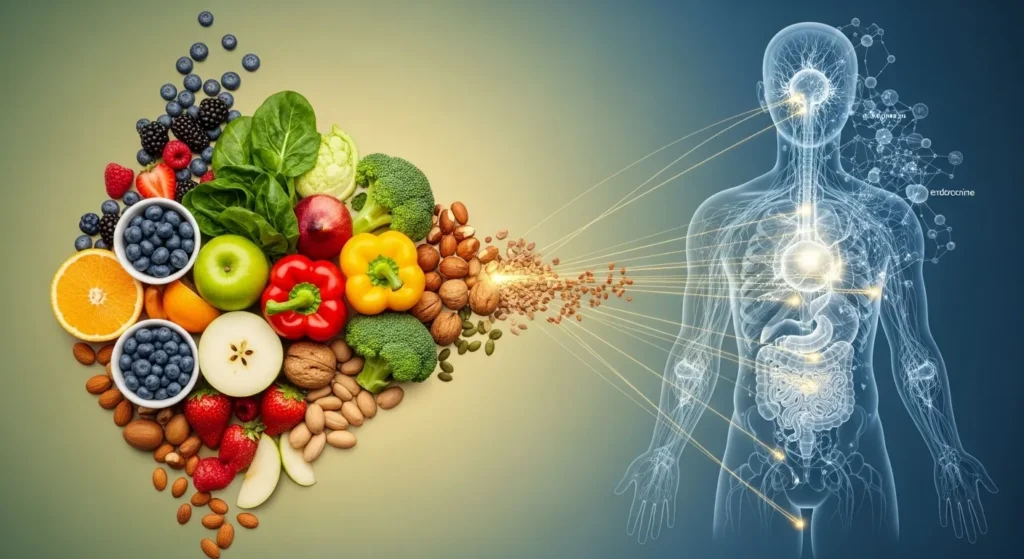
Food does more than provide calories.
It sends information.
Every meal communicates:
- “Resources are available”
- “Repair is safe”
- “Growth can continue”
When these signals are consistent, the body stabilizes its internal environment.
When they’re chaotic, the body stays reactive—even if you eat “healthy” foods.
Why Consistent Nutrition Stabilizes Energy
Energy crashes aren’t just about calories.
They’re about predictability.
When the body can’t anticipate energy intake:
- Blood sugar regulation becomes reactive
- Stress hormones spike unnecessarily
- Fatigue appears suddenly
Consistent nutrition helps:
- Smooth glucose response
- Reduce adrenaline-driven energy swings
- Improve mitochondrial efficiency
You don’t feel “amped.”
You feel steady.
Real-Life Example: The Person Who Eats Well—But Randomly
This pattern is common.
Someone eats:
- Nutritious foods
- Enough calories
- Minimal junk
But meals are:
- Skipped
- Delayed
- Clustered late
The result:
- Erratic hunger
- Energy crashes
- Mood instability
Nothing is “wrong” with the food.
The problem is unpredictability.
How Nutrition Creates Predictable Hormonal Signals
Hormones respond to patterns, not intentions.
Regular nutrition helps:
- Insulin stay responsive
- Cortisol follow a natural rhythm
- Hunger hormones normalize
- Thyroid signaling stabilize
Irregular eating forces hormones into constant adjustment.
Over time, this increases:
- Stress load
- Fatigue
- Irritability
Predictable nutrition lowers hormonal noise.
Predictability vs. Excitement: A Health Trade-Off
Many diet trends chase excitement.
But the body prefers calm.
| Nutrition Pattern | Body Response | Long-Term Effect |
|---|---|---|
| Erratic but “healthy” | Reactive | Unstable |
| Extreme dieting | Alarmed | Rebound |
| Consistent & adequate | Calm | Resilient |
| Perfect but short-lived | Suspicious | Temporary |
Health rarely feels dramatic.
It feels reliable.
Why Digestion Improves With Predictable Nutrition
Your gut is rhythmic.
It expects:
- Regular input
- Familiar foods
- Consistent timing
When meals are unpredictable:
- Acid secretion becomes erratic
- Motility changes
- Bloating and discomfort increase
When nutrition is consistent:
- Enzyme release improves
- Microbiome stability increases
- Digestion becomes quieter
Less drama doesn’t mean less function.
It means better function.
The Nervous System Needs Nutritional Reliability
The nervous system constantly asks:
“Are resources coming—or should I prepare for shortage?”
Nutrition answers that question.
Consistent nourishment:
- Reduces sympathetic (fight-or-flight) activation
- Supports parasympathetic recovery
- Improves sleep regulation
This is why people often report:
- Better sleep
- Calmer mood
- Improved stress tolerance
without any dramatic dietary changes.
What Happens When Nutrition Is Unpredictable Long-Term
Over time, inconsistent nutrition leads to:
- Narrow stress tolerance
- Reactive hunger cues
- Emotional volatility
- Reduced recovery capacity
None of this appears overnight.
It accumulates quietly—until life feels harder than it should.
Why Modern Life Disrupts Nutritional Predictability
Modern schedules encourage:
- Skipped meals
- Late-night eating
- Grazing instead of meals
- Caffeine replacing food
Even “healthy” people often eat in biologically chaotic ways.
Large population studies summarized by organizations like the World Health Organization and the National Institutes of Health consistently show that diet consistency and adequacy matter as much as diet quality for long-term health.
Hidden Signs Your Body Craves More Predictability
Your body often asks quietly.
Watch for:
- Energy that depends on caffeine
- Hunger that feels urgent, not gradual
- Mood shifts tied to meals
- Poor recovery from stress
- Feeling “off” without clear cause
These aren’t failures.
They’re signals for stability.
Common Mistakes That Undermine Predictability
Even well-meaning people make these errors:
- Constantly changing eating styles
- Skipping meals to “be disciplined”
- Treating hunger as weakness
- Over-prioritizing novelty
- Ignoring timing consistency
Nutrition doesn’t need to be exciting.
It needs to be reliable.
Why This Matters Today (Even If You’re Coping Fine)
Life is already unpredictable.
Work.
Relationships.
Stress.
Nutrition shouldn’t add to that uncertainty.
A predictable body:
- Handles stress better
- Recovers faster
- Makes clearer decisions
- Ages more gracefully
Predictability is not control—it’s support.
How to Make Nutrition More Predictable (Without Rigidity)
You don’t need strict rules.
You need signals of safety.
Actionable steps:
- Eat at roughly consistent times
- Prioritize meals over constant snacking
- Repeat foods you digest well
- Avoid long gaps during high-stress days
- Focus on reliability before optimization
Small consistency beats perfect planning.
Key Takeaways
- Nutrition teaches the body what to expect
- Predictability reduces internal stress
- Stable energy beats dramatic spikes
- Consistency matters more than novelty
- A predictable body is a resilient body
Frequently Asked Questions
1. Does predictable nutrition mean eating the same foods daily?
No. It means consistent timing and adequacy, not monotony.
2. Can irregular eating affect mood?
Yes. Blood sugar and stress hormones respond to unpredictability.
3. Is flexibility bad for health?
No—chronic unpredictability is the issue, not occasional variation.
4. Why do I feel calmer when I eat regularly?
Because your nervous system interprets consistent nourishment as safety.
5. How long does it take to feel benefits?
Often within weeks, as energy and stress responses stabilize.
Conclusion: Calm Is a Sign of Health
Nutrition doesn’t just change how you look.
It changes how predictable your body feels to live in.
When meals are reliable, the body relaxes.
When nutrients are consistent, systems cooperate.
When signals are stable, health becomes quieter—and stronger.
That calm isn’t boring.
It’s biology saying, “I’ve got this.”
Disclaimer: This article is for general educational purposes only and does not replace personalized medical or nutritional guidance. Individual needs may vary.

Pingback: Your Brain Remembers How You Eat — Even When You Forget
Pingback: Why What You Eat Can Quiet an Overactive Mind
Pingback: How Everyday Food Choices Keep Your Body From Falling Apart
Pingback: Why Aging Reflects Efficiency Loss, Not Failure — The Nutrition Truth That Changes How We Age