You get a small cut.
It heals.
You feel exhausted after stress.
You recover.
You strain a muscle.
It repairs.
These processes feel automatic—almost guaranteed.
But here’s the truth most people never hear:
Your body’s ability to repair itself depends heavily on how well it’s nourished.
Repair isn’t magic.
It’s biology—and biology needs fuel.
When nutrition supports repair, healing feels smooth and predictable.
When it doesn’t, recovery quietly slows.
Repair Is a Constant Job, Not an Emergency Response
We often think of repair as something the body does after injury.
In reality, repair happens all the time.
Every day, your body:
- Rebuilds damaged proteins
- Replaces worn-out cells
- Fixes microscopic tissue injuries
- Repairs DNA damage
This continuous maintenance is what keeps you functioning.
According to public health and biological research frequently referenced by organizations like the World Health Organization, nutrition plays a central role in supporting these repair processes across the lifespan.
When repair keeps up with damage, health feels stable.
When it falls behind, decline begins quietly.
What “Repair Capacity” Actually Means
Repair capacity refers to how efficiently your body can:
- Fix tissue damage
- Restore normal function
- Recover from stress
It’s not fixed.
Repair capacity is influenced by:
- Nutrient availability
- Energy stability
- Inflammation levels
- Hormonal balance
Two people can experience the same stress—but recover very differently.
Nutrition is often the difference.
Why Healing Slows Before You Notice Anything Is Wrong
One of the most misunderstood things about repair is timing.
Repair capacity declines before symptoms appear.
You don’t feel:
- Slower healing
- Longer soreness
- Lingering fatigue
…until repair has been compromised for a while.
By the time recovery feels slow, the system has already been under-fueled for years.
Real-Life Example: The “Why Am I Not Bouncing Back?” Moment
Think about a time when:
- Minor stress lingered longer than usual
- Muscle soreness took days instead of hours
- Illness recovery felt slower
Most people blame age or bad luck.
Often, the real cause is reduced repair capacity—driven by nutrition that no longer supports rebuilding efficiently.
Protein: The Structural Foundation of Repair
Protein is not just for muscle.
It’s the raw material for:
- Tissue rebuilding
- Enzyme production
- Immune repair
- Hormone synthesis
When protein intake is consistently low:
- Repair slows
- Muscle loss accelerates
- Recovery weakens
This doesn’t show up immediately—but it compounds over time.
Repair requires building blocks.
Protein supplies them.
Energy Availability: Repair Needs Fuel, Not Just Materials
Even with adequate nutrients, repair can stall if energy is unstable.
Repair processes require:
- ATP (cellular energy)
- Stable glucose delivery
- Efficient metabolism
Chronic under-eating, skipped meals, or extreme restriction send the message:
“Energy is scarce. Prioritize survival.”
When that happens, repair becomes optional.
Micronutrients: The Silent Repair Enablers
Micronutrients don’t provide calories—but they run the system.
Key repair-supporting nutrients include:
- Vitamin C → collagen formation
- Zinc → wound healing and immune repair
- B vitamins → DNA repair and energy metabolism
- Magnesium → cellular stability and signaling
Small deficiencies don’t stop repair overnight.
They slow it down quietly.
Inflammation: When Repair Gets Blocked
Inflammation is part of healing.
But chronic inflammation interferes with repair.
Highly processed, nutrient-poor diets:
- Increase inflammatory signals
- Divert resources away from rebuilding
- Damage tissues faster than they can be repaired
When inflammation stays high, repair never catches up.
Nutrition that reduces inflammation frees energy for healing.
Gut Health and Repair Capacity
Repair doesn’t start at the injury site.
It starts in the gut.
A healthy gut:
- Absorbs nutrients efficiently
- Supports immune balance
- Reduces systemic inflammation
Poor gut health limits nutrient availability—even when diet looks adequate.
This is why people can “eat well” yet still recover poorly.
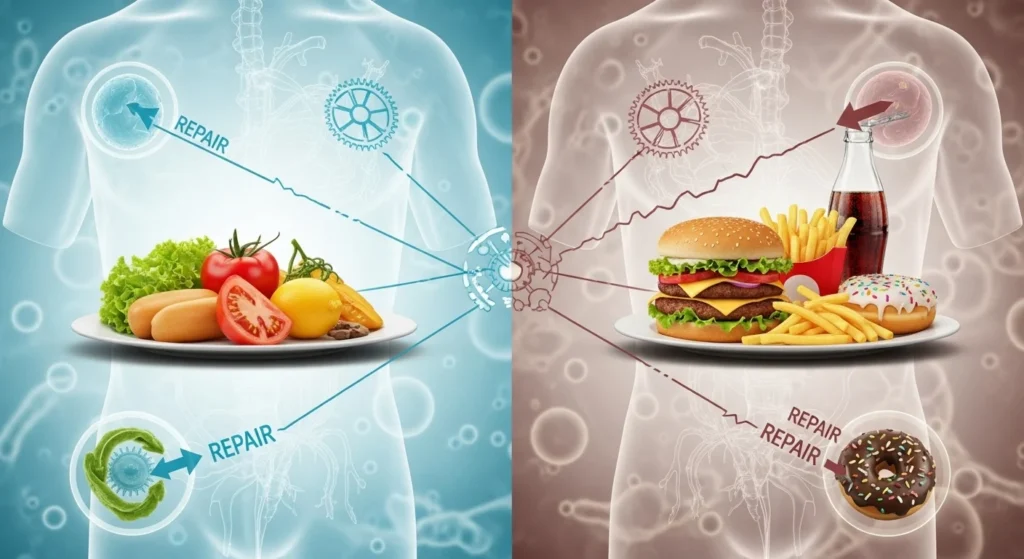
Repair vs Damage: A Simple Comparison
| When Nutrition Supports Repair | When Nutrition Undermines Repair |
|---|---|
| Fast recovery | Lingering soreness |
| Efficient healing | Frequent setbacks |
| Stable energy | Chronic fatigue |
| Strong resilience | Fragile health |
Health reflects which side wins—most days.
Common Nutrition Mistakes That Reduce Repair Capacity
Even well-intentioned habits can interfere with healing.
❌ Chronic Undereating
Reduces energy available for repair.
❌ Low Protein Intake
Limits rebuilding materials.
❌ Nutrient-Poor Convenience Diets
Increase damage without supporting repair.
❌ Ignoring Recovery Nutrition
Assuming healing is automatic.
Repair must be supported, not assumed.
How to Support the Body’s Repair Capacity Daily
You don’t need specialized supplements or extreme protocols.
You need consistency.
Practical, Actionable Steps:
- Eat enough to support energy needs
- Include protein at every meal
- Prioritize nutrient-dense foods
- Avoid long periods of underfueling
- Think of food as rebuilding material
These habits strengthen repair quietly over time.
Hidden Tip: Recovery Speed Is a Repair Signal
One of the clearest signs of repair capacity is recovery speed.
Ask yourself:
- How fast do aches resolve?
- How quickly do you regain energy?
- How long does stress linger physically?
Slower recovery often signals under-supported repair—not just aging.
Why This Matters Today
Modern life increases:
- Stress exposure
- Inflammatory load
- Energy demands
At the same time, many diets:
- Prioritize convenience
- Undersupply nutrients
- Disrupt energy stability
This mismatch explains why many people feel “run down” despite no clear illness.
Repair systems are working—but without enough support.
Key Takeaways
- The body repairs itself constantly—not just after injury
- Nutrition directly determines repair efficiency
- Protein, energy, and micronutrients are essential
- Chronic inflammation blocks healing
- Recovery speed reflects repair capacity
Frequently Asked Questions (FAQs)
1. Can nutrition really affect how fast I heal?
Yes. Healing depends on energy, protein, and micronutrient availability.
2. Is slow recovery always a sign of aging?
Not always. Poor nutrition can reduce repair capacity at any age.
3. Do I need supplements to improve repair?
Most people benefit more from consistent, balanced nutrition than supplements.
4. Why do injuries linger when I’m stressed?
Stress increases energy demand and inflammation, leaving fewer resources for repair.
5. How long does it take to improve repair capacity?
Some improvements (energy, soreness) appear within weeks; deeper repair improves over months.
Conclusion: Healing Is Fueled, Not Guaranteed
Your body wants to repair itself.
But it can only work with what you provide.
When nutrition supplies steady energy, adequate protein, and essential nutrients, repair feels effortless.
When it doesn’t, healing slows—quietly, gradually.
Supporting repair isn’t about perfection.
It’s about giving your body the tools it needs to rebuild—every single day.
Disclaimer: This article is for general educational purposes only and does not replace personalized nutrition or medical advice.








Pingback: Why Aging Is a Gradual Nutritional Process (And Not Just Time Catching Up With You)
Pingback: How Nutrition Supports Cellular Renewal — The Daily Repair Process That Shapes How You Age
Pingback: How the Body Uses Nutrition to Slow Wear and Tear — The Repair System Most People Undervalue
Pingback: How Nutrition Quietly Controls the Speed of Aging (And Why It Matters More Than Genetics)
Pingback: Why Avocados Are Considered the Gold Standard of Healthy Fats