
Your “Normal” Health Was Built Long Before You Noticed It
Most people describe their health using words like normal.
“This is just how my energy is.”
“I’ve always been this stiff.”
“My digestion is just sensitive.”
But what feels normal is often not neutral.
It’s a baseline — a default state your body has settled into after years of nutritional input.
That baseline determines:
- How much energy you wake up with
- How resilient you feel to stress
- How quickly you recover
- How easily symptoms appear
And nutrition is one of the strongest forces shaping it.
What Baseline Health Really Means
Baseline health is not peak performance.
It’s your body’s starting point.
It shows up when:
- You’re not sick
- You’re not training hard
- You’re not under acute stress
It reflects:
- Muscle tone
- Metabolic efficiency
- Inflammation levels
- Hormonal balance
- Nervous system stability
This baseline is what your body falls back to — again and again.
And it’s shaped quietly, meal by meal.
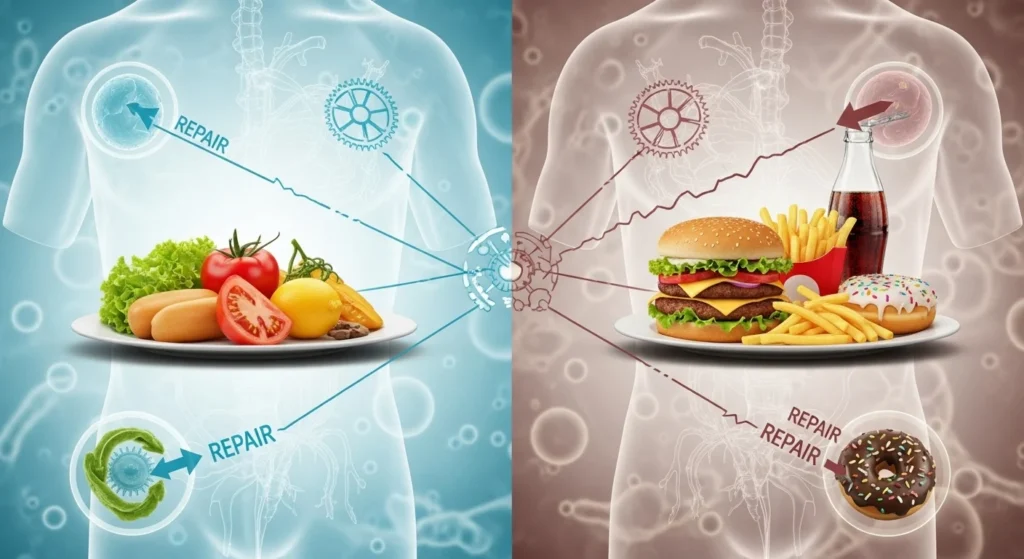
Nutrition Sets the Body’s “Default Settings”
Think of nutrition as the operating system running in the background.
When nutrition is consistent and adequate:
- Repair stays ahead of damage
- Inflammation resolves efficiently
- Energy production remains stable
When nutrition is inconsistent or insufficient:
- Repair slows
- Inflammation lingers
- Systems operate closer to their limits
Over time, the body adapts to what it repeatedly receives.
That adaptation becomes your baseline.
Why Baseline Health Changes Without Warning
Baseline health doesn’t shift suddenly.
It drifts.
Small nutritional gaps:
- Slight protein shortfalls
- Micronutrient inconsistencies
- Irregular meals
- Chronic under-eating
These don’t cause symptoms right away.
They lower the body’s margin.
Eventually, what once felt energetic becomes “just okay.”
What once recovered quickly now lingers.
That’s a baseline shift — not sudden decline.
The Role of Nutrition Patterns (Not Individual Meals)
Your body doesn’t remember single meals.
It remembers patterns.
Nutrition research emphasized by Harvard T.H. Chan School of Public Health consistently shows that long-term dietary patterns predict health outcomes far more reliably than isolated food choices.
Baseline health reflects:
- How often nutrients arrive
- Whether shortages are frequent
- How predictable energy supply is
Consistency trains the body to maintain.
Inconsistency trains it to conserve.
Protein Availability Shapes the Physical Baseline
Muscle is one of the strongest determinants of baseline health.
It supports:
- Posture
- Balance
- Metabolism
- Glucose control
- Joint stability
When protein intake is consistent:
- Muscle is preserved
- Baseline strength remains higher
- Daily movement feels easier
Guidance summarized by the National Institute on Aging highlights muscle preservation as central to maintaining long-term function and independence.
Low protein doesn’t cause sudden weakness.
It quietly lowers your baseline.
Micronutrients Define How “Smoothly” the Body Runs
Micronutrients don’t boost performance dramatically.
They prevent friction.
They support:
- Nerve signaling
- Oxygen transport
- Cellular energy
- Immune readiness
When micronutrients are inconsistent:
- Fatigue becomes normal
- Sleep feels lighter
- Stress tolerance drops
- Digestion becomes unpredictable
People often assume this is personality or age.
It’s frequently baseline nutrition.
Inflammation Is a Baseline Condition — Not Just a Reaction
Inflammation isn’t only a response to injury.
It can become a baseline state.
Nutrition influences whether inflammation:
- Resolves fully
- Or lingers at low levels
Ultra-processed foods, nutrient gaps, and irregular eating patterns keep inflammation slightly elevated.
That low-grade inflammation affects:
- Energy
- Mood
- Joint comfort
- Recovery
Baseline inflammation equals baseline discomfort.
High Baseline Health vs. Low Baseline Health
| Higher Baseline Health | Lower Baseline Health |
|---|---|
| Stable daily energy | Frequent fatigue |
| Faster recovery | Lingering soreness |
| Clear thinking | Brain fog |
| Resilient digestion | Sensitive digestion |
| Stress tolerance | Easy overwhelm |
These aren’t personality traits.
They’re physiological defaults.
Real-Life Example: “This Is Just How I Am”
Many people live with:
- Daily stiffness
- Afternoon crashes
- Poor sleep quality
They assume it’s normal.
But often, small nutritional improvements:
- Regular meals
- Adequate protein
- Better micronutrient intake
Shift the baseline upward.
Nothing dramatic changes.
Everything feels easier.
Hidden Ways Baseline Health Gets Undermined
Even health-conscious people slip into baseline erosion.
Common mistakes:
- Skipping meals regularly
- Eating “light” for long periods
- Replacing meals with snacks
- Under-eating during stress
- Assuming supplements replace food
These habits don’t cause illness.
They lower the default.
Why This Matters Today
Modern life pushes baselines downward:
- Chronic stress
- Irregular schedules
- Convenience foods
- Diet culture encouraging restriction
At the same time, public health guidance from the World Health Organization emphasizes nutrition as a foundation for population-level health and resilience.
Baseline health determines how much life feels manageable — or draining.
Actionable Ways to Raise Your Baseline Health
You don’t need optimization.
You need reliability.
Focus on:
- Protein at every main meal
- Regular eating windows
- Whole-food micronutrient sources
- Eating enough during busy or stressful days
- Avoiding long, repeated food gaps
Baseline health improves through repetition, not intensity.
Emotional Relief: Your Baseline Is Not Fixed
Many people believe:
“This is just how my body works.”
Often, it’s not.
Baselines are adaptive, not permanent.
When nutrition becomes more supportive, the body recalibrates upward.
Slowly. Quietly. Reliably.
Key Takeaways
- Baseline health is your body’s default operating state
- Nutrition patterns shape this baseline over time
- Protein and micronutrients preserve functional capacity
- Inconsistent eating lowers baseline resilience
- Improving nutrition raises how “good” normal feels
Frequently Asked Questions
1. Can nutrition really change my baseline health?
Yes. Long-term patterns directly influence energy, resilience, and recovery.
2. Why does my health feel “off” even without illness?
Baseline inflammation or nutrient gaps often go unnoticed.
3. Is baseline health the same as fitness?
No. Fitness is performance; baseline is default function.
4. Do supplements fix a low baseline?
They can help gaps, but consistent food intake matters more.
5. Is it too late to improve baseline health?
No. The body adapts positively at any age.
Baseline Health Is Built — Not Assigned
Your baseline health isn’t luck.
It’s not genetics alone.
It’s the result of what your body has learned to expect.
When nutrition becomes consistent and adequate, the body raises its standards.
And what once felt like “normal”
becomes better than expected.
Disclaimer: This article is for general educational purposes and does not replace personalized medical or nutritional advice.







Pingback: Why Aging Is About Maintenance, Not Decline — The Nutrition Truth That Changes How You Age
Pingback: How Everyday Food Choices Keep Your Body From Falling Apart
Pingback: How the Body Protects Balance Through Nutrition, Not Willpower
Pingback: Why Small Eating Habits Matter More Than You Think
Pingback: The Hidden Health Benefits of Eating Mangoes (Why This Fruit Does More Than Taste Amazing)