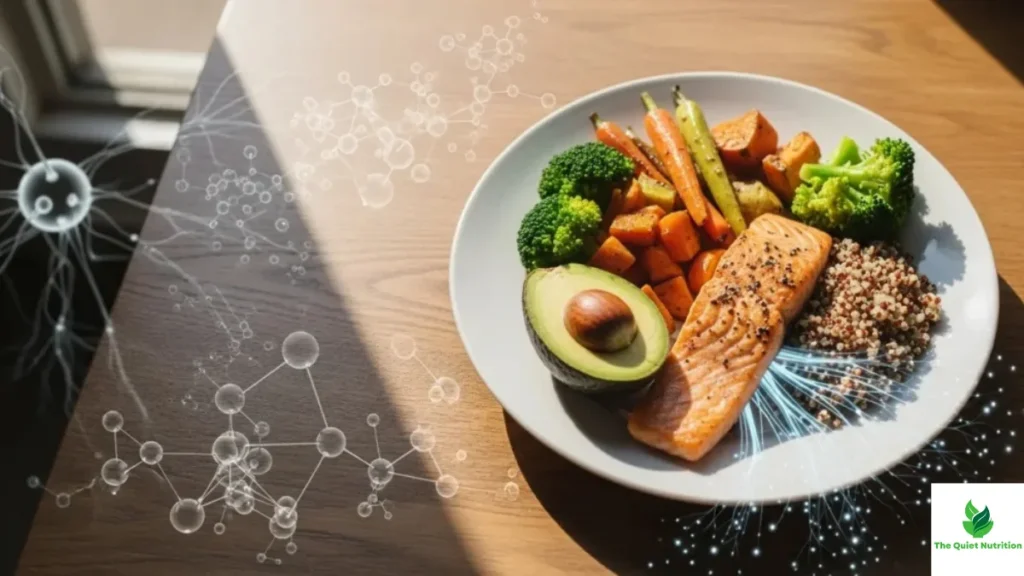
Somewhere between the first bite of a meal and the moment you feel satisfied, an extraordinary amount of biological work happens that you’ll never consciously notice. Your gut isn’t just a tube that food passes through on its way to becoming waste. It’s actively reading what’s inside it, sending precise reports to your brain, and adjusting your body’s chemistry in real time — all before you’ve even finished chewing.
For a long time, scientists assumed this communication happened slowly, through hormones drifting through the bloodstream over minutes. Recent research has revealed something far faster and more deliberate: a direct neural wiring system connecting your gut to your brain, operating on a timescale closer to reflexes than digestion.
Your Gut Has Its Own Sensory Cells, Wired Straight to the Brainstem
Scattered throughout the lining of your intestine are specialized cells called enteroendocrine cells — hormone-producing cells that constantly sample the contents passing through your gut. For decades, the assumption was that these cells communicated with the brain only indirectly, releasing hormones into the bloodstream that eventually influenced appetite and digestion, a process taking minutes to unfold.
Then researchers discovered something that changed the picture entirely. A subset of these gut cells, now called neuropod cells, don’t just release hormones passively — they form actual synapses with the vagus nerve, the same kind of direct neural connection your eyes use to send visual information to your brain. Using glutamate, the same neurotransmitter involved in fast neural signaling elsewhere in the body, these cells can transmit information about what you’ve just eaten to the brainstem in milliseconds. Researchers demonstrated that stimulating these cells triggered responses in connected neurons almost instantly — not the slow hormonal drift previously assumed, but something closer to a direct sensory circuit, on par with how touch or taste gets transmitted.
This means your gut has something functioning almost like its own sense organ, purpose-built to detect nutrients and relay that information to the brain with startling speed and precision.
The System Can Tell the Difference Between Real Sugar and a Sugar Substitute
One of the more striking findings from this research area is how discerning this gut-to-brain wiring actually is. Studies have shown that these gut sensory cells can distinguish real sugar from artificial sweeteners, using a specific sugar-detecting transporter, and that this distinction directly shapes preference. When researchers experimentally blocked the activity of the relevant gut cells, animals’ preference for real sugar over artificial sweetener disappeared. The gut wasn’t just detecting “something sweet.” It was detecting the actual metabolic content of what had been consumed, and using that specific information to shape feeding behavior going forward.
This Signaling Network Reaches Far Beyond Just Appetite
The vagus nerve carrying these signals isn’t a narrow appetite channel — it’s one of the most extensive nerves in the body, connecting the gut to organs across the digestive, cardiovascular, and respiratory systems. Research describes the vagus nerve as central to regulating energy balance, digestion, immune responses, reward processing, memory, and cognition, all interconnected through this same gut-to-brain communication highway.
Some of the sensory endings along this nerve detect mechanical information, like the stomach physically stretching as it fills. Others penetrate deeper into the gut lining specifically to access the nutrient-triggered chemical signals released by enteroendocrine and neuropod cells. Together, these different input types let the brain build a remarkably detailed, real-time picture of not just how much you’ve eaten, but what you’ve eaten and how your body should respond metabolically as a result.
Speed Is the Whole Point
What makes this system so effective at maintaining balance is exactly how fast it operates. Research tracking neurons involved in satiety has found measurable brain activation within seconds of nutrients reaching the gut — a response time that would be impossible if the body were relying solely on hormones diffusing slowly through the bloodstream. This rapid feedback loop lets your body begin adjusting — insulin release, digestive enzyme activity, subsequent appetite — while a meal is still actively being processed, rather than waiting until well after eating to course-correct.
This fast circuitry appears to matter for more than routine digestion. Researchers have also traced a specific gut-to-brain reward pathway running through the right side of the vagus nerve, linking nutrient detection directly to brain regions involved in reward and motivation — a finding that helps explain why eating can feel intrinsically rewarding at a level that operates well beneath conscious food choice.
The Quiet Intelligence Behind Every Bite
None of this requires any conscious effort on your part, which is exactly what makes it easy to overlook. Every meal triggers a fast, precise, and remarkably specific conversation between your gut and your brain — one that distinguishes real nutrients from synthetic stand-ins, adjusts your body’s internal chemistry in near real time, and shapes both your immediate physiology and your future food preferences, all through a sensory system operating faster than most people realize their own gut even could.
The next time a meal leaves you feeling settled, energized, or simply “right,” that sensation isn’t vague or coincidental. It’s the tail end of an extraordinarily fast, precise sensory conversation your body has been having with itself the entire time you were eating.
Sources:
- Science — A Gut-Brain Neural Circuit for Nutrient Sensory Transduction
- Frontiers in Neuroscience — Enteroendocrine Cell Regulation of the Gut-Brain Axis
- Cell Press, Trends in Endocrinology & Metabolism — Neuroendocrine Gut-Brain Signaling in Obesity
- NCBI/PMC — Monitoring In Vivo Neural Activity to Understand Gut-Brain Signaling

Aarti Solanki, B.Sc. (Food Science), is a food science writer passionate about making nutrition simple and evidence-based. She creates well-researched, easy-to-understand articles on healthy eating, food science, and nutrition, using information from trusted scientific and public health sources.






Pingback: Why Oranges Support Your Immune System So Well (The Science Behind This Everyday Fruit)
Pingback: The Hidden Health Power of Lemons Most People Completely Overlook
Pingback: Why Avocados Are Considered the Gold Standard of Healthy Fats
Pingback: The Hidden Power of Kiwi: The Superfruit Most People Overlook
Pingback: Watermelon Isn’t Just Water: The Hidden Health Benefits Most People Don’t Know
Pingback: The Surprising Heart Benefits of Grapes (And Why Doctors Love Them)
Pingback: What Nutrition Labels Leave Out: The Missing Context Behind “Healthy” Foods
Pingback: Why Tart Cherries Are Becoming a Popular Natural Sleep Food
Pingback: How Your Eating Schedule Quietly Controls Energy, Sleep, and Hunger
Pingback: Why Your Body’s Strength Depends on What You Eat Every Day