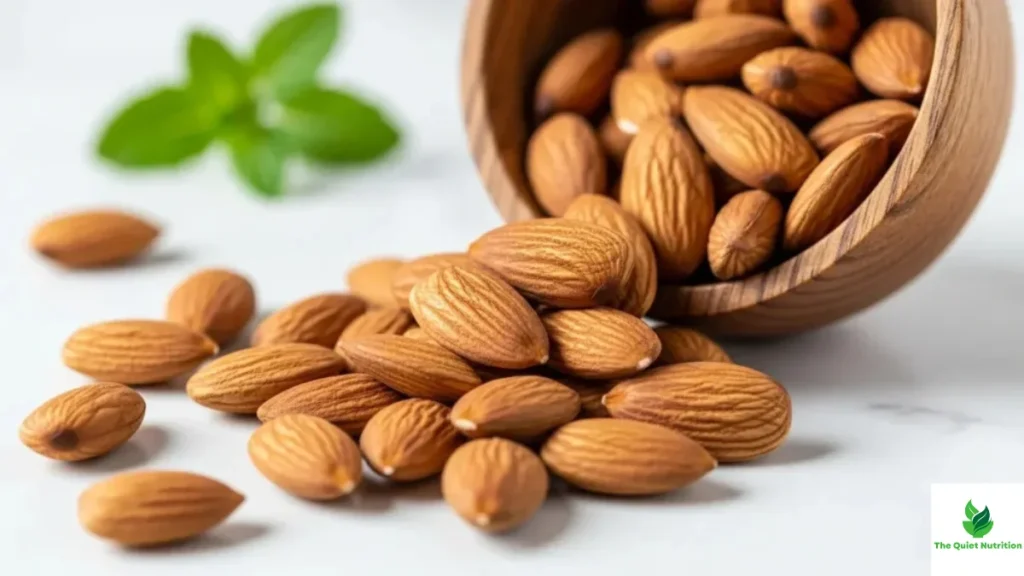
Grab a handful of almonds and you’re holding one of the most researched foods in nutrition science. They’re not a passing wellness trend — decades of studies from Harvard, the USDA, and major medical journals keep landing on the same conclusion: a small daily serving of almonds does a lot of heavy lifting for your heart, blood sugar, brain, and waistline.
Here’s what’s actually happening inside your body every time you snack on them.
A Tiny Nut With a Massive Nutrient Profile
One ounce of almonds (about 23 nuts) packs a surprising amount into roughly 165 calories: 6 grams of protein, 14 grams of fat (mostly the heart-friendly monounsaturated kind), 3 grams of fiber, and a hefty dose of vitamin E, magnesium, and calcium, according to the Harvard T.H. Chan School of Public Health. Per 100 grams, USDA data shows almonds deliver 270 mg of magnesium, 269 mg of calcium, and 733 mg of potassium — a nutrient combination few snack foods can match.
About 80% of the fat in almonds is monounsaturated, the same type found in olive oil, which is a big part of why they’re considered a heart-protective food rather than just a “high-fat” one.
1. Your Heart Gets a Real Boost
This is the most well-documented benefit. Nutritionists have long known that almonds tend to lower harmful LDL cholesterol while supporting healthy HDL cholesterol. A study published in the Journal of Nutrition found that people who swapped a daily muffin for 1.5 ounces of almonds saw a more favorable shift in their HDL cholesterol subtypes and an improved ability to clear cholesterol from the bloodstream, compared to those eating the same calories from a muffin (Harvard Health Publishing).
Larger population studies back this up: people who eat tree nuts like almonds at least four times a week tend to have a significantly lower risk of heart disease, and health professionals who ate them two or more times weekly showed about a 13% lower risk of total cardiovascular disease (Harvard T.H. Chan School of Public Health).
2. Blood Sugar Stays More Stable
Almonds are low in carbs but rich in fiber, protein, and magnesium — a combination that slows digestion and blunts blood sugar spikes. In one Harvard-affiliated comparison, researchers found that a serving of French fries spiked blood glucose and insulin far more than an equal-calorie serving of almonds, even though the total health markers looked similar over time (Harvard Health Publishing).
Magnesium in particular plays a key role in insulin function, which is one reason almonds are frequently recommended as a smart snack for people managing — or trying to avoid — type 2 diabetes.
3. They Help You Feel Full, Not Fat
It seems counterintuitive that a calorie-dense food could support weight management, but that’s exactly what the research shows. The fiber, protein, and fat in almonds work together to increase satiety, so you naturally eat less later. Despite being calorie-dense, research does not support a link between nut intake and weight gain — in fact, regular nut eaters tend to show less weight gain and a lower risk of obesity over time (Harvard T.H. Chan School of Public Health).
In a well-known weight-loss study, dieters who added almonds and olive oil to a low-fat diet lost as much weight as those on a strict low-calorie plan — and kept it off six months later, while the low-fat-only group regained weight (Psychology Today, citing Harvard research).
4. Antioxidants and Vitamin E Fight Cellular Damage
Almonds are one of the world’s best food sources of vitamin E, a fat-soluble antioxidant that helps protect your cells from oxidative stress — a key driver of aging and chronic disease. The skin of the almond alone contains around 20 different flavonoid compounds, which work alongside vitamin E in the nut’s flesh to create a uniquely protective nutritional package (Live Science, citing Harvard research).
This is also why nutrition experts recommend eating almonds whole and unblanched (with the brown skin on) rather than skinned — the skin is where much of the antioxidant activity lives.
5. Bones, Brain, and Gut Benefits Too
- Bone strength: Almonds’ calcium and phosphorus content supports bone density and may help protect against osteoporosis.
- Brain health: The vitamin E and flavonoid content has anti-inflammatory, antioxidant effects that researchers are studying for their potential role in protecting against age-related cognitive decline.
- Gut health: Almonds contain phytonutrients that support the growth of beneficial gut bacteria, and their fiber content helps keep digestion regular (Harvard T.H. Chan School of Public Health).
How Many Almonds Should You Eat a Day?
Most research points to about 1 ounce (roughly 20-23 almonds) as the sweet spot — enough to get the cholesterol, blood sugar, and satiety benefits without overdoing the calories. A few tips to make them a true daily habit:
- Keep a small portioned bag at your desk or in your bag so you’re not eyeballing handfuls straight from the jar.
- Choose raw or dry-roasted, unsalted almonds to avoid unnecessary sodium.
- Eat them with the skin on for the full antioxidant benefit.
- Pair with fruit for a fiber-and-protein combo that keeps you full for hours.
Quick FAQ
Are almonds good for you every single day? Yes — for most people, a daily 1-ounce serving is considered safe and beneficial, and is the amount used in most of the clinical studies showing heart and metabolic benefits.
Do almonds cause weight gain? Despite being calorie-dense, research consistently shows nut consumption, including almonds, is associated with less weight gain, not more, when eaten in place of less nutritious snacks.
Are raw or roasted almonds healthier? Both offer similar nutrient profiles. Raw or dry-roasted, unsalted almonds are generally the better choice since oil-roasted and salted varieties add extra fat and sodium.
Can people with nut allergies eat almonds? No — almonds are a tree nut and a common allergen. Anyone with a tree nut allergy should avoid them entirely and consult a doctor about safe alternatives.
Sources
- Harvard T.H. Chan School of Public Health – The Nutrition Source: Almonds
- Harvard Health Publishing – An Advantage of Adding Almonds to Your Diet
- Harvard Health Publishing – French Fries vs. Almonds
- USDA FoodData Central
- Live Science – Almonds: Nutrition and Health Benefits

Aarti Solanki, B.Sc. (Food Science), is a food science writer passionate about making nutrition simple and evidence-based. She creates well-researched, easy-to-understand articles on healthy eating, food science, and nutrition, using information from trusted scientific and public health sources.