
Notice how hunger tends to show up right around the same time every day, almost like clockwork, even before you’ve consciously thought about food. Then notice what happens on a day when meals get pushed around — a missed lunch, an unpredictable schedule, snacking at random hours instead of eating on any real pattern. Something about that second kind of day just feels worse. Not hungrier, necessarily. Off. Distracted. A little on edge for no obvious reason.
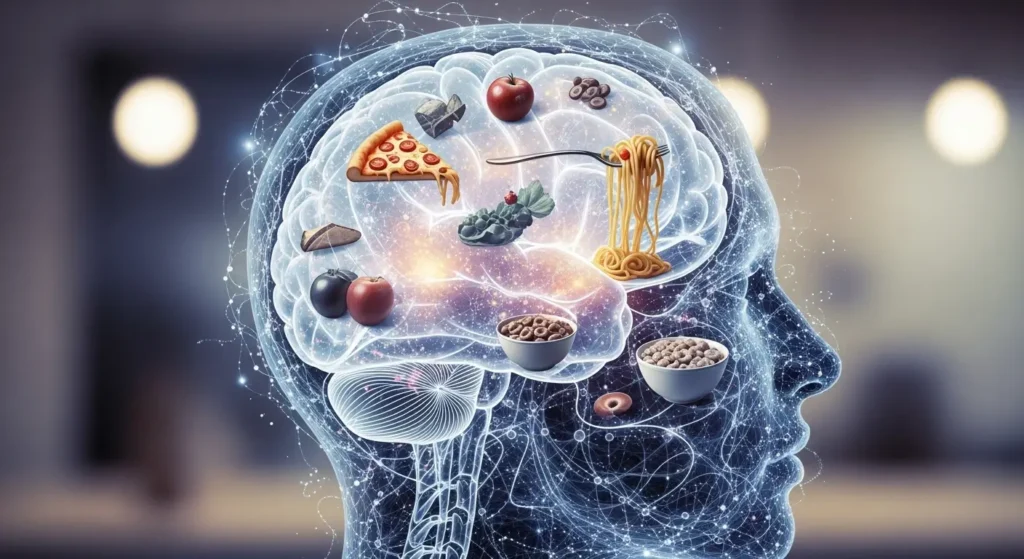
That difference isn’t random, and it isn’t just about calories. Your brain isn’t simply reacting to food as it arrives — it’s constantly trying to predict when the next meal is coming, and it prepares your body in advance based on that prediction. When those predictions are reliable, the system runs quietly in the background. When they’re not, the brain has to work harder, and that extra work shows up as exactly the kind of restless, foggy, edgy feeling that unpredictable eating days tend to produce.
Your Body Starts Digesting Before You Take a Bite
The clearest evidence that the brain is a prediction engine, not just a reaction engine, comes from something called the cephalic phase response — a concept that traces back to Ivan Pavlov’s original research on anticipatory digestion.
Here’s the basic idea: your body doesn’t wait for food to physically arrive before it starts preparing for it. The sight, smell, or even just the expected timing of a meal triggers real physiological changes — increased saliva, digestive enzyme release, and critically, an early rise in circulating insulin — all before a single calorie has been absorbed. Researchers describe these as anticipatory physiological responses that prepare the body to digest, absorb, and metabolize nutrients efficiently, and note that when this anticipatory insulin response is experimentally blocked, the result is worse glucose control and smaller meals, because the body loses its head start.
This anticipatory system isn’t limited to insulin. Ghrelin, the hormone that drives hunger, has been shown to rise on a learned schedule tied to when people typically expect to eat — and in a striking demonstration of how deeply this prediction is wired in, ghrelin levels will fall again around the usual mealtime even if no food actually shows up, simply because the body expected it and adjusted anyway. A comprehensive review published in the journal Physiological Reviews describes this cephalic phase insulin response as a genuine, robust phenomenon in humans, functioning specifically to limit how much the body gets thrown off balance by the act of eating.
The takeaway is worth sitting with: your body isn’t just responding to food. It’s placing a bet on when food will arrive, and it prepares its internal chemistry in advance based on that bet. A predictable eating pattern lets that prediction system work with confidence. An unpredictable one forces the body to either guess wrong repeatedly or stop making the prediction altogether — and both outcomes come at a cost.
What Happens When the Pattern Breaks
That cost becomes measurable once you look at what happens metabolically when eating times become irregular.
Chrononutrition — the study of how meal timing interacts with the body’s internal circadian clock — has become an active area of nutrition research precisely because the timing and regularity of eating, not just its content, appears to shape metabolic health. According to a review published through the National Institutes of Health, the circadian system includes not just the brain’s central clock but peripheral clocks located in metabolic organs like the liver and fat tissue, and these peripheral clocks are synchronized largely by feeding schedule. Disrupting that schedule — through irregular meals, shift work, or late-night eating — has been linked to impaired hormonal rhythms, reduced insulin sensitivity, and increased fat storage, independent of how much food was actually eaten.
Breakfast timing offers a particularly well-studied example of this pattern. The same review notes that skipping breakfast has been associated with increased risk of obesity, type 2 diabetes, and cardiovascular disease across multiple studies, with one systematic review of prospective research finding that the risk of developing type 2 diabetes rose in step with how frequently breakfast was skipped. A separate, broader review of chrononutrition research covering cardiovascular health specifically points out that eating regularity — not just what time meals happen, but how consistent that timing is from day to day — appears to matter for metabolic outcomes independent of total calories or food choices.
This is the physiological half of the story: your metabolic systems are built to synchronize with a rhythm, and when that rhythm keeps shifting unpredictably, the systems that depend on it — glucose regulation, hormone timing, energy availability — lose their footing.
Uncertainty Itself Is a Cognitive Tax
There’s a second, less obvious cost to unpredictable food access, and it has nothing to do with metabolism directly. It’s psychological, and the research behind it is some of the most cited work in behavioral science.
In a landmark study published in the journal Science, researchers Anandi Mani, Sendhil Mullainathan, Eldar Shafir, and Jiaying Zhao demonstrated that scarcity itself — not being poor as a fixed trait, but the immediate cognitive experience of not having enough of something you need — measurably reduces cognitive performance. Their research introduced the concept of a “bandwidth tax”: when the mind is preoccupied with an unmet need, whether that need is money, time, or food, it consumes mental resources that would otherwise go toward attention, planning, and self-control, leaving less cognitive capacity available for everything else. In one striking demonstration from this line of research, the same sugarcane farmers scored measurably worse on cognitive tests before harvest, when money was tight, compared to after harvest, when they’d just been paid — same people, same intelligence, dramatically different available “bandwidth” depending on how uncertain their resources felt in the moment.
This matters for eating patterns specifically because food uncertainty doesn’t have to mean literal scarcity to trigger some version of this tax. A schedule where meals happen at unpredictable times, or where you’re not sure when you’ll next get a real chance to eat, keeps a low hum of that same “when is this getting resolved” preoccupation running in the background — mental bandwidth quietly rerouted toward monitoring an unresolved need, rather than being fully available for the task in front of you.
Building Predictability Back Into Your Day
None of this requires rigid meal plans or eating at the exact same minute every day. It requires giving your body’s prediction systems something consistent enough to lock onto.
Anchor your meal times, even loosely. Because cephalic phase responses and ghrelin rhythms appear to entrain to expected mealtimes, eating within roughly the same windows each day — even a two-hour range — gives your body’s anticipatory systems something reliable to synchronize with, rather than forcing them to guess.
Treat breakfast timing as a metabolic signal, not just a personal preference. Given the research linking breakfast skipping and irregular morning eating to worse long-term metabolic outcomes, a consistent morning eating pattern is one of the more evidence-backed places to prioritize regularity if you can only fix one part of your schedule.
Notice the difference between hunger and low-grade food anxiety. If part of your day’s mental static is spent quietly wondering when you’ll next get to eat, that’s worth recognizing as its own cognitive cost — not just an inconvenience, but a real draw on the attention and planning capacity you have available for everything else.
Build in a buffer for unpredictable days. Keeping a reliable backup — a piece of fruit, nuts, anything simple — on hand for days when your schedule genuinely can’t be predicted removes one layer of uncertainty even when the timing itself can’t be controlled.
Give new patterns a real trial period. Circadian and metabolic systems adjust gradually, not instantly. A week of consistent meal timing is a more honest test of how it affects your energy and focus than judging it after a single day.
The Bigger Picture
The brain didn’t evolve to simply react to food as it shows up. It evolved to anticipate it — adjusting hormones, digestive readiness, and even mood in advance based on a learned rhythm of when nourishment is expected to arrive. That system runs beautifully when the rhythm holds steady, and it runs poorly, both physiologically and cognitively, when the rhythm keeps changing. Predictable eating isn’t a minor lifestyle preference. It’s the input a prediction-based system was built to expect — and giving it that input tends to be the difference between a brain running smoothly in the background and one quietly working overtime just to keep up.
Sources
- American Physiological Society – Physiological Reviews: “The Elusive Cephalic Phase Insulin Response: Triggers, Mechanisms, and Functions”
- Springer Nature – “Anticipatory Physiological Regulation in Feeding Biology”
- PMC (National Institutes of Health) – Chrononutrition and Energy Balance: How Meal Timing and Circadian Rhythms Shape Weight Regulation and Metabolic Health
- Science – Mani, Mullainathan, Shafir & Zhao, “Poverty Impedes Cognitive Function” (2013)
- PMC (National Institutes of Health) – Chrononutrition and Cardiometabolic Health: An Overview of Epidemiological Evidence and Key Future Research Directions

Aarti Solanki, B.Sc. (Food Science), is a food science writer passionate about making nutrition simple and evidence-based. She creates well-researched, easy-to-understand articles on healthy eating, food science, and nutrition, using information from trusted scientific and public health sources.







Pingback: How Nutrition Keeps Your Body Predictable — The Hidden Stability Most People Never Notice
Pingback: Why Nutrition Is About Signals, Not Just Substances — How Food Actually Communicates With Your Body