Brazil nuts are unusual among everyday foods. A single nut can supply more selenium than most people need in an entire day, yet the same nutrient that makes these large Amazonian nuts distinctive can become a problem when intake is excessive.
Selenium is essential for normal thyroid function, antioxidant defence and several other biological processes. Brazil nuts also provide unsaturated fats, protein, magnesium and other nutrients associated with a balanced diet.
That combination gives them genuine nutritional value. But Brazil nuts are not a food where eating more necessarily means getting more benefit. Their selenium content varies substantially, and regularly consuming large quantities can push intake beyond recommended limits.
Understanding that balance is the key to appreciating Brazil nuts: what they offer, what research has actually demonstrated, and why moderation matters more with these nuts than with many other snacks.
What makes Brazil nuts nutritionally distinctive?
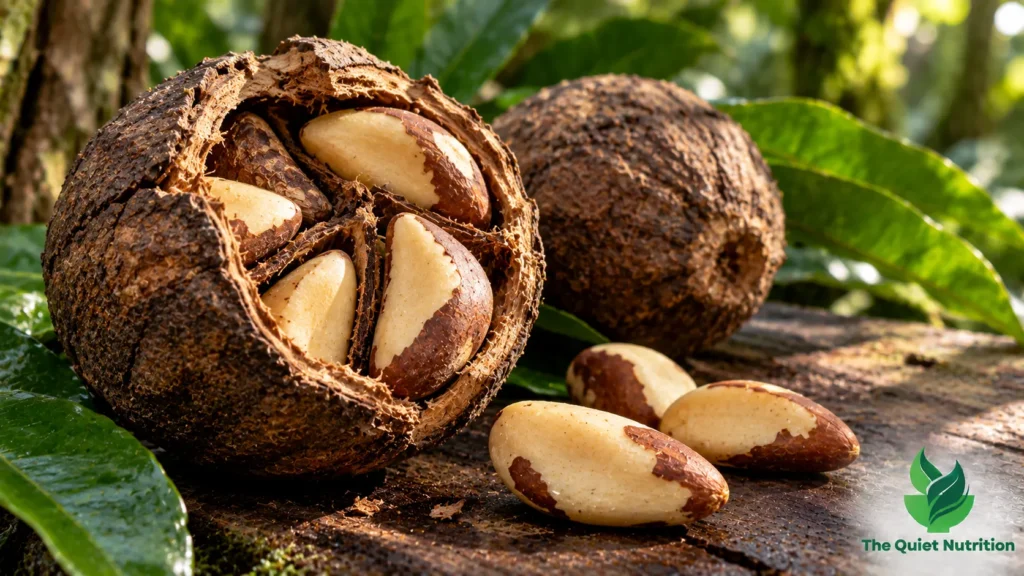
Brazil nuts come from the tree Bertholletia excelsa, which grows in the Amazon region of South America. Their large, creamy kernels have a rich texture and a high fat content, much of it unsaturated.
They also contain protein, fiber and minerals such as magnesium and copper. However, their most distinctive nutritional feature is selenium.
Selenium is a trace mineral, meaning the body requires it in relatively small amounts. It is incorporated into proteins called selenoproteins, which help regulate processes such as antioxidant defence, thyroid hormone metabolism and normal immune function.
Brazil nuts accumulate selenium from the soil in which the trees grow. Because soil composition differs by location, the selenium content of individual nuts can vary widely.
According to the US National Institutes of Health Office of Dietary Supplements, an ounce of Brazil nuts—approximately six to eight nuts—contains an average of about 544 micrograms of selenium in USDA data. That is almost ten times the US recommended daily allowance for adults, which is 55 micrograms.
This figure is an average, not a reliable prediction of the selenium content of every handful. Some nuts contain considerably less, while others contain substantially more.
That variability explains why Brazil nuts deserve a different approach from ordinary snack nuts.
1. Brazil nuts provide selenium for the body’s antioxidant defences
One of selenium’s important functions is supporting the activity of antioxidant enzymes.
These enzymes help control reactive molecules produced during normal metabolism and other biological processes. When reactive molecules accumulate beyond the body’s ability to manage them, they can contribute to oxidative stress, which is involved in several disease processes.
Selenium is part of glutathione peroxidases, a family of enzymes that help protect cells by breaking down certain peroxides.
The body cannot make these enzymes without the necessary selenium. Brazil nuts can therefore be a useful dietary source of the mineral, especially for people whose usual diets provide too little.
Human research supports this nutritional role. A randomized controlled trial published in 2008 followed 59 New Zealand adults for 12 weeks. Participants received two Brazil nuts daily, a selenium supplement or a placebo. The researchers found that the Brazil nut group experienced a substantial increase in blood selenium levels and improvements in certain measures of glutathione peroxidase activity.
This establishes that Brazil nuts can improve selenium status and influence a relevant biological marker.
It does not establish that eating them prevents cancer, heart disease or premature aging. An improvement in antioxidant enzyme activity is not the same as demonstrating fewer cases of disease.
The useful conclusion is that Brazil nuts provide a highly concentrated source of a nutrient required for normal antioxidant function. People who already obtain sufficient selenium may not gain additional benefits from consuming substantially more.
2. They support normal thyroid hormone metabolism
The thyroid gland depends on selenium-containing enzymes for several aspects of normal hormone metabolism.
These enzymes help convert thyroid hormone thyroxine (T4) into triiodothyronine (T3), a more biologically active form. Selenium-dependent proteins also participate in protecting thyroid tissue from oxidative damage associated with hormone production.
This makes selenium an essential nutrient for normal thyroid function.
Brazil nuts can contribute to selenium intake, but the relationship between selenium and thyroid health is not as simple as eating more nuts to improve thyroid function.
People who are deficient may benefit from correcting inadequate intake. However, research has not established that increasing selenium intake beyond adequate levels reliably improves thyroid function in otherwise selenium-sufficient people.
Excess selenium can also be harmful. Brazil nuts should not be treated as a replacement for thyroid medication or as a self-directed treatment for hypothyroidism or autoimmune thyroid disease.
If you have a thyroid condition and are considering selenium supplements or regularly eating Brazil nuts for a specific health purpose, discuss the plan with your healthcare professional.
3. Brazil nuts provide magnesium, copper and unsaturated fats
Selenium attracts most of the attention, but Brazil nuts offer other nutritional advantages.
Their fat content is predominantly unsaturated, including monounsaturated and polyunsaturated fatty acids. Replacing some foods rich in saturated fat with nuts can help improve the overall quality of dietary fat intake.
Brazil nuts also supply magnesium, which supports normal muscle and nerve function, energy metabolism and bone health.
Copper is another mineral present in Brazil nuts. It contributes to iron metabolism, connective tissue formation and normal nervous system function.
The nuts also contain some protein and fiber, making them more nutritionally substantial than many highly refined snack foods.
However, their energy density matters. Brazil nuts provide roughly 185–190 calories per ounce, depending on the food database and product. Their richness means that a small portion can supply considerable energy.
A modest amount can add variety to a balanced diet. There is no need to eat a large bowl to obtain their nutritional advantages, particularly given the uncertainty around selenium content.
4. They may influence blood cholesterol, but the findings are mixed
Brazil nuts contain unsaturated fats and other nutrients that make them plausible candidates for supporting cardiovascular health.
Some small clinical trials have reported improvements in blood lipid measurements after participants consumed Brazil nuts. Other studies have found no significant changes.
A systematic review and meta-analysis published in 2022 examined eight articles reporting randomized clinical trials of Brazil nut consumption. The researchers found clear increases in blood selenium and improvements in glutathione peroxidase activity.
However, they did not find statistically significant overall effects on total cholesterol, LDL cholesterol or HDL cholesterol.
This is an important distinction. Brazil nuts can improve selenium status without necessarily producing measurable improvements in every cardiovascular risk marker.
The findings also show why it is misleading to describe Brazil nuts as a proven cholesterol-lowering food.
Their unsaturated fats can fit into a heart-conscious eating pattern, particularly when nuts replace less nutritious snacks. But the available evidence does not establish that Brazil nuts alone reduce heart attacks or strokes.
For cardiovascular health, the broader dietary pattern matters more than the supposed superiority of one particular nut.
5. They contain plant compounds, but more research is needed
Like other nuts, Brazil nuts contain naturally occurring plant compounds in addition to their vitamins, minerals and fatty acids.
Researchers have investigated their potential effects on oxidative stress, inflammation and other biological processes. Some clinical studies have reported changes in markers associated with antioxidant activity following Brazil nut consumption.
However, these results should not be interpreted as proof that Brazil nuts have a direct anti-inflammatory effect that prevents disease.
A systematic review of clinical trials published in 2022 found evidence of improved selenium status and glutathione peroxidase activity, but the results for other measured outcomes were less consistent.
There is also a broader limitation in nutrition research: changes in a laboratory marker do not necessarily translate into a meaningful improvement in how long or how well someone lives.
Brazil nuts are nutritious foods, but claims that they detoxify the body, reverse aging or reliably prevent chronic disease go beyond what the current evidence establishes.
6. They may be useful when dietary selenium intake is low
Selenium requirements vary with age and life stage, but the US recommended dietary allowance for adults is 55 micrograms per day.
Selenium is available from several foods, including seafood, meat, poultry, eggs, dairy products and grains. Brazil nuts are one of the richest natural sources, but they are not the only way to obtain enough.
For someone whose diet provides insufficient selenium, Brazil nuts can substantially increase intake. Yet their concentration makes them a less predictable way to manage a precise nutritional dose than foods with more consistent selenium levels.
A person who already eats a varied diet containing selenium-rich foods may have no reason to seek additional selenium specifically.
The goal is adequacy, not maximizing intake.
The important catch: Brazil nuts can provide too much selenium
This is the part that deserves more attention than it usually receives in discussions of Brazil nuts.
Selenium is essential, but chronic excessive intake can cause a condition known as selenosis.
Possible symptoms include nausea, diarrhea, a metallic taste, garlic-like breath, skin rashes, fatigue, brittle nails and hair loss. More severe poisoning can affect the nervous system and other organs.
The US adult tolerable upper intake level for selenium is 400 micrograms per day from all sources, including food and supplements. The European Food Safety Authority uses a lower adult upper limit of 255 micrograms per day.
These limits are not targets. They are ceilings intended to help reduce the risk of harmful excessive intake.
An ounce of Brazil nuts averages approximately 544 micrograms of selenium in USDA data, already exceeding both limits. Individual nuts vary, so it is not possible to calculate an exact dose from the number of nuts alone.
This does not mean that eating one Brazil nut automatically causes harm. It means that regularly eating several nuts every day can make excessive intake more likely, particularly if you also take selenium supplements or consume other concentrated sources.
For most people, the sensible approach is to treat Brazil nuts as an occasional, small-portion food rather than a supplement that must be taken daily.
How many Brazil nuts should you eat?
There is no universally established daily Brazil nut serving that guarantees a health benefit while keeping selenium intake within safe limits.
Because selenium content varies so much between nuts, recommending a fixed daily quantity as a precise nutritional dose would be misleading.
A cautious practical approach is to enjoy Brazil nuts occasionally in small amounts, rather than automatically eating a handful every day. If you already use a selenium supplement or regularly eat other selenium-rich foods, be particularly mindful of your combined intake.
You can also enjoy Brazil nuts alongside other nuts, such as almonds, walnuts or pistachios, to vary your nutrient intake without relying so heavily on one unusually concentrated source of selenium.
A few useful habits include:
- Choose plain, unsalted Brazil nuts when possible.
- Avoid combining regular Brazil nut consumption with selenium supplements unless advised by a healthcare professional.
- Store nuts in an airtight container in a cool place to help preserve their quality.
- Do not assume that every nut contains the same amount of selenium.
The central principle is simple: Brazil nuts can contribute valuable nutrients, but more is not necessarily better.
Are Brazil nuts better than other nuts?
Brazil nuts are distinctive because of their selenium content, but that does not make them nutritionally superior in every respect.
Walnuts provide alpha-linolenic acid, a plant-based omega-3 fatty acid. Almonds are useful sources of vitamin E. Pistachios provide protein, fiber and several minerals, while cashews contribute magnesium and copper.
Brazil nuts provide a different combination, with selenium being their most notable feature.
For everyday eating, variety is often more useful than choosing one nut as the healthiest. Different nuts offer different nutrient profiles, flavours and textures.
If you enjoy Brazil nuts, there is no need to eliminate them from your diet. Simply avoid treating their selenium content as a reason to eat them in large quantities.
Frequently asked questions
Is eating one Brazil nut a day safe?
For many healthy adults, one Brazil nut may fit into a balanced diet. However, selenium content varies substantially between individual nuts, so one nut cannot be assumed to supply a predictable dose. Consider your total selenium intake, especially if you take supplements.
Can Brazil nuts improve thyroid function?
Selenium is essential for normal thyroid hormone metabolism. However, eating more selenium does not reliably improve thyroid function in people who already obtain enough. Brazil nuts should not replace prescribed thyroid treatment.
Can Brazil nuts lower cholesterol?
Some small studies have reported improvements in selected cholesterol measurements. However, a 2022 systematic review and meta-analysis did not find significant overall effects on total cholesterol, LDL cholesterol or HDL cholesterol. The evidence remains insufficient to recommend Brazil nuts as a cholesterol-lowering treatment.
Are Brazil nuts good for hair and nails?
Selenium is involved in normal biological functions, but there is no strong evidence that eating Brazil nuts improves hair or nail growth in people who already obtain enough selenium. Excessive selenium intake can actually cause hair loss and brittle nails.
Should you take selenium supplements if you eat Brazil nuts?
Not automatically. Brazil nuts can provide substantial selenium, and combining them with supplements may increase the risk of excessive intake. Supplements are best used when there is a clear nutritional reason and appropriate professional guidance.
The takeaway
Brazil nuts are valuable because they provide selenium alongside unsaturated fats, protein, magnesium and other nutrients. Research supports their ability to improve selenium status and certain antioxidant-enzyme measurements, but evidence for consistent improvements in cholesterol and other clinical outcomes is limited.
Their most important feature is also their main limitation: selenium is concentrated in an unpredictable amount.
Rather than treating Brazil nuts as a daily health supplement, enjoy them in moderation as part of a varied diet. You can obtain their nutritional benefits without assuming that more nuts mean better health.
With Brazil nuts, the smartest approach is not to maximize the dose. It is to respect how concentrated this particular food can be.
Scientific sources
1. Cardoso et al. (2017) — “Brazil nuts: Nutritional composition, health benefits and safety aspects.” A review of Brazil nut nutrients, potential health effects and safety considerations. Read the review on PubMed.
2. “Effect of Brazil Nuts on Selenium Status, Blood Lipids, and Biomarkers of Oxidative Stress and Inflammation: A Systematic Review and Meta-Analysis of Randomized Clinical Trials” (2022). Found improvements in selenium status and glutathione peroxidase activity, but no significant overall effects on total, LDL or HDL cholesterol. Read the full review.
3. Thomson et al. (2008) — “Brazil nuts: an effective way to improve selenium status.” A 12-week randomized controlled trial involving 59 New Zealand adults. Read the study on PubMed.
4. NIH Office of Dietary Supplements — Selenium: Health Professional Fact Sheet. Covers selenium requirements, food sources, geographical variability in Brazil nut selenium content and upper intake limits. Read the fact sheet.
5. NIH Office of Dietary Supplements — Selenium: Consumer Fact Sheet. Explains symptoms associated with excessive selenium intake and practical safety information. Read the consumer guide.
6. da Silva et al. (2022) — “Effects of Regular Brazil Nut (Bertholletia excelsa H.B.K.) Consumption on Health: A Systematic Review of Clinical Trials.” Reviews clinical research on Brazil nuts across different populations and health outcomes. Read the full review.

Aarti Solanki, B.Sc. (Food Science), is a food science writer passionate about making nutrition simple and evidence-based. She creates well-researched, easy-to-understand articles on healthy eating, food science, and nutrition, using information from trusted scientific and public health sources.