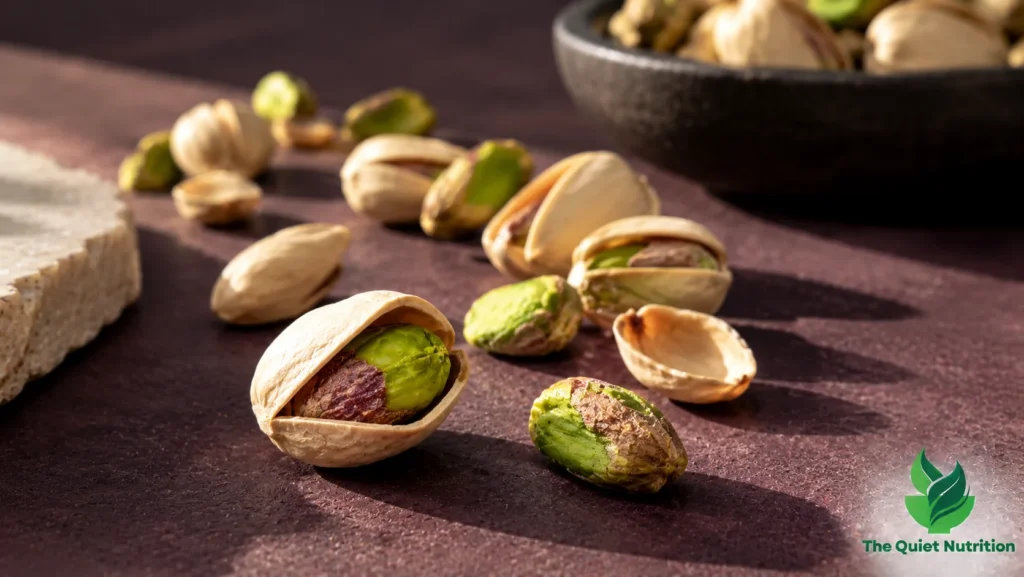
Pistachios have an unusual advantage among snack foods: they provide a combination of unsaturated fats, fiber, plant protein and minerals in a small, convenient serving. Their green kernels also contain plant compounds that researchers have investigated for their potential role in cardiovascular health.
But the strongest argument for eating pistachios is not that they contain a special ingredient that protects the heart. It is that they can help improve the overall nutritional quality of a diet, particularly when they replace snacks rich in sodium, refined carbohydrates or saturated fat.
Clinical studies have also examined pistachios more directly, measuring changes in cholesterol, blood vessel function and other markers associated with cardiovascular health. Some results are encouraging, although the evidence is not equally strong for every outcome.
Understanding that distinction helps explain why pistachios can be a useful addition to a heart-conscious diet without being a treatment for heart disease.
What makes pistachios interesting for heart health?
A typical one-ounce (28-gram) serving of shelled pistachios provides approximately 160 calories, 6 grams of protein, 3 grams of fiber and 13 grams of fat. Most of that fat is unsaturated rather than saturated.
That composition matters because replacing saturated fat with unsaturated fat can help improve blood cholesterol levels. The American Heart Association includes nuts such as pistachios among its recommended choices for a heart-healthy eating pattern.
Pistachios also supply potassium, magnesium, vitamin B6, vitamin E and carotenoids, including lutein and zeaxanthin.
None of these nutrients works in isolation. Cardiovascular health depends on a range of factors, including blood pressure, cholesterol, blood glucose, physical activity, smoking status and the quality of the overall diet.
Pistachios are useful because they can contribute to several aspects of a nutritious eating pattern at once.
1. Their unsaturated fats can help improve cholesterol balance
One of the best-established reasons to include nuts in a heart-conscious diet is their fat composition.
Pistachios contain both monounsaturated and polyunsaturated fats. When these replace saturated fats in the diet, they can help lower LDL cholesterol, often called “bad” cholesterol because elevated levels contribute to plaque buildup in arteries.
This is not the same as saying that simply adding pistachios to an unchanged diet will automatically lower cholesterol. The replacement matters.
For example, replacing a snack made with substantial amounts of butter or other sources of saturated fat with a measured portion of unsalted pistachios changes the types of fat you consume. Adding pistachios on top of everything you already eat may increase total calorie intake without producing the same dietary substitution.
Research has examined this effect directly. A randomized crossover trial published in 2007 studied 15 adults with moderately elevated cholesterol. Participants followed a diet in which pistachios supplied 15% of daily calories for four weeks.
The researchers observed improvements in certain cholesterol-related ratios, including the ratio of total cholesterol to HDL cholesterol. However, they did not find statistically significant reductions in every lipid measurement, including LDL cholesterol itself.
The trial was small and short, so it cannot establish the long-term effects of daily pistachio consumption. Nevertheless, it illustrates why the quality of dietary fat matters.
The practical takeaway is to use pistachios as a replacement for less nutritious snacks, rather than treating them as an extra food that must produce a specific cholesterol result.
2. Pistachios provide fiber that supports a heart-healthy diet
Fiber is often discussed in relation to digestion, but certain types of dietary fiber can also help regulate blood cholesterol.
Pistachios provide approximately 3 grams of fiber per ounce. That is a useful contribution for a relatively small snack, although it represents only part of the fiber most adults need each day.
Some dietary fibers can reduce the absorption of cholesterol or bile acids in the digestive tract. When bile acids are excreted, the liver uses cholesterol to produce replacements. This is one mechanism through which particular fiber-rich foods can help lower LDL cholesterol.
Pistachios should not be confused with foods that provide especially large amounts of soluble fiber, such as oats and certain legumes. Their cardiovascular value comes from their combined nutritional profile rather than an exceptionally high fiber content alone.
The broader benefit is that a snack containing fiber, protein and unsaturated fats may be more satisfying than one based mainly on refined starch or added sugar.
Try adding pistachios to plain yogurt, oatmeal or a salad. These combinations can improve the nutritional composition of a meal without requiring a major change to your eating routine.
3. They contain potassium and magnesium, which support normal blood pressure regulation
Blood pressure is influenced by several interacting systems, including kidney function, blood vessel activity, fluid balance and the nervous system.
Potassium helps regulate the body’s sodium balance and supports normal blood pressure. Magnesium contributes to normal muscle and nerve function, including processes involved in blood vessel regulation.
Pistachios supply both minerals, making them a useful addition to a varied diet.
However, their mineral content should be kept in perspective. A one-ounce serving provides roughly 290–300 milligrams of potassium and about 34 milligrams of magnesium, depending on the product and the nutrient database used.
Those amounts contribute to daily intake but do not make pistachios a substitute for other mineral-rich foods.
Blood pressure management is also not simply a matter of consuming more potassium. Sodium intake, body weight, physical activity, genetics, kidney function and medication use can all influence blood pressure.
People with chronic kidney disease or those advised to restrict potassium should follow their clinician’s dietary guidance rather than deliberately increasing potassium intake.
For most people, unsalted pistachios fit comfortably into a dietary pattern that emphasizes vegetables, fruits, legumes, whole grains and other minimally processed foods.
4. Their plant compounds are interesting, but the evidence has limits
Pistachios contain several plant compounds, including carotenoids and polyphenols.
Lutein and zeaxanthin are carotenoids that contribute to pistachios’ distinctive green and yellow colouring. Pistachios also contain gamma-tocopherol, a form of vitamin E, and other compounds involved in the plant’s natural defence systems.
Researchers have investigated whether these substances influence oxidative stress, a process involving reactive molecules that can affect cells and tissues.
A randomized crossover study published in 2010 examined 28 adults with elevated cholesterol who consumed diets containing different amounts of pistachios. The researchers observed increases in circulating concentrations of certain carotenoids and changes in some measures related to oxidative status.
This is useful evidence that eating pistachios can change measurable biological markers.
However, a change in an antioxidant concentration or an oxidative-stress marker does not establish that a person will experience fewer heart attacks, strokes or other cardiovascular events.
Laboratory findings also cannot be directly translated into a guaranteed effect from eating a handful of nuts.
The sensible conclusion is that pistachios supply a range of plant compounds that may contribute to their nutritional value, while the size of their independent effects on long-term cardiovascular outcomes remains uncertain.
5. Pistachios may influence blood vessel function
Healthy blood vessels must be able to respond to changing demands by widening and narrowing appropriately.
The endothelium, a thin layer of cells lining blood vessels, helps regulate this response. One way researchers assess vascular function is by measuring flow-mediated dilation, which examines how a blood vessel widens in response to increased blood flow.
A randomized study published in 2015 investigated the effects of daily pistachio consumption in 60 adults with mild dyslipidemia, a condition involving abnormal blood lipid levels. Participants received lifestyle advice alone or lifestyle advice alongside pistachios for three months.
The pistachio group showed improvements in several cholesterol-related measurements, including LDL cholesterol, HDL cholesterol and the ratio of total cholesterol to HDL cholesterol.
The researchers also assessed vascular function and arterial stiffness. The results do not establish that pistachios consistently improve every measure of blood vessel health, and the study was relatively small.
This distinction is important because vascular measurements are intermediate markers. They can help researchers understand cardiovascular physiology, but they are not equivalent to demonstrating fewer heart attacks or strokes.
Pistachios remain a promising food to include in a heart-conscious diet, not a proven standalone intervention for repairing blood vessels.
6. They may help improve the nutritional quality of snacks
One of the most practical advantages of pistachios is that they are easy to eat without preparation.
A small handful can replace a portion of biscuits, crisps, candy or another snack that provides relatively little fiber or protein. This substitution may improve the overall balance of the diet.
Pistachios offer plant protein, unsaturated fats and fiber together. These nutrients can help make a snack more satisfying, although individual appetite responses vary.
There is also a useful behavioural detail: pistachios sold in their shells require more time to eat than shelled kernels. Some people may find this slows their eating and makes portions easier to notice.
That does not guarantee lower calorie intake. Eating pace, appetite and total food consumption differ between individuals, and pistachios are still energy-dense.
The best approach is to portion out a serving rather than eating continuously from a large container.
A handful of unsalted pistachios alongside fresh fruit, or a small amount sprinkled over a salad, can add texture and nutrients without making the snack unnecessarily complicated.
7. Pistachios can fit into a weight-conscious eating pattern
Pistachios provide approximately 160 calories per ounce, so portion size matters.
Yet their calorie content alone does not determine whether they are helpful or unhelpful for weight management. Protein, fiber, fat, food texture and overall dietary habits all influence how satisfying a snack feels.
A 2020 systematic review and meta-analysis of randomized clinical trials examined pistachio consumption in relation to several cardiometabolic risk factors. The review found benefits for some measures, while results for other outcomes, including body weight and blood pressure, were not consistently adverse.
This supports a measured conclusion: pistachios can fit into a balanced diet without necessarily causing weight gain, but they are not a weight-loss food in themselves.
If you want to include them while managing your weight, use them in place of another snack rather than automatically adding them to your usual intake.
There is no need to avoid pistachios because they contain fat. The more useful consideration is whether the portion and the rest of your diet suit your energy needs.
How many pistachios should you eat for heart health?
A practical serving for many adults is approximately 1 ounce (28 grams) of shelled pistachios, equivalent to roughly 45–50 kernels, depending on their size.
This is a convenient portion, not a clinically established dose that guarantees a cardiovascular benefit.
Choose plain or unsalted pistachios most often, particularly if you are trying to reduce sodium intake. Salted varieties can contain considerably more sodium, depending on the product.
You can incorporate them into everyday meals in several ways:
- Eat a small handful as an afternoon snack.
- Add chopped pistachios to plain yogurt with fresh berries.
- Sprinkle them over a salad containing leafy greens and beans.
- Use crushed pistachios as a topping for roasted vegetables.
- Combine them with oats or whole-grain cereal for additional texture.
Pistachios do not need to be eaten at a particular time of day to support heart health. Consistency and the quality of your overall eating pattern matter more than precise timing.
Are pistachios better for the heart than other nuts?
Pistachios are a good choice, but there is no strong reason to assume they are universally superior to almonds, walnuts, hazelnuts or other nuts.
Different varieties provide different nutritional combinations. Walnuts, for example, are notable for their alpha-linolenic acid, a plant-based omega-3 fatty acid. Almonds provide vitamin E, while pistachios contribute a distinctive mix of carotenoids, fiber, protein and unsaturated fats.
The American Heart Association recommends nuts as part of a heart-healthy dietary pattern rather than identifying a single nut as essential.
For most people, variety is more useful than loyalty to one particular type. Choose nuts you enjoy, consider their cost and availability, and pay attention to added salt, sugar and preparation methods.
If pistachios make it easier for you to replace less nutritious snacks, they can be an excellent everyday choice.
Who should be careful with pistachios?
Pistachios are suitable for many people, but a few considerations matter.
People with tree nut allergies: Pistachios can trigger serious allergic reactions in susceptible individuals. Anyone with a known pistachio allergy should avoid them and follow medical advice about related nut allergies.
People managing blood pressure: Unsalted varieties are generally preferable when sodium intake is a concern. Check the nutrition label because salt content varies widely between products.
People managing calorie intake: Measure portions rather than eating directly from a large bag. Nuts are nutritious but energy-dense.
People with specific dietary restrictions: Anyone following a medically prescribed diet, including a potassium-restricted diet, should account for pistachios within that plan.
Pistachios should complement prescribed cardiovascular treatment, not replace medication, medical follow-up or other recommended lifestyle changes.
The bottom line
Pistachios have a credible place in a heart-conscious diet because they combine unsaturated fats, fiber, plant protein, potassium and a range of plant compounds in a convenient snack.
Clinical research suggests that pistachio-enriched diets may improve certain cholesterol-related measurements, but the results vary across studies and do not establish that pistachios alone prevent cardiovascular disease.
The most useful habit is to eat a modest portion of unsalted pistachios in place of a less nutritious snack. Pair that habit with a diet rich in vegetables, fruits, whole grains, legumes and other sources of unsaturated fats.
Pistachios do not need to be a miracle food to be worthwhile. Their value comes from how they contribute to a dietary pattern that supports heart health over time.
Scientific sources
1. Sheridan et al. (2007), “Pistachio nut consumption and serum lipid levels.” A randomized crossover trial examining lipid measurements in 15 adults with moderately elevated cholesterol. Read the study on PubMed.
2. Gebauer et al. (2010), “Pistachios increase serum antioxidants and lower serum oxidized-LDL in hypercholesterolemic adults.” A randomized crossover feeding study involving 28 adults. Read the study.
3. “Effect of pistachio nut consumption on endothelial function and arterial stiffness” (2015). A randomized study involving 60 adults with mild dyslipidemia. Read the study on PubMed.
4. “Pistachios and cardiometabolic risk factors: A systematic review and meta-analysis of randomized controlled clinical trials” (2020). Reviews evidence across several cardiovascular and metabolic risk markers. Read the review.
5. USDA FoodData Central. Nutrient composition for raw and dry-roasted pistachios, including calories, protein, fat, fiber and minerals. Search the official database.
6. American Heart Association, “Go Nuts (But Just a Little!).” Guidance on nut portions, nutritional characteristics and choosing lower-sodium varieties. Read the guidance.
7. American Heart Association, “2026 Dietary Guidance to Improve Cardiovascular Health.” Current guidance emphasizing dietary patterns rich in vegetables, fruits, whole grains and plant-based protein, alongside unsaturated fats and lower sodium intake. Read the guidance.

Aarti Solanki, B.Sc. (Food Science), is a food science writer passionate about making nutrition simple and evidence-based. She creates well-researched, easy-to-understand articles on healthy eating, food science, and nutrition, using information from trusted scientific and public health sources.