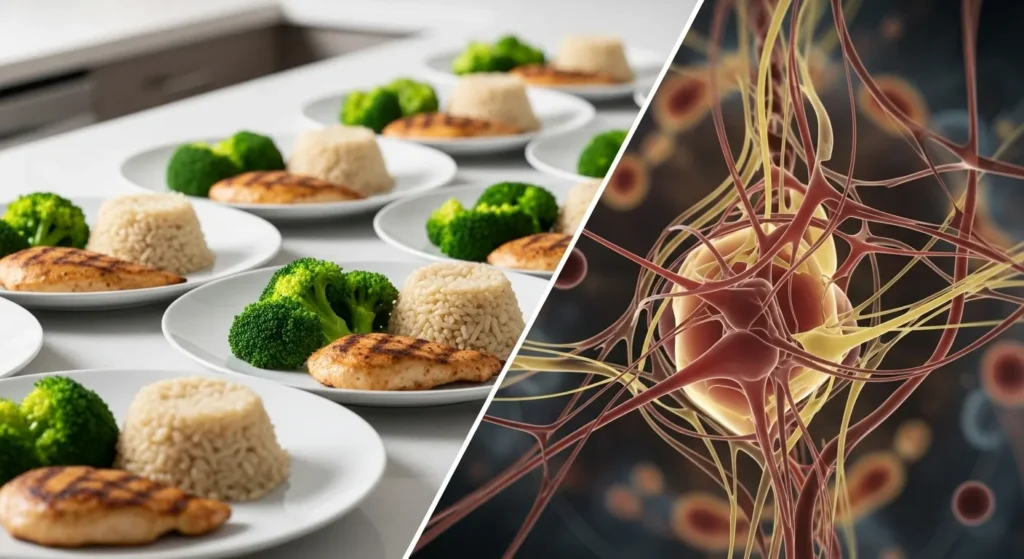
Your Body Is Always Paying Attention
You may not think twice about what you eat on a typical day.
Breakfast feels routine.
Lunch is familiar.
Dinner follows a pattern.
But inside your body, something remarkable is happening:
Every repeated meal is information. And your body is learning from it.
Not consciously.
Not immediately.
But biologically.
Your digestion, hormones, metabolism, and even your nervous system adjust based on what shows up again and again. This is why some people thrive on simple, repetitive meals—while others feel constantly off-balance when their diet changes daily.
Understanding how the body learns from repeated meals explains:
- Why consistency feels calming
- Why digestion improves over time
- Why “random eating” often backfires
And why nutrition works more like training than treatment.
The Body Is a Pattern-Recognizing System
Human biology evolved to detect patterns.
Food availability used to be uncertain.
So when the body noticed reliable meals, it interpreted that as safety.
Repeated meals signal:
- Resources are stable
- Energy supply is predictable
- Repair can proceed without urgency
This pattern recognition happens across multiple systems—often without you noticing.
The body doesn’t just process food.
It learns what to expect from it.
What “Learning” Means in Biological Terms
Learning doesn’t require a brain.
In the body, learning means:
- Enzymes adjust their production
- Hormones fine-tune their response
- Cells optimize fuel usage
- The gut adapts to recurring inputs
When meals repeat, the body stops guessing and starts preparing.
That preparation is what creates efficiency.
How Digestion Improves With Familiar Meals
The digestive system loves predictability.
When similar foods arrive repeatedly:
- Enzyme secretion becomes more precise
- Stomach acid timing improves
- Gut motility stabilizes
- Bloating and discomfort often decrease
This is why people often say:
“My digestion is better when I eat simpler, familiar meals.”
It’s not about food quality alone.
It’s about recognition.
Repeated Meals Train Blood Sugar Responses
Blood sugar regulation is a learning process.
With consistent meals:
- Insulin response becomes more efficient
- Glucose spikes reduce
- Energy release smooths out
With erratic meals:
- The body stays reactive
- Hunger feels urgent
- Energy crashes appear
Repeated meals allow the body to anticipate demand instead of scrambling to respond.
Real-Life Example: The “Same Breakfast” Effect
Many people notice this pattern unintentionally.
They eat the same breakfast for weeks:
- Oats and fruit
- Eggs and toast
- Yogurt and nuts
Suddenly:
- Hunger stabilizes
- Energy feels smoother
- Digestion improves
Nothing magical changed.
The body simply learned the pattern—and optimized for it.
Why Repetition Calms the Nervous System
The nervous system constantly evaluates risk.
Food unpredictability signals potential scarcity.
Repeated meals signal:
- Safety
- Reliability
- Reduced survival stress
This lowers unnecessary activation of stress hormones like cortisol.
That’s why consistent eating often leads to:
- Better sleep
- Calmer mood
- Improved stress tolerance
Nutrition doesn’t just feed cells.
It reassures the nervous system.
Metabolism Adapts to What It Sees Most Often
Metabolism is flexible—but it prefers efficiency.
Repeated meals teach metabolism:
- Which fuels are coming
- How much energy to allocate
- When repair can occur
Over time, this reduces metabolic “noise” and wasted effort.
The result isn’t excitement.
It’s reliability.
Repetition vs. Variety: Clearing the Confusion
People often hear:
“You need variety for health.”
That’s true—over time.
But constant novelty creates chaos.
| Eating Pattern | Body Response | Outcome |
|---|---|---|
| Repeated core meals | Efficient adaptation | Stability |
| Random daily variety | Reactive adjustment | Inconsistency |
| Short-term extremes | Alarm response | Rebound |
| Structured rotation | Balanced learning | Resilience |
Repetition doesn’t mean monotony forever.
It means enough consistency for learning to occur.
Why Diet Hopping Confuses the Body
Changing diets frequently prevents learning.
Each new approach forces the body to:
- Relearn digestion
- Recalculate hormones
- Reassess energy needs
This creates:
- Fatigue
- Hunger dysregulation
- Frustration
The body never settles long enough to optimize.
The Gut Microbiome Learns Too
Your gut bacteria adapt to what you eat most.
Repeated meals:
- Encourage stable bacterial populations
- Improve fermentation efficiency
- Reduce digestive surprises
Constant dietary change:
- Disrupts microbial balance
- Increases bloating and discomfort
Consistency feeds not just you—but the ecosystem inside you.
Why Repeated Meals Don’t Mean Nutrient Deficiency
A common fear is:
“If I eat the same meals, I’ll miss nutrients.”
In reality:
- A few well-constructed meals can cover most needs
- Rotation can happen weekly, not daily
- The body values reliability more than novelty
Nutritional adequacy + repetition beats chaotic variety.
What Science Tells Us About Consistency
Long-term nutrition research summarized by organizations like the World Health Organization and the National Institutes of Health shows that dietary patterns over time predict health outcomes better than isolated food choices.
Patterns are what the body responds to.
Not one-off meals.
Hidden Signs Your Body Is Learning Your Meals
You’ll often notice:
- Less digestive effort
- Smoother hunger cues
- Fewer energy swings
- Reduced cravings
- Better tolerance of missed meals
These are signs the body has stopped guessing.
Common Mistakes That Disrupt Meal Learning
Even health-conscious people make these errors:
- Changing meals daily “for balance”
- Overreacting to minor discomfort
- Chasing novelty for motivation
- Ignoring timing consistency
- Assuming boredom means failure
Boredom often means biological trust.
Why This Matters Today
Modern life is unpredictable enough.
Schedules shift.
Stress fluctuates.
Sleep varies.
Repeated meals provide one stable anchor.
That stability:
- Reduces decision fatigue
- Lowers physiological stress
- Improves long-term adherence
Predictable nutrition makes unpredictable life easier.
How to Use Repeated Meals Intentionally
You don’t need rigid rules.
You need structure.
Actionable steps:
- Choose 2–3 core meals you digest well
- Repeat them most days
- Rotate foods weekly, not daily
- Keep meal timing consistent
- Observe trends, not day-to-day feelings
Let the body learn before asking it to perform.
Key Takeaways
- The body learns from repeated meals
- Consistency improves digestion and energy
- Repetition calms the nervous system
- Learning requires time and predictability
- Stability comes before optimization
Frequently Asked Questions
1. Is eating the same meals every day unhealthy?
Not if meals are balanced and rotated periodically.
2. Why do repeated meals feel calming?
Because the body interprets predictability as safety.
3. How long before the body adapts to repeated meals?
Often within weeks, with deeper benefits over months.
4. Can repetition help with blood sugar control?
Yes. Familiar meals improve glucose and insulin responses.
5. When should I introduce variety?
After consistency is established—not before.
Conclusion: Familiarity Is a Biological Advantage
Your body doesn’t crave surprise.
It craves signals it can trust.
Repeated meals aren’t boring to biology—they’re reassuring. They allow digestion to refine, hormones to settle, energy to stabilize, and stress to soften.
Once the body knows what’s coming, it finally has the freedom to function well.
Disclaimer: This article is for general educational purposes only and does not replace personalized medical or nutritional advice. Individual responses may vary.


Pingback: How Nutrition Keeps Your Body Predictable — The Hidden Stability Most People Never Notice
Pingback: Your Brain Remembers How You Eat — Even When You Forget
Pingback: Why Your Brain Struggles When Your Meals Have No Rhythm
Pingback: How Long-Term Eating Patterns Shape Brain Efficiency — The Quiet Nutrition Factor Behind Mental Clarity